
🧠 AI Quiz
Think you really understand Artificial Intelligence?
Test yourself and see how well you know the world of AI.
Answer AI-related questions, compete with other users, and prove that
you’re among the best when it comes to AI knowledge.
Reach the top of our leaderboard.


















AI Dream Analyzer
What is AI Dream Analyzer?
Waking up from a strange dream and feeling like it was trying to tell you something—but you can’t quite put your finger on what—happens to almost everyone. This tool takes that foggy feeling and turns it into something clear, thoughtful, and surprisingly personal. You type out whatever you remember (the wilder the better), and it responds with an interpretation that feels like a kind, insightful friend who’s read a lot of Jung and Freud but doesn’t lecture. I’ve had mornings where I typed a chaotic dream about flying over an endless city, and the analysis came back connecting it to a real-life decision I’d been avoiding. It wasn’t spooky-accurate, but it was gentle and useful enough that I kept going back.
Introduction
Dreams are messy, symbolic, deeply personal—and usually forgotten by breakfast. This platform changes that by giving you a private space to capture them right after waking and receive layered, compassionate interpretations without judgment or mysticism overload. It draws on psychological frameworks (Jungian archetypes, Freudian symbolism, modern cognitive views) while staying grounded and conversational. No dream dictionary clichés, no generic horoscope-style answers—just thoughtful reflections tailored to what you actually wrote. For journalers, therapists’ clients, creative people mining their subconscious, or anyone curious about their inner world, it becomes a quiet nightly companion that makes the strange parts of sleep feel meaningful instead of random.
Key Features
User Interface
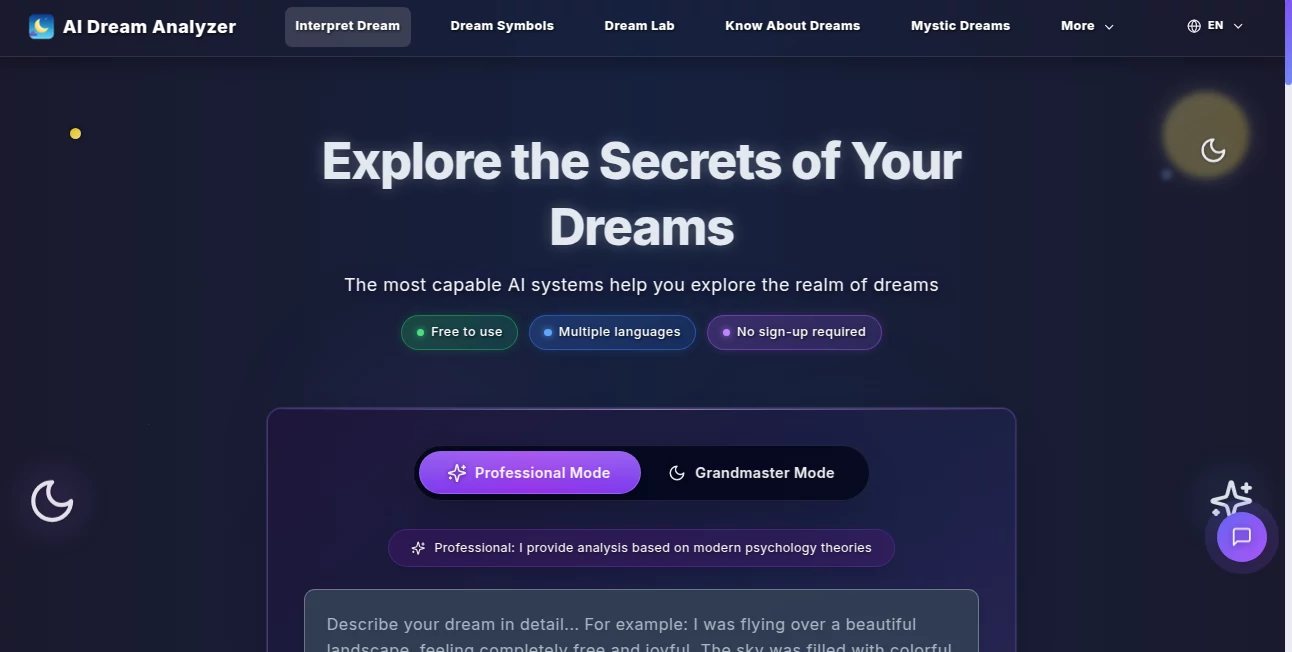
The experience is intentionally simple and calm. A large text box invites you to “Describe your dream…” with no character limit pressure. Below it, a single “Analyze” button. Once submitted, the interpretation unfolds in clear sections: literal summary, symbolic breakdown, emotional themes, possible life connections, and reflective questions. No ads interrupting, no forced sign-up, no distracting sidebars—just your dream and a thoughtful reply. It feels like writing in a private diary that writes back.
Accuracy & Performance
The interpretations rarely feel off-base. It picks up recurring symbols (falling, water, being chased) and contextualizes them with what you actually described rather than slapping on universal meanings. Responses arrive in seconds to a minute, even for long, detailed dreams. Consistency is strong—submit the same dream twice and you’ll get similar (but not identical) insights, showing real understanding rather than random generation. The emotional nuance stands out most: it recognizes anxiety, longing, empowerment, confusion—and reflects them back without exaggeration.
Capabilities
Handles everything from single-scene fragments to multi-part epics. Supports recurring dreams (compares them across entries if you save), lucid dreams, nightmares, prophetic-feeling ones, and mundane daily residues. Offers multiple lenses (psychological, spiritual, creative) via dropdown or follow-up prompts. You can ask clarifying questions (“What does the red door mean?”) and get deeper dives. Saved dream journal lets you track patterns over weeks or months. It’s a complete pocket dream companion—analysis, tracking, reflection—all in one place.
Security & Privacy
Your dreams stay yours. No mandatory account for basic use; optional sign-up uses email only for saving journal entries. All data is encrypted, never used for training, never shared. You can delete individual dreams or your entire journal with one click. For deeply personal or sensitive content (trauma dreams, recurring fears), that level of control and privacy makes the whole experience feel safe rather than exposed.
Use Cases
A writer wakes from a vivid dream and uses the analysis to unlock a new story direction she hadn’t consciously considered. Someone going through a breakup journals recurring abandonment dreams and notices patterns that help them talk to their therapist more clearly. A creative professional tracks “flying” dreams over months and sees how they correlate with periods of freedom vs. restriction in life. A curious skeptic types out a bizarre dream just to see what happens—and ends up reflecting on a work stress they’d been ignoring. It fits anywhere self-understanding or creative fuel is needed.
Pros and Cons
Pros:
- Interpretations feel wise, compassionate, and surprisingly on-point.
- Journal tracking reveals long-term patterns you’d otherwise miss.
- Zero judgment—perfect for weird, dark, or deeply personal dreams.
- Fast, clean, private—no account pressure to start.
- Follow-up questions let you dig deeper on anything that resonates.
Cons:
- Free tier limits how many dreams you can save or deeply analyze per day.
- AI, while thoughtful, can’t replace a human therapist for serious emotional processing.
- Occasional generic phrasing if the dream description is very short/vague.
Pricing Plans
Free tier gives generous daily use—several full analyses and temporary saves. Premium unlocks unlimited journal storage, deeper multi-angle interpretations, pattern tracking over time, export options (PDF/journal summaries), and priority response speed. Pricing is modest—less than a single therapy co-pay per month—and feels worthwhile once you start seeing recurring themes that give real insight into your waking life.
How to Use Dream Analyzer
Wake up, open your phone or laptop, type (or voice-to-text) everything you remember—no editing, no making it “make sense.” Hit Analyze. Read the breakdown slowly—literal summary first, then symbols, emotions, possible meanings. Jot notes or ask follow-up questions (“Why do I keep dreaming about water?”). If you sign up, save it to your private journal to spot patterns later. That’s it—takes 2–5 minutes and often leaves you with something worth thinking about all day.
Comparison with Similar Tools
Dream dictionary sites give static, one-size-fits-all meanings. Generic chatbots spit out surface-level interpretations without depth or memory. This one combines psychological insight, personalization, and long-term tracking in a way that feels more like a thoughtful guide than a lookup table or cold AI. The journal feature and follow-up questioning set it apart—turning one-off readings into an ongoing conversation with your subconscious.
Conclusion
Dreams are too strange and too personal to leave uninterpreted—or worse, forgotten. This tool meets them with curiosity and kindness, giving you insight without dogma. It doesn’t pretend to have all the answers, but it asks better questions and connects dots you might never have seen alone. Whether you’re chasing creativity, processing emotions, or just curious about the night-time stories your mind tells, it’s a gentle, powerful companion worth keeping by your bedside. Sometimes the best therapy starts with remembering what happened while you slept.
Frequently Asked Questions (FAQ)
How accurate are the interpretations?
They’re insightful and psychologically informed, but ultimately subjective—use them as a mirror, not a prophecy.
Do I need an account to start?
No—analyze right away without signing up; account only needed for saving journal entries.
Can I ask follow-up questions?
Yes—reply to any analysis with more details or specific questions for deeper exploration.
Are my dreams private?
Completely. Encrypted, never used for training, deleted if you choose—no exceptions.
How many dreams can I analyze for free?
Several per day—enough for regular use; unlimited with premium.
AI Life Assistant , AI Fun Tools .
These classifications represent its core capabilities and areas of application. For related tools, explore the linked categories above.
AI Dream Analyzer details
Pricing
- Free
Apps
- Web Tools
Categories

AI Dream Analyzer Alternatives Product

MatchMyType

Lexikon AI

AuraMeaning

world

lovetype16

Face Shape D…

YouCam AI & …

OC-Maker

Universal To…