
🧠 AI Quiz
Think you really understand Artificial Intelligence?
Test yourself and see how well you know the world of AI.
Answer AI-related questions, compete with other users, and prove that
you’re among the best when it comes to AI knowledge.
Reach the top of our leaderboard.


















EverMind

What is EverMind?
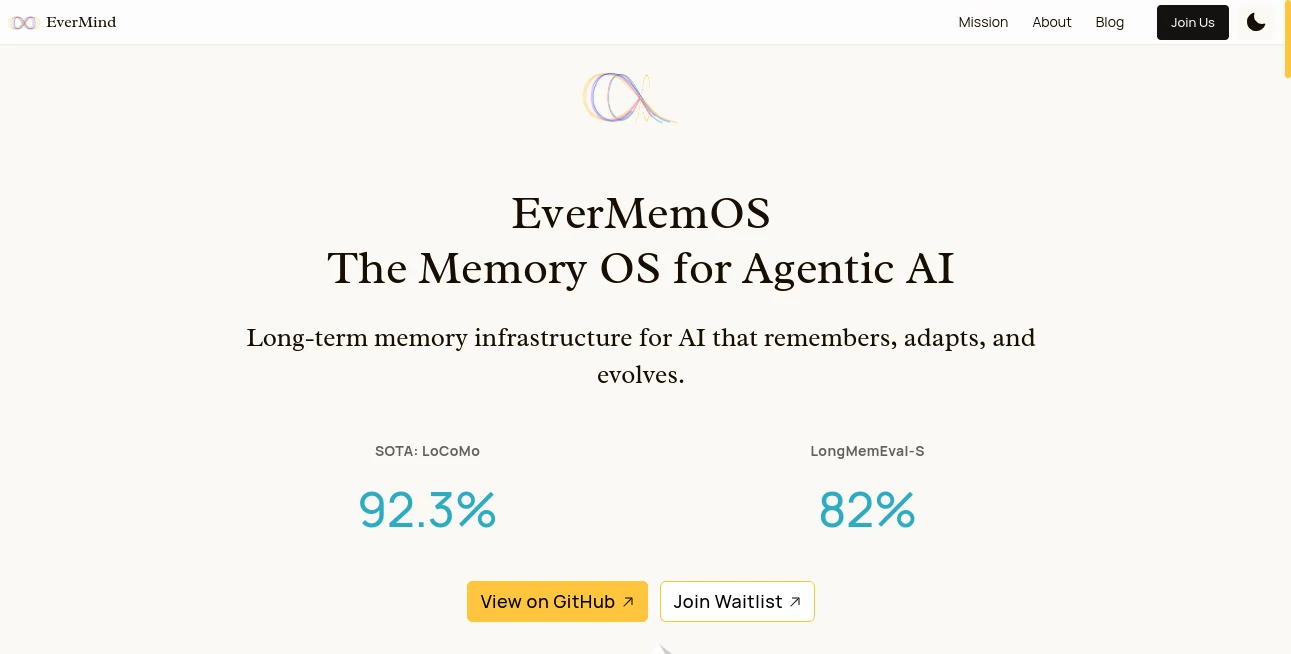
There's something almost poetic about watching an AI companion remember the little details from weeks ago—the offhand comment about your favorite coffee spot or that ongoing debate about the best hiking trail. This platform makes that kind of continuity real, giving agents a persistent backbone that turns fleeting chats into evolving relationships. I've tinkered with plenty of memory add-ons, but this one stands out for how it weaves long-term recall into something reliable and nuanced, without the usual drop-offs or context crumbles that plague others.
Introduction
At its core, this project tackles the big gaps in today's language models: those tiny context windows that forget everything after a few turns, the lack of real personalization, and the inability to grow or stay consistent over time. EverMemOS steps in as an open-source memory layer that mimics human recall—layered, adaptive, and capable of building a true "soul" for agents. It's inspired by brain structures, from quick planning to deep storage, and the results speak volumes in benchmarks where it outpaces rivals like Mem0 or Zep. For anyone building agents that need to stick around and evolve, this feels like the missing piece that's been holding back truly intelligent companions.
Key Features
User Interface
Since it's more infrastructure than a flashy app, the "interface" lives in code and configs—straightforward Docker setups and clear docs that guide you through spinning up services without endless headaches. The GitHub repo lays it out step by step, from cloning to environment tweaks, making it approachable even if you're not a systems wizard. Once running, integration feels seamless, like plugging in a reliable engine that hums in the background.
Accuracy & Performance
Where it truly impresses is in benchmarks: topping charts with 92.3% on reasoning tasks and 82% on long-memory evals, leaving competitors in the dust. It handles massive data ingestion without choking, reranking results smarter, and keeping recall sharp over extended interactions. In practice, that translates to agents that don't just respond—they remember, adapt, and reason with a depth that feels genuinely advanced.
Capabilities
A four-layer setup borrows from neuroscience: planning up top, long-term storage in the middle, smart indexing below, and flexible hooks for external systems. It extracts semantic units from raw text, builds dynamic graphs, and actively applies memories to shape outputs—going beyond passive retrieval to true behavioral consistency. Whether for precise business tools or warm companion bots, it scales the memory strategy to fit, even evolving agents toward self-improvement.
Security & Privacy
Being open-source and self-hostable via Docker, you keep full control over data—no cloudy unknowns or forced sharing. Configs let you lock down APIs and storage as needed, aligning with serious compliance if you're in regulated spaces. It's the kind of setup that prioritizes trust, especially for sensitive personalizations or enterprise integrations.
Use Cases
Think of a virtual assistant that recalls your work habits over months, refining suggestions until it feels like a true colleague. Or companion apps that build emotional depth, remembering shared stories for conversations that grow richer. In business, agents handle ongoing projects with unbroken context, pulling from vast histories without losing threads. Developers love layering it into custom bots, creating experiences that adapt and endure, from tutoring systems to creative collaborators.
Pros and Cons
Pros:
- State-of-the-art benchmarks that prove real-world reliability.
- Open-source freedom for full customization and hosting.
- Human-inspired layers that deliver genuine long-term smarts.
- Flexible for everything from enterprise precision to personal warmth.
Cons:
- Requires some setup—Docker and configs aren't plug-and-play for total beginners.
- Performance ties to your hardware or hosting choices.
Pricing Plans
Completely open-source and free to use, with the repo ready for cloning and self-hosting—no subscriptions or hidden gates. You cover your own infrastructure costs if scaling big, but the core is wide open, inviting tinkers and teams alike to build without barriers. It's that generous spirit that draws in contributors and keeps the project pushing boundaries.
How to Use EverMind
Clone the repo, fire up Docker Compose for the services, install dependencies with uv, and tweak your env file for API keys—docs walk you through it clearly. From there, integrate via the API layer into your agents, feeding interactions to build memory graphs over time. Start small with a test bot, watch it retain details across sessions, and scale as the "personality" emerges—it's rewarding to see the evolution unfold with each run.
Comparison with Similar Tools
Options like Mem0 or Zep offer solid retrieval, but they fall short on the hierarchical depth and active application that make memories truly influential here. Benchmarks highlight the gap—this one consistently tops for reasoning and long-term eval, with a modular framework that's more adaptable for diverse needs. For builders wanting agents that don't reset every chat, it's the deeper, more thoughtful choice that feels built for the future.
Conclusion
This platform quietly addresses what many see as the next frontier for AI: memory that endures and enriches. It transforms agents from clever responders into evolving entities, opening doors to interactions that feel meaningful and lasting. If you're crafting something that needs to remember and grow, this is the foundation worth building on—solid, innovative, and freely yours to shape.
Frequently Asked Questions (FAQ)
Is it really open-source?
Yes, fully on GitHub—clone, modify, and deploy as you like.
What benchmarks back it up?
Leads on LoCoMo and LongMemEval-S, outperforming similar systems.
Easy for beginners?
Docs help, but some dev comfort with Docker pays off.
Commercial use okay?
Open nature welcomes it, with your hosting handling scale.
How does it evolve agents?
Active memory application shapes reasoning for ongoing growth.
AI Developer Tools , AI Research Tool , AI Knowledge Base , AI Workflow Management .
These classifications represent its core capabilities and areas of application. For related tools, explore the linked categories above.
EverMind details
This tool is no longer available on submitaitools.org; find alternatives on Alternative to EverMind.
Pricing
- Free
Apps
- Web Tools
Categories

EverMind Alternatives Product

Zapier

JSON-Tools

LocaFlow

Motion

Serplux
JSON to TOON…

CoinIQ

Miro

Surmado
