
🧠 AI Quiz
Think you really understand Artificial Intelligence?
Test yourself and see how well you know the world of AI.
Answer AI-related questions, compete with other users, and prove that
you’re among the best when it comes to AI knowledge.
Reach the top of our leaderboard.


















Frontegg

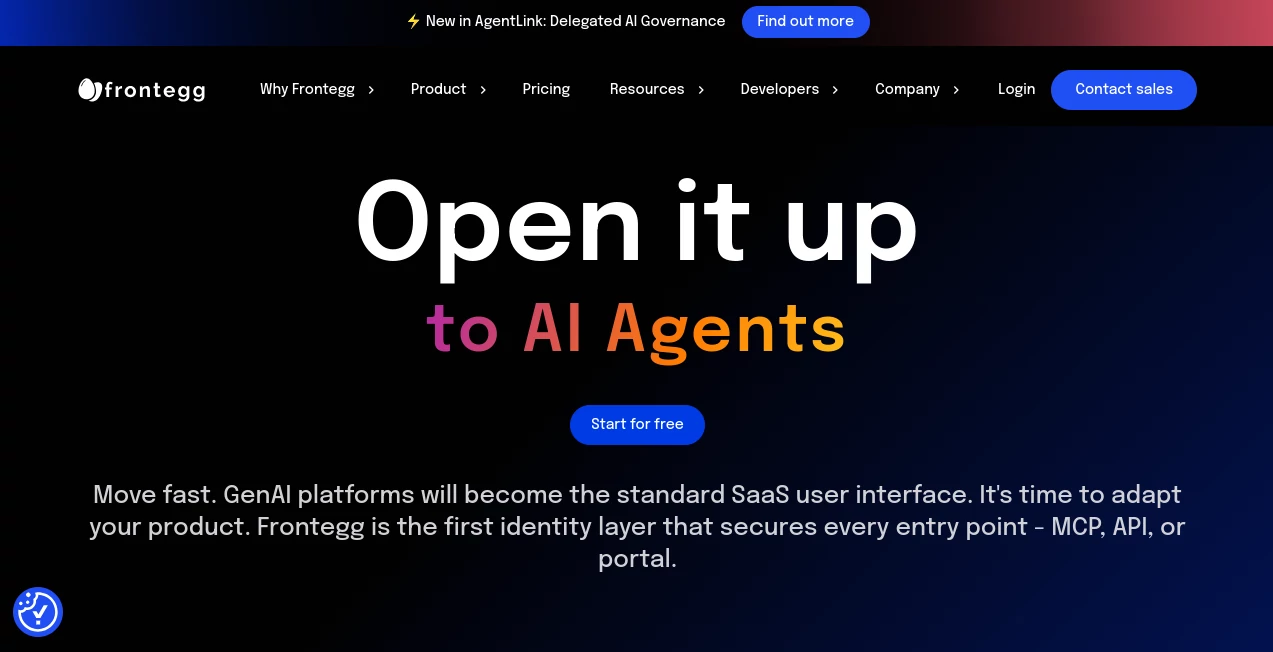
What is Frontegg?
Imagine launching a SaaS product that feels rock-solid from day one, where users glide in seamlessly and AI agents play nice without a hitch. That's the quiet revolution this platform brings to the table—a smart, scalable way to handle authentication, access, and everything in between. I've seen teams breathe a sigh of relief after ditching clunky in-house setups, watching their engineering hours pour back into what really matters: building features that wow customers. It's not just secure; it's the kind of reliable that lets you sleep at night, knowing your app's doors are guarded by something built for the long haul.
Introduction
In the rush to ship faster and smarter, most SaaS builders get tripped up by the basics: who gets in, what they can touch, and how to keep the bad guys out. This platform steps in as that essential underlayer, wrapping your portals, APIs, and even emerging AI touchpoints in a coat of armor that's as flexible as it is fierce. Picture a world where multi-tenant setups hum without headaches, and your devs spend 90% of their time innovating instead of firefighting auth bugs—that's the promise here. Drawing from real-world wins like slashing costs for security firms or boosting engagement for health apps, it's the glue that holds modern stacks together, turning potential pitfalls into smooth sails.
Key Features
User Interface
The dashboard hits you like a well-organized toolbox—clean lines, intuitive flows, and everything just a click away from setup to oversight. Whether you're tweaking roles for a quick test or diving into analytics for deeper insights, it feels less like wrangling code and more like sketching on a napkin that comes alive. Teams love how the low-code bits let non-devs jump in, configuring self-service portals without summoning the whole squad. It's that rare blend of power and approachability, where even on a hectic Monday, you find what you need without the frustration.
Accuracy & Performance
When it comes to keeping things tight and fast, this setup shines with auth checks zipping by in under a millisecond, right at the edge where latency can't hide. Uptime clocks in over 99.99%, backed by redundant systems that shrug off spikes like they're nothing. In my chats with users, one dev shared how it handled a Black Friday surge without flinching, while another praised the pinpoint accuracy in enforcing policies—no false positives eating into legit access. It's the kind of performance that doesn't just work; it anticipates, scaling effortlessly as your user base balloons.
Capabilities
From multi-tenant auth that isolates tenants like pros to role-based gates that fine-tune every permission, the toolkit covers the full spectrum of user management with flair. Throw in agent connectors that make your APIs dance with AI without skipping a beat, and you've got a builder for enterprise-grade bots that think and act securely. Analytics peel back layers on usage patterns, while self-service options empower users to handle their own tweaks—think password resets or profile updates that feel personal, not procedural. It's versatile enough for portals humming with community buzz or APIs feeding hungry integrations, all while prepping for that AI-driven future where agents roam free.
Security & Privacy
Security here isn't an afterthought; it's woven in deep, with continuous monitoring and compliance that ticks every box from GDPR to SOC 2. The AI suite spots risks in real time, enforces ironclad policies, and can even slam the door on rogue actors before they blink. Data stays where it belongs—confidential and controlled—with multi-geo options ensuring privacy aligns with where your users sit. One startup founder told me it cut their breach worries by half overnight, freeing them to chase growth instead of ghosts. It's that fortress feel, built for peace of mind in a world where one slip can cost everything.
Use Cases
Health platforms like Plume have seen engagement soar 400% by layering in seamless sign-ons that keep patients coming back without friction. Security outfits pour saved engineering bucks—hundreds of thousands annually—into core tech, ditching the drag of custom auth. For AI-forward teams, it's about unlocking safe agent access to APIs, letting bots handle grunt work while humans dream bigger. Or take community-driven apps: self-service dashboards turn passive users into active participants, fostering loyalty that sticks. Across the board, it's the enabler that lets SaaS dreams scale without the seams showing.
Pros and Cons
Pros:
- Slashes dev time on non-core chores, freeing up 25% or more for innovation.
- Boasts a 67% higher success rate over shaky in-house builds.
- Handles AI agents like a pro, future-proofing your stack today.
- Global compliance and geo-smart privacy that scales with your ambitions.
Cons:
- Deep customization might nudge you toward their pro support for the trickiest tweaks.
- Best for growing SaaS; solo side projects might find it a touch heavyweight at first.
Pricing Plans
You can dive right in with a free starter tier that covers the essentials—auth basics, single-tenant setups, and core analytics—for those testing the waters. As you ramp up, growth plans kick in around the low three-figures monthly, unlocking multi-tenancy, advanced roles, and that AI security suite. Enterprise tiers flex with custom needs, like dedicated infra or white-glove onboarding, often tailored after a quick chat. It's refreshingly straightforward, with no hidden gotchas, and that free entry point means you can feel the lift before committing a dime.
How to Use Frontegg
Getting rolling is a breeze: sign up for free, snag their SDK, and wire it into your app in under an hour—docs are gold, with snippets that just work. From there, spin up a tenant, map out roles via the dashboard, and watch self-service portals light up for users. For AI kicks, hook in the agent connector to expose safe endpoints, test with their builder, and monitor via built-in analytics. One team I know went from zero to hero in a weekend, tweaking as they went, and never looked back. It's that hands-on ease that turns setup into a stepping stone, not a stumble.
Comparison with Similar Tools
Stack it against piecemeal auth kits, and it wins on wholeness—no more juggling libraries that clash or lag. Where open-source options demand dev devotion (and often crumble under scale), this delivers out-of-the-box reliability with 67% better odds of sticking the landing. Big-name IAM giants might boast bells, but they weigh heavy on wallets and wits; here, you get enterprise punch at startup speeds, especially shining for AI-ready flows that others are still scrambling to catch up on. It's the smart pick for teams that want robust without the rigmarole.
Conclusion
This platform isn't just another layer—it's the foundation that lets your SaaS soar, blending bulletproof security with the agility to embrace tomorrow's AI wave. By reclaiming dev hours and closing breach gaps, it empowers builders to craft experiences that delight, not deter. If you're weary of auth woes holding you back, dive in; the transformation from fragile to fortified is as rewarding as it is rapid. In the end, it's about building with confidence, and few tools hand you that gift quite so gracefully.
Frequently Asked Questions (FAQ)
How fast can I integrate it into my stack?
Most teams report full auth flows live in days, thanks to SDKs that slot in seamlessly.
Does it play nice with AI agents?
Absolutely—the agent connector makes your APIs bot-friendly, with guardrails to keep things safe.
What's the uptime like under heavy load?
Over 99.99%, with edge computing that laughs off traffic spikes.
How does it handle global privacy rules?
Multi-geo setups ensure compliance wherever your users roam, from GDPR to beyond.
Is there a free way to try it out?
Yep, the starter plan lets you build and test at zero cost, scaling as you grow.
AI API Design , AI Developer Tools , AI Team Collaboration , AI Workflow Management .
These classifications represent its core capabilities and areas of application. For related tools, explore the linked categories above.
Frontegg details
This tool is no longer available on submitaitools.org; find alternatives on Alternative to Frontegg.
Pricing
- Free
Apps
- Web Tools
Categories

Frontegg Alternatives Product

JSON to TOON…

Manifestly C…

VisualGPT

ModelsLab

LaunchBoard

Sourcetable

Candidate Sc…

MindSnapz

Workik