🧠 AI Quiz
Think you really understand Artificial Intelligence?
Test yourself and see how well you know the world of AI.
Answer AI-related questions, compete with other users, and prove that
you’re among the best when it comes to AI knowledge.
Reach the top of our leaderboard.


















GPTLocalhost
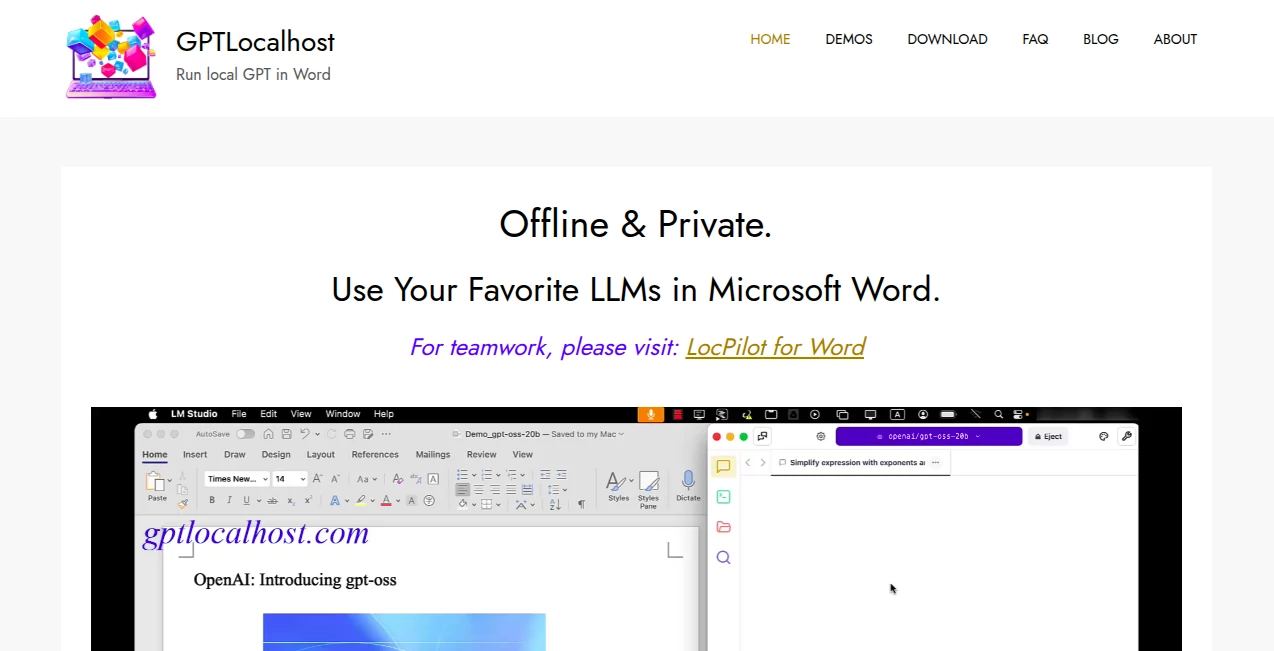
What is GPTLocalhost?
GPTLocalhost opens the door to having advanced conversation partners humming away on your own hardware, keeping things swift and self-contained. This setup lets tinkerers and teams alike summon smart replies without waiting on distant servers, turning your laptop into a private powerhouse for brainstorming or building. Those who've switched over often chat about the freedom it brings, ditching laggy links for responses that feel instant and intimate.
Introduction
GPTLocalhost came together from a itch among coders who craved the smarts of big models but balked at the black-box billing and bandwidth bites. It surfaced a short spell ago, quickly finding fans in garages and offices where folks pieced together personal bots for daily digs. Stories float around of weekend warriors who rigged up custom helpers for everything from code cleanups to casual chit-chat, all without a whisper to the cloud. What started as a niche nod to offline enthusiasts has rippled wider, proving that keeping the brains local can spark sharper workflows and safer secrets, all while your setup stays the star.
Key Features
User Interface
The dashboard lands light and lean, with a central chat pane that mirrors a familiar messenger, complete with history scrolls and quick-start prompts tucked in the sidebar. Drop in your model picks from a tidy dropdown, tweak settings like temperature or token limits with sliders that slide smooth, and watch the console log hum below without overwhelming the flow. It's built for the hands-on crowd, feeling more like a workbench than a walled garden, where every nudge shows right away.
Accuracy & Performance
It draws from proven open-source hearts, serving up replies that hold steady against their hosted kin, often with a personal polish from your hardware's hum. Speeds clock in snappy on decent rigs, churning through queries without the usual web waits, and holds its own on longer threads by sipping resources wisely. Users tip hats to how it nails context carryover, keeping threads tight even after dozens of back-and-forths.
Capabilities
Beyond basic banter, it hooks into your scripts for tasks like debugging drafts or drafting docs, layering in tools for web scrapes or file fetches right from the local lane. Swap models on the fly for specialized spins, from code-savvy to creative bursts, and even chain calls for workflows that weave multiple minds. The open underbelly means you can tweak the guts, adding custom voices or vector stores to make it yours through and through.
Security & Privacy
Everything stays housebound, with no outbound pings or data drifts, wrapping your whispers in the walls of your own setup. It leans on standard ciphers for any stored chats, and you call the shots on what lingers or leaves, from full wipes to encrypted archives. That built-in barrier builds trust, especially for those handling hot topics or house rules that demand discretion.
Use Cases
Developers fire it up for pair-programming sessions that pace with their thoughts, spotting syntax slips in scripts without server side-eye. Writers weave outlines in quiet corners, pulling plot points without plot leaks. Teams test internal ideas in isolated bubbles, brainstorming bold without broadcasting. Even hobbyists host home assistants for recipe riffs or reading recs, all tuned to their tastes without the usual eavesdrop worries.
Pros and Cons
Pros:
- Keeps costs capped at your current kit, no creeping credits.
- Privacy baked in, with zero cloud confessions.
- Custom corners for coders craving control.
- Snaps to your speed, no network nonsense.
Cons:
- Hardware hurdles if your box bucks under big brains.
- Setup steps steeper for setup shy.
- Lacks live updates, so tweaks take a turn.
Pricing Plans
It's all open-source at heart, free to fetch and fiddle with no fences, though donations nudge the nest. For those wanting wrappers or extras, community tiers float around a few bucks for polished ports, but the core stays gift-wrapped for grab-and-go. That no-strings setup suits the self-starters, with optional upsells for easier entries.
How to Use GPTLocalhost
Grab the goods from the repo, unpack and point to your preferred model folder, then fire up the server with a single line in your terminal. Head to the local link, paste a prompt in the pane, and let it roll—tune the dials for depth or brevity as you chat. Hook scripts via the API endpoint for deeper dives, saving sessions to disk if the mood strikes, and restart with fresh flags for new forays.
Comparison with Similar Tools
Where hosted heavies heap on hourly hits, GPTLocalhost levels the lane by leaning local, trading team-scale thump for tailored thrift, though those might muster more muscle for massive meshes. Against other open outfits, it edges with easier embeds, skipping the sprawl but perhaps pinching on plugin parades. It fits folks favoring freedom over fanfare, outpacing the paywalled with personal punch.
Conclusion
GPTLocalhost lights a lantern for local lovers, proving that potent partners needn't phone home to perform. It empowers the everyday engineer to engineer escapes from echo chambers, fostering flows that feel fresh and fenced. As more minds mull moving models homeward, this trailblazer keeps the path clear, inviting all to chat closer to the code.
Frequently Asked Questions (FAQ)
What rigs run it right?
Any with a decent GPU or CPU punch, though beefier bites bigger brains.
Models from where?
Pull from Hugging Face or peers, slotting seamless into the setup.
API access a go?
Built-in, for scripting smarts into your stacks.
Windows whispers work?
Yup, cross-platform charm from the jump.
Community close?
Forums and forks foster fixes and frills.
AI API Design , AI Developer Tools , AI Chatbot , Large Language Models (LLMs) .
These classifications represent its core capabilities and areas of application. For related tools, explore the linked categories above.
GPTLocalhost details
Pricing
- Free
Apps
- Web Tools
Categories

GPTLocalhost Alternatives Product

Grok

Random Promp…

JSON to TOON…
JSON to TOON…

UPDF AI

Blushly Chat

CodeSpy AI

Lovable APP

ChatGot