🧠 AI Quiz
Think you really understand Artificial Intelligence?
Test yourself and see how well you know the world of AI.
Answer AI-related questions, compete with other users, and prove that
you’re among the best when it comes to AI knowledge.
Reach the top of our leaderboard.

















grok imagine 2.0
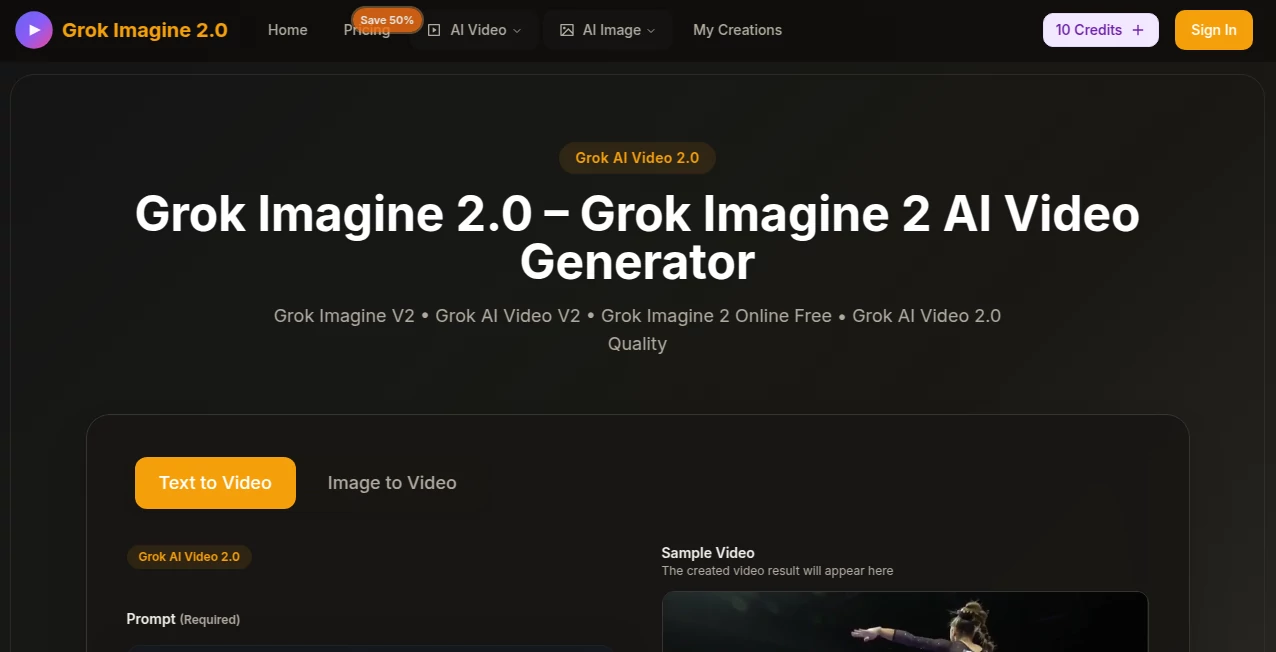
What is grok imagine 2.0?
There's a special kind of rush when you type a half-formed idea—"a lone astronaut sitting on a cliff under twin moons, soft neon glow, cinematic lighting"—and seconds later a finished painting appears that feels like it was made for you. The colors are rich, the composition thoughtful, the mood exactly what you pictured (sometimes even better). This tool captures that spark and turns it into something shareable, printable, or frame-worthy without making you fight the interface or wait forever. I've watched non-artists light up when their first try looks gallery-ready, and seasoned creators quietly nod because the details—light bounce, edge quality, atmospheric depth—are handled with real care.
Introduction
Most AI art generators still feel like lottery machines: sometimes brilliant, often disappointing, usually requiring prompt engineering gymnastics. This one changes the game by understanding natural language the way a human collaborator would. Describe a scene casually, throw in mood words, reference styles or artists if you want, and it delivers coherent, emotionally resonant images that rarely need heavy post-editing. It’s become a quiet favorite among illustrators who use it for quick concepts, writers who need cover art, and hobbyists who just want to see their daydreams made real. The joy isn’t only in the output—it’s in how little friction there is between imagination and result.
Key Features
User Interface
The screen is calm and focused: a wide prompt box that invites you to write naturally, a row of style presets you can tap (or ignore), aspect-ratio buttons, and a single prominent “Imagine” button. As soon as generation finishes, you get a clean grid of variations with zoom, download, and remix options right there. No account required to start, no aggressive upsell overlays. It feels built by people who hate clutter, so you can actually stay in the creative flow instead of wrestling menus.
Accuracy & Performance
It listens—really listens—to nuance in prompts. Mention “golden hour light filtering through cherry blossoms” and the warmth, the softness, the gentle lens flare all appear naturally. Complex compositions with multiple subjects and specific interactions hold together far better than most. Generations are fast (usually 8–25 seconds per image), and the model rarely produces the usual AI giveaways: six-fingered hands, melting backgrounds, impossible anatomy. Consistency across multiple runs is strong—same character in different poses actually looks like the same person.
Capabilities
Text-to-image with strong prompt understanding, style references (artists, mediums, eras), multiple aspect ratios (portrait, landscape, square, custom), up to 8 variations per run, high-resolution output (up to 2048×2048), inpainting/outpainting for extending or editing scenes, and remix mode that lets you evolve favorites with new prompts. It handles photorealism, painterly styles, concept art, anime, surrealism, product visualization, book covers—pretty much anything visual you can describe. The emotional tone and storytelling coherence set it apart from flatter, more mechanical outputs.
Security & Privacy
No mandatory sign-up for basic generations means your prompts and images aren’t tied to a persistent profile unless you choose to create one. Images are processed ephemerally and not used for training. For personal projects, client concepts, or anything sensitive, that low-commitment approach feels respectful and reassuring.
Use Cases
A fantasy author generates cover concepts in minutes instead of commissioning months later—picks a favorite, tweaks with inpainting, and sends to the designer. A small business owner creates hero product visuals that look like pro photoshoots without hiring a photographer. A social media creator builds consistent character art for a comic series by remixing the same seed across poses and scenes. A game dev prototypes environment concepts and UI mockups before modeling. Wherever imagination needs to become visual fast, it quietly becomes indispensable.
Pros and Cons
Pros:
- Understands natural, conversational prompts—no need for keyword salads.
- Exceptional coherence and emotional tone in complex scenes.
- Fast generation with high-quality, usable resolutions.
- Remix and inpaint tools let you iterate without starting over.
- Free tier is generous—no hard paywall to discover the quality.
Cons:
- Occasionally over-interprets ambiguous prompts (though usually in charming ways).
- Highest resolutions and unlimited generations require paid plan.
- Very niche or hyper-specific styles may need prompt refinement.
Pricing Plans
Free daily credits let anyone experience the quality firsthand—no card needed to fall in love with the results. Paid plans unlock higher resolutions, faster queue times, unlimited generations, advanced remix features, and priority support. Pricing stays accessible for hobbyists and scales sensibly for heavy users. Many creators say one month covers what they used to spend on stock art or freelance illustrators for a single project.
How to Use GrokImagine 2
Write a description as naturally as you’d tell a friend (“a cyberpunk street market at night, rain-slicked neon, lone figure in trench coat under umbrella, moody cinematic lighting”). Optionally pick a style preset or aspect ratio. Hit generate—watch variations appear in seconds. Click any image to zoom, download, or remix with new instructions. Use inpainting to edit specific areas (add/remove objects, change expressions). Iterate until it feels perfect. The loop is fast and forgiving—you’ll have a keeper in minutes.
Comparison with Similar Tools
Many generators require keyword-heavy prompts and still produce incoherent compositions or style drift. This one excels at understanding plain English and delivering emotionally coherent, visually balanced images. Where others feel mechanical, the outputs here carry mood and narrative weight. Speed, consistency, and creative control put it in a class of its own for anyone who wants art that feels directed rather than randomized.
Conclusion
Great art starts with imagination, not perfect prompts or expensive software. This tool bridges that gap beautifully—letting ideas become visuals quickly, faithfully, and with real emotional depth. It doesn’t replace artists; it empowers everyone who has ever wanted to see their thoughts rendered with care. When a vague description turns into a painting that moves you, you realize how much creative possibility just became accessible. For dreamers, makers, and storytellers, that’s a gift worth celebrating.
Frequently Asked Questions (FAQ)
How detailed should my prompt be?
Write naturally like describing a scene to a friend—more detail helps, but it understands casual language very well.
Can I use the images commercially?
Yes—paid plans grant full commercial rights; free tier allows personal and non-commercial use.
What resolutions are available?
Up to 2048×2048 on paid plans; free tier offers high-quality previews.
Can I edit specific parts of the image?
Yes—inpainting lets you mask and regenerate only selected areas.
Is there a watermark on free images?
Small watermark on free generations; paid removes it completely.
AI Photo & Image Generator , AI Art Generator , AI Design Generator , AI Text to Image .
These classifications represent its core capabilities and areas of application. For related tools, explore the linked categories above.
grok imagine 2.0 details
Pricing
- Free
Apps
- Web Tools
Categories

grok imagine 2.0 Alternatives Product
Uni-1
claude image
Color-Analys…
Action Figur…
Consistent C…
Card Maker AI
nano banana

ColorChanger

Nano Banana …
