
🧠 AI Quiz
Think you really understand Artificial Intelligence?
Test yourself and see how well you know the world of AI.
Answer AI-related questions, compete with other users, and prove that
you’re among the best when it comes to AI knowledge.
Reach the top of our leaderboard.


















HookSmith

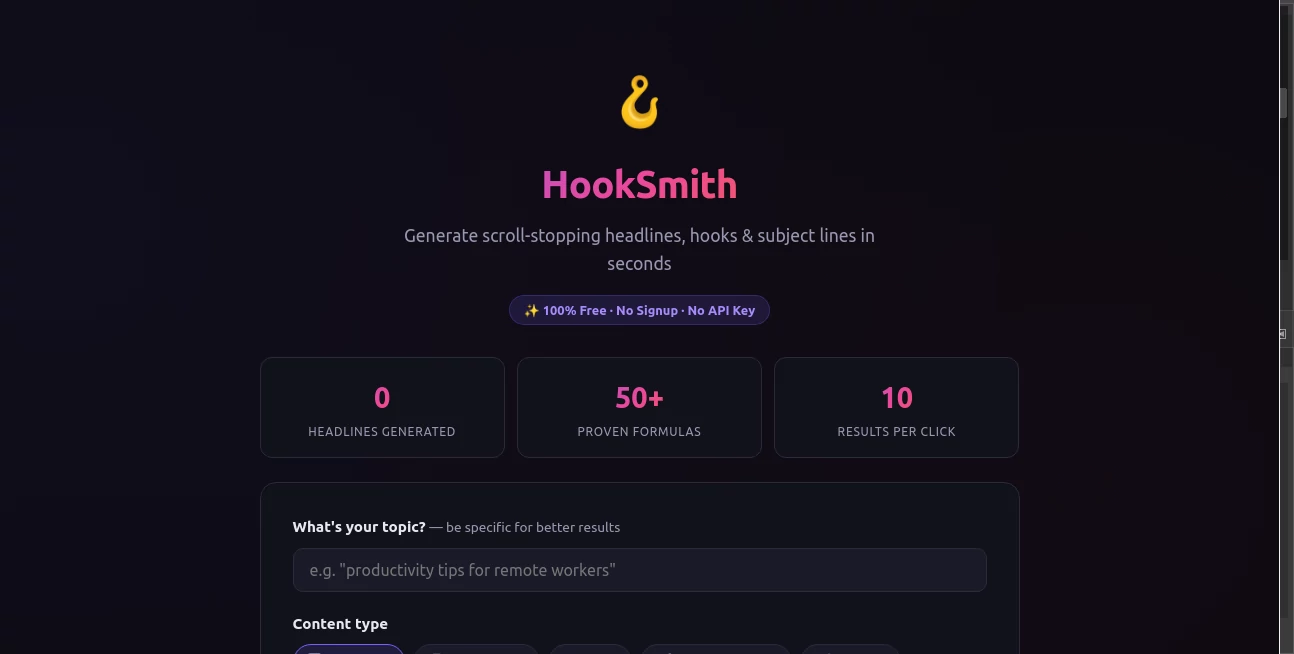
What is HookSmith?
Building webhooks can feel like walking a tightrope—one small mistake in the payload, headers, or retry logic and your integration silently fails. This tool changes that entirely. You visually design the exact request you need, test it live against real endpoints, and get a production-ready webhook URL in seconds. No code, no servers, no debugging at 2 a.m. I’ve seen solo founders replace brittle Zapier zaps and custom Node scripts with these clean, reliable hooks and suddenly sleep better knowing their data flows exactly as intended.
Introduction
Webhooks are the nervous system of modern apps—quietly moving data between services—but setting them up is often painful. You either write fragile scripts, wrestle with third-party middleware that adds latency and cost, or pray your no-code tool doesn’t mangle the payload. This platform fixes the pain at the root: it lets you build, test, and host custom webhook receivers entirely in the browser with zero infrastructure. The result is a clean, inspectable, retry-capable endpoint you can point any service at. For indie hackers, small teams, and anyone who’s tired of “it works on my machine” webhook failures, it’s a breath of fresh air.
Key Features
User Interface
The editor is beautifully minimal: a canvas where you drag blocks for headers, body transformation, authentication, retries, and response rules. Real-time previews show exactly what the incoming payload will become before it leaves. Test requests fire instantly with full request/response inspection. Everything is visual, but the generated code (if you ever want it) is clean and readable. It feels like drawing a flowchart that actually runs in production.
Accuracy & Performance
Payloads arrive untouched unless you explicitly transform them—no hidden parsing surprises. Retries respect exponential backoff with configurable jitter. Responses are fast (sub-100ms p99 in most regions), and the inspector logs every detail: raw body, headers, timing, status code. In practice, it catches edge cases (large payloads, weird content-types, rate-limits) that would otherwise take hours of debugging in a custom endpoint.
Capabilities
Transform incoming JSON/XML/form-data with visual mappers, add/remove headers, sign requests, filter events, retry failed deliveries, delay processing, forward to multiple endpoints, respond with custom status/body, store payloads temporarily for inspection, and generate shareable test links. It handles authentication (Basic, Bearer, HMAC), rate-limiting protection, and dead-letter queues. Essentially anything you’d write in a small Node/Go handler, but built with drag-and-drop blocks instead of code.
Security & Privacy
Endpoints are private by default—only the exact URL works, and you can add IP restrictions, secret tokens, or HMAC validation. Payloads are encrypted in transit and at rest during temporary storage; nothing is kept after the retention period you set (default 7 days). No access to your downstream services’ credentials unless you explicitly configure them. For sensitive integrations (payments, personal data), the isolation and transparency are reassuring.
Use Cases
A solo SaaS founder replaces brittle Zapier paths with a single reliable hook that transforms Stripe webhooks into clean internal events. A small agency builds a custom lead routing system without standing up a server. An e-commerce store owner filters Shopify order events and forwards only high-value ones to Slack with enriched data. A developer prototypes a webhook consumer for a client in minutes instead of days. Wherever data needs to move reliably between services without custom backend code, this fits perfectly.
Pros and Cons
Pros:
- Visual builder replaces hundreds of lines of boilerplate code.
- Instant testing and full request/response inspection eliminate guesswork.
- Built-in retries, queuing, and dead-letter handling make it production-grade.
- No servers to manage—zero DevOps overhead.
- Free tier is genuinely useful for small projects and experiments.
Cons:
- Very complex conditional logic can feel a bit clunky in the visual editor (though still better than raw code).
- Long-term payload storage and advanced analytics require paid plans.
- Maximum execution time per request caps very long-running transformations (rarely an issue for webhooks).
Pricing Plans
Free plan includes several active endpoints, generous monthly requests, basic transformations, and 7-day history—enough for side projects and small production use. Paid tiers unlock unlimited endpoints, higher request quotas, longer retention, advanced transformations (scripting blocks), team collaboration, custom domains, and priority support. Pricing stays reasonable for the reliability and time saved—many users say it replaces tools that cost 3–5× more.
How to Use HookSmith
Create a new hook from the dashboard. Drag blocks onto the canvas: start with “Receive Webhook”, add transformations (map, filter, enrich), configure retries and error handling, set the final destination (HTTP POST, Slack, email, etc.), and define your response. Test with the built-in request sender or point a real service at the generated URL. Watch live deliveries in the inspector. Tweak blocks as needed. Deploy. Done—reliable webhook magic without touching a server.
Comparison with Similar Tools
Zapier and Make are great for simple flows but add latency, cost per task, and hidden parsing quirks. Custom Node/Go endpoints give full control but require hosting, monitoring, and scaling. This tool sits in a sweet spot: visual like no-code platforms, reliable like custom code, zero infrastructure. It’s especially strong when you need precise payload control, retries, and inspection without ongoing maintenance.
Conclusion
Webhooks should be boringly reliable—not a source of late-night alerts and frantic debugging. This platform makes them exactly that: predictable, inspectable, and effortless to build. It frees you to focus on the product instead of the plumbing. When your integrations hum quietly in the background and your users never notice a failure, you realize how much mental overhead it removes. For anyone shipping connected software, that peace of mind is priceless.
Frequently Asked Questions (FAQ)
Do I need to host anything?
No—endpoints are fully hosted and managed by the platform.
How many requests can I handle on free?
Thousands per month—plenty for small projects and prototypes.
Can I transform payloads before forwarding?
Yes—map, filter, enrich, sign, or completely reshape with visual blocks.
What happens if the downstream service fails?
Built-in retries with exponential backoff; failed events go to a dead-letter queue you can inspect/replay.
Is it secure for sensitive data?
Encrypted in transit and at rest, private endpoints, optional IP restrictions, HMAC validation, and minimal retention.
AI Workflow Management , AI No-Code & Low-Code , AI API Design , AI Developer Tools .
These classifications represent its core capabilities and areas of application. For related tools, explore the linked categories above.
HookSmith details
This tool is no longer available on submitaitools.org; find alternatives on Alternative to HookSmith.
Pricing
- Free
Apps
- Web Tools
Categories

HookSmith Alternatives Product

DeepSeek

KaneAI

Somnio

TutuoAI

Bolt AI

Tate-A-Tate

LocaFlow

Emergent

Miro