
🧠 AI Quiz
Think you really understand Artificial Intelligence?
Test yourself and see how well you know the world of AI.
Answer AI-related questions, compete with other users, and prove that
you’re among the best when it comes to AI knowledge.
Reach the top of our leaderboard.


















MiniValuator
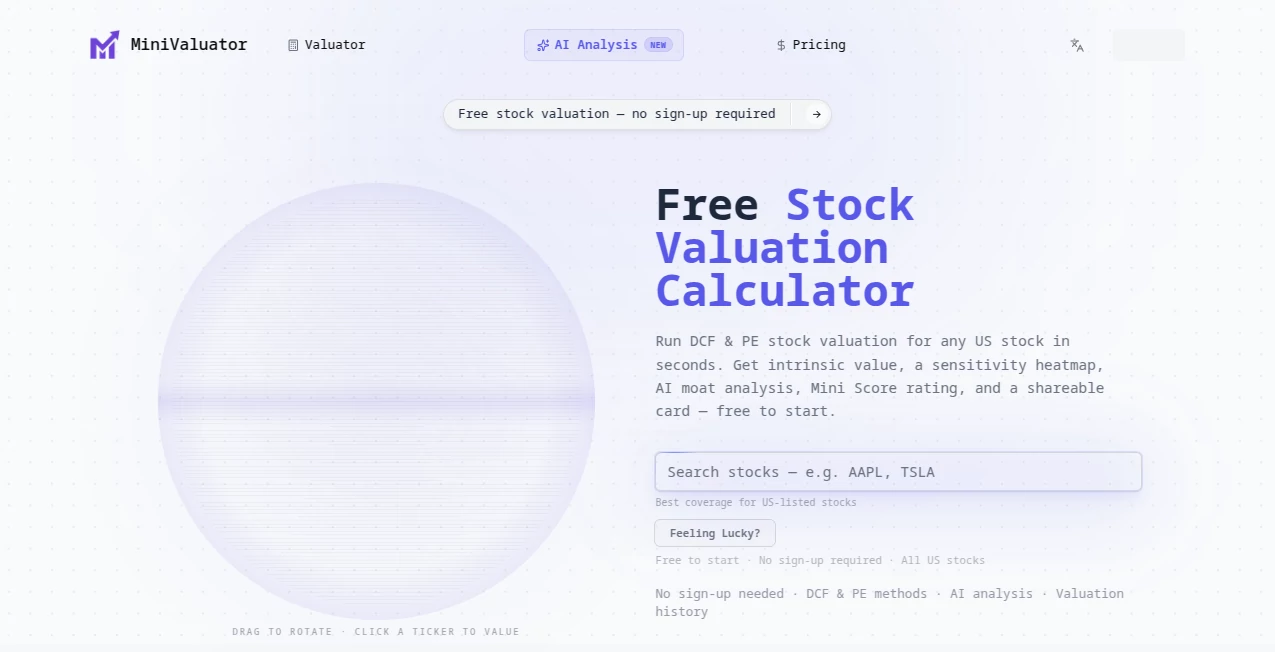
What is MiniValuator?
There’s something deeply satisfying about taking a stock you’re interested in and getting a clear, numbers-based sense of what it might actually be worth. Not hype, not headlines—just a calm, logical valuation you can understand. This tool delivers exactly that. It’s clean, focused, and built by investors who got tired of overly complicated spreadsheets and flashy calculators that bury you in assumptions. You input the key figures, and it gives you a straightforward DCF-based valuation with transparent logic. I’ve used it on stocks I was researching, and it helped me move from “this looks interesting” to “here’s roughly what it seems worth” with much more confidence.
Introduction
Valuing a company properly is one of the most important skills in investing, yet it’s also one of the most intimidating for many people. Traditional methods involve complex Excel models that take hours to build and maintain. MiniValuator changes that. It’s a minimalist, web-based stock valuation calculator centered on Discounted Cash Flow (DCF) analysis, designed to be fast, transparent, and actually useful for real investors. Whether you’re a beginner trying to understand valuation for the first time or an experienced investor who wants a quick sanity check, it strips away the noise and gives you the core numbers you need to make better decisions.
Key Features
User Interface
The interface is beautifully simple—exactly what you want when working with numbers. Clear input fields for revenue, growth rates, margins, discount rate, and terminal value assumptions. Everything is laid out logically with helpful explanations next to each field so you understand what you’re changing. No clutter, no distracting charts until you’re ready. You can tweak assumptions and see the fair value update instantly. It feels like a well-designed spreadsheet that someone finally made easy to use.
Accuracy & Performance
It uses a standard multi-stage DCF model with sensible defaults, but gives you full control to adjust every major assumption. The calculations are transparent—you can see exactly how changes in growth rate or WACC affect the final valuation. Results come back instantly, and the model behaves predictably. Many users appreciate that it doesn’t pretend to be magically precise; instead, it shows a range and lets you understand the drivers behind the number.
Capabilities
It supports full DCF modeling with multiple growth stages, flexible margin and growth assumptions, WACC calculation helpers, and sensitivity analysis. You can save different scenarios to compare bullish, base, and conservative cases. The tool works for both established companies and higher-growth stocks by allowing custom stage lengths. Export options let you take the full calculation with you for further analysis.
Security & Privacy
Your inputs and calculations stay private—nothing is saved unless you choose to store a scenario. No account is required to run valuations, which keeps things lightweight and secure. For investors working with portfolio ideas or research, that simple, no-tracking approach is refreshing.
Use Cases
A long-term investor runs a quick valuation on a stock that caught their eye after earnings to see if the current price makes sense. A value investing student practices DCF modeling on real companies and immediately sees how assumptions affect outcomes. An active trader uses it as a sanity check before entering positions. Even experienced analysts use it for quick cross-checks against their more complex models. It’s particularly useful when you want an unbiased second opinion on whether a stock looks cheap or expensive based on fundamentals.
Pros and Cons
Pros:
- Extremely clean and focused interface that reduces analysis paralysis.
- Transparent calculations—you always understand where the number comes from.
- Fast enough to run multiple scenarios in one sitting.
- Free to use with no heavy paywalls for core functionality.
- Built by investors for investors, not by marketers.
Cons:
- Focused primarily on DCF, so users wanting other valuation methods (comparables, etc.) may need supplementary tools.
- Advanced users may eventually want more customization options.
Pricing Plans
The core tool is completely free to use, which is rare and genuinely appreciated for something this useful. There may be optional premium features or ad-free experience for heavy users, but the essential valuation engine remains accessible without payment. This approach makes it approachable for students, hobbyists, and serious investors alike.
How to Use MiniValuator
Go to the valuation page, enter the company’s ticker or basic financials (revenue, EBITDA, free cash flow, etc.). Adjust the growth assumptions, margins, discount rate, and terminal growth to match your view of the business. Watch the fair value update live as you change inputs. Run a few different scenarios (optimistic, base, pessimistic) to see the range. Save the ones you like for later reference. The whole process can take as little as 5–10 minutes once you’re familiar with it.
Comparison with Similar Tools
Many online calculators are either too simplistic (one magic number with no explanation) or overwhelmingly complex with dozens of hidden assumptions. This one hits a sweet spot: transparent enough to learn from, simple enough to use regularly, and focused on what actually matters for valuation. It avoids the bloat of full financial modeling software while giving more insight than basic screeners or generic calculators.
Conclusion
Good investing starts with good questions, and one of the most important is “What is this company really worth?” This tool makes answering that question clearer, faster, and more educational. It won’t make investing decisions for you, but it will give you a solid, logical foundation to stand on. For anyone serious about understanding the numbers behind the stocks they own or are considering, it’s one of the most practical and honest tools available.
Frequently Asked Questions (FAQ)
Is the tool really free?
Yes, the main valuation calculator is free to use with no hidden limits on core functionality.
Do I need financial expertise to use it?
No—helpful explanations guide you, but the more you understand the assumptions, the more value you’ll get.
Can I save my valuations?
Yes, you can save different scenarios to compare them later.
Does it work for any stock?
It works best for companies with positive or predictable cash flows. Highly speculative or early-stage companies may need more manual adjustment.
How accurate are the valuations?
Accuracy depends entirely on the quality of your assumptions. The tool is transparent so you can see exactly how sensitive the result is to changes in growth or discount rate.
AI Investing Assistant , AI Research Tool .
These classifications represent its core capabilities and areas of application. For related tools, explore the linked categories above.
MiniValuator details
Pricing
- Free
Apps
- Web Tools
Categories

MiniValuator Alternatives Product

Sound Level …

Harvey

Robux Tax Ca…

JSON to TOON…

Sourcetable

StockTalker …

LocaFlow

Website Traf…

Sorank
