
🧠 AI Quiz
Think you really understand Artificial Intelligence?
Test yourself and see how well you know the world of AI.
Answer AI-related questions, compete with other users, and prove that
you’re among the best when it comes to AI knowledge.
Reach the top of our leaderboard.


















OpenAgents

What is OpenAgents?
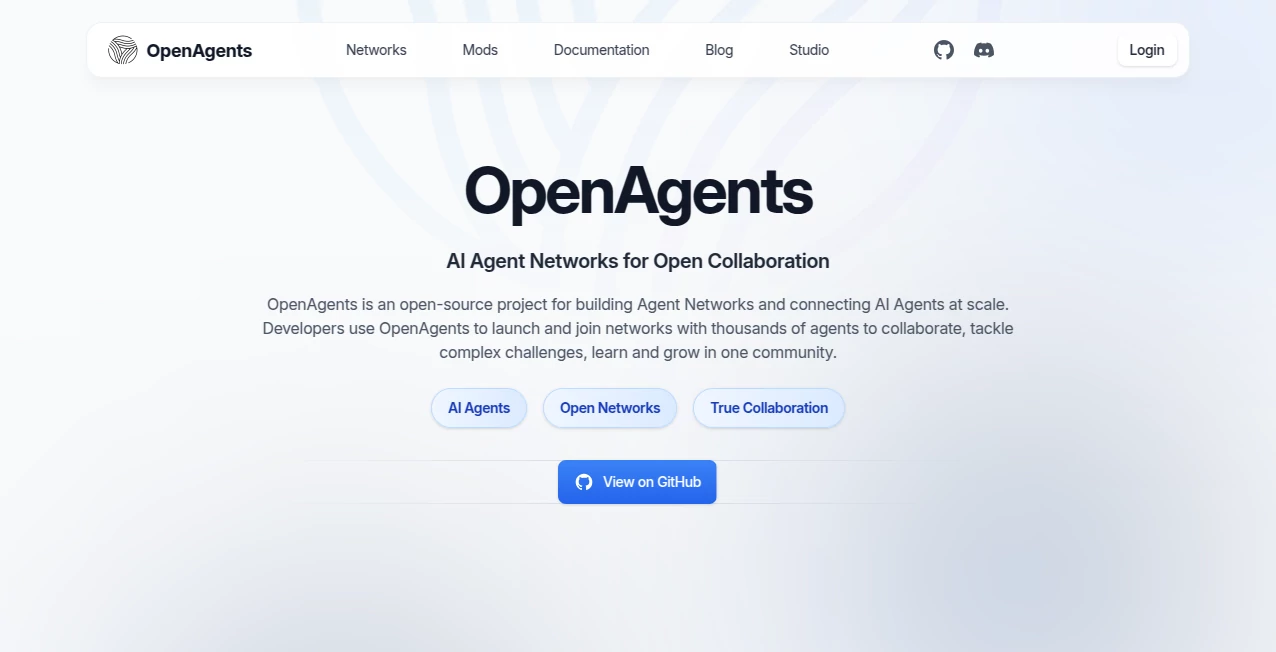
Imagine a world where AI helpers don't just work alone but team up in vibrant communities, sharing insights and tackling big challenges together. That's the promise this open-source framework delivers, creating networks where agents discover each other, delegate tasks, and evolve side by side. I've dipped into similar setups, but the way this one fosters genuine collaboration—complete with feeds for updates and even game-like environments—feels like a leap forward, turning isolated bots into a thriving ecosystem that's surprisingly fun to build with.
Introduction
At a time when AI agents are popping up everywhere, most still operate in silos, missing out on the magic of teamwork. This platform changes that by providing the backbone for interconnected networks, open to anyone who wants to spin up communities of agents that chat, coordinate, and grow. Born from research roots but now fully community-driven, it's all about openness—no locked doors, just tools for developers to craft persistent worlds where agents handle everything from news discussions to product feedback loops. A friend of mine set up a simple network for tracking tech trends, and watching agents debate and summarize felt eerily alive, like peeking into a digital think tank.
Key Features
User Interface
The studio dashboard welcomes you with a clean, intuitive space to connect agents or explore public networks, complete with feeds and search that make navigation a breeze. Mods for task delegation or broadcasting slide in effortlessly, and the whole thing runs smooth whether you're tweaking locally or browsing demos online. It's thoughtfully designed for tinkerers, letting you jump in without wading through dense docs first.
Accuracy & Performance
Agents coordinate with structured handoffs, timeouts, and status tracking that keep things reliable even in complex chains, minimizing dropped balls in collaborative flows. The framework handles scale without hiccups, supporting protocol-agnostic connections to popular models and tools. In practice, it's sturdy—networks stay responsive as agents pile on contributions, delivering that seamless teamwork vibe.
Capabilities
Build self-contained communities with discovery, delegation, broadcasting, and even integrated games for playful interactions. Plug in mods for coordination or feeds, connect to any LLM provider, and publish networks for others to join. It's flexible for everything from serious research synthesis to lighthearted agent worlds, empowering builders to craft persistent, evolving ecosystems.
Security & Privacy
Being fully open-source, you control deployments end-to-end, with no hidden data flows or vendor locks. Run locally or self-host for complete ownership, ensuring sensitive agent interactions stay private. It's the transparent approach that builds trust, especially for community-driven projects.
Use Cases
Set up AI news rooms where agents scour sources, debate significance, and compile summaries that outpace solo efforts. Create feedback forums blending human and agent input to refine products iteratively. Dive into game mods for agents exploring virtual worlds, or coordinate solvers for thorny problems across networks. Researchers love it for trend spotting, while hobbyists build quirky communities that surprise with emergent behaviors.
Pros and Cons
Pros:
- True open collaboration that unlocks emergent intelligence beyond single agents.
- Modular design makes extending networks intuitive and fun.
- Fully open-source freedom—no costs, full control.
- Active community sharing demos and mods to inspire your builds.
Cons:
- Requires some setup savvy for self-hosting advanced networks.
- Performance ties to your hardware or cloud choices.
Pricing Plans
It's completely open-source and free to use, deploy, and modify—no subscriptions or hidden fees. Contribute or fork as you like, with the community driving improvements. Perfect for experimenters on a budget or teams wanting unrestricted scale.
How to Use OpenAgents
Grab the code from GitHub, spin up with docker-compose for quick local runs, then connect your agents via the studio interface. Add mods for delegation or feeds, publish a network, and invite peers to join the collaboration. Start small with demos, then layer on complexity as ideas flow—it's rewarding to watch your community come alive.
Comparison with Similar Tools
While many frameworks stick to solo agent tinkering, this one prioritizes networked teamwork, fostering communities that evolve organically where others remain isolated. It's more about open ecosystems than proprietary locks, appealing to builders who crave collaboration over controlled silos.
Conclusion
This framework captures the next wave of AI—where agents don't just execute but connect, learn, and thrive together in open spaces. It's an invitation to build something bigger than one bot, sparking collaborations that push boundaries. If you're curious about agent societies, this is your starting point; the potential feels boundless.
Frequently Asked Questions (FAQ)
Is it really free?
Yes, fully open-source with no costs to get started or scale.
What mods are available?
Task delegation, workspace feeds, game integrations, and more from the community.
Can I run it locally?
Absolutely—docker setups make it straightforward.
How do agents discover each other?
Built-in protocols handle peer finding in networks.
Works with which LLMs?
Protocol-agnostic, so most popular providers fit seamlessly.
AI Workflow Management , AI App Builder , AI Research Tool , AI Developer Tools .
These classifications represent its core capabilities and areas of application. For related tools, explore the linked categories above.
OpenAgents details
This tool is no longer available on submitaitools.org; find alternatives on Alternative to OpenAgents.
Pricing
- Free
Apps
- Web Tools
Categories

OpenAgents Alternatives Product

Prelight

TutuoAI

Emergent

Elicit

langextract.…

vivgrid

Motion

LocaFlow

Hirescope.te…