🧠 AI Quiz
Think you really understand Artificial Intelligence?
Test yourself and see how well you know the world of AI.
Answer AI-related questions, compete with other users, and prove that
you’re among the best when it comes to AI knowledge.
Reach the top of our leaderboard.

















PortBackLinks
What is PortBackLinks?
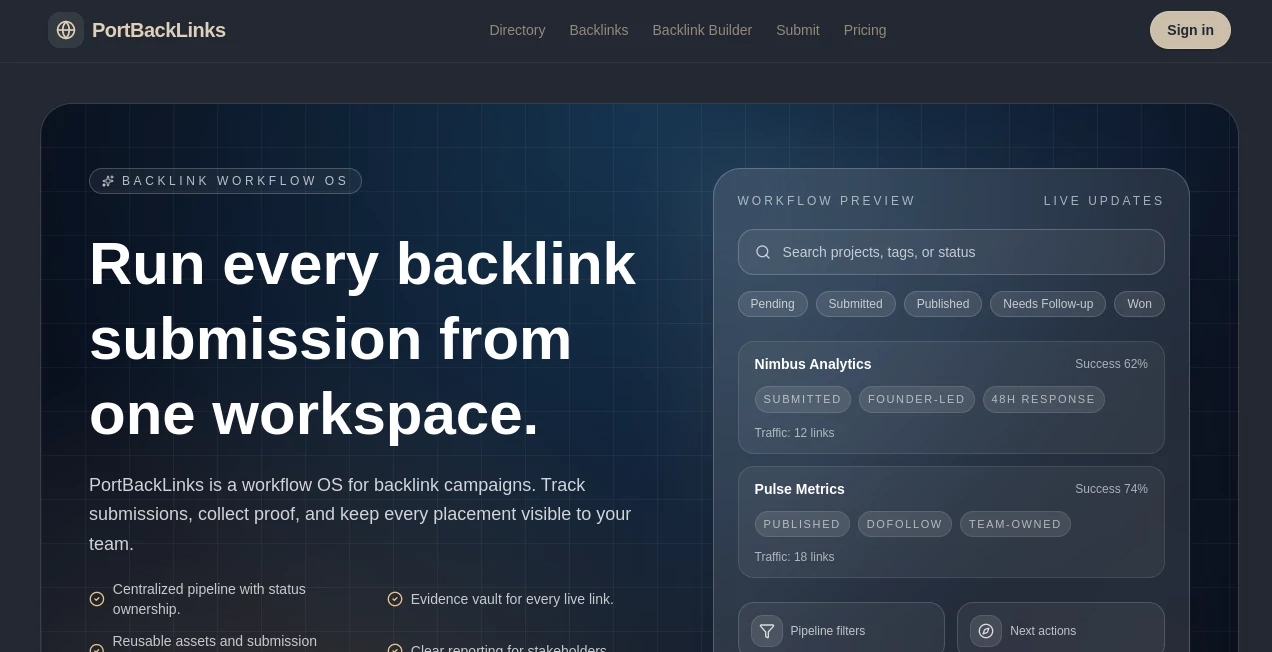
Running backlink campaigns can feel like herding cats—outreach emails vanish into inboxes, proofs get buried in shared drives, and suddenly you're scrambling to show progress to stakeholders. This workspace changes all that by pulling everything into one clean, focused spot where nothing slips through the cracks. It's the kind of tool you wish you'd had years ago when a single lost follow-up meant missing a solid link. Now, teams actually finish campaigns feeling organized instead of exhausted, and the difference in clarity is night and day.
Introduction
Backlinks still move the needle for SEO, but the process behind them is messy: scattered spreadsheets, endless email threads, screenshots floating in chats. This platform steps in as a dedicated operating system just for that workflow, giving every submission its own lane, owner, and timeline. What I love most is how it forces structure without feeling rigid—create a workspace for a guest post push, attach reusable assets like your media kit or pitch template, then watch the pipeline flow from intake to published with real visibility. Agencies and in-house SEO folks alike say it cuts down on "where did that link go?" moments and makes reporting a breeze. It's built for the reality of link building: follow-ups take time, proofs matter, and teams need to see wins as they happen.
Key Features
User Interface
The dashboard is refreshingly straightforward: workspaces on the left, pipeline in the center, and quick filters across the top so you can zoom in on "follow-up due" or "proof needed" without digging. Dragging submissions between stages feels natural, and the evidence vault pops up right next to each card—no hunting through folders. It's designed so even when you're juggling multiple campaigns, you never lose sight of the big picture or the next action.
Accuracy & Performance
Status updates are real-time and reliable—when someone marks a link live and uploads proof, the whole team sees it instantly. No more outdated spreadsheets or "did that publish?" emails. The average time-to-publish sits around 4 days in active projects, with reply rates hovering near 40%, numbers that reflect a system built to keep momentum instead of letting it stall. It doesn't guess or automate outreach, but it makes sure every manual step is tracked perfectly.
Capabilities
You can run entire campaigns end-to-end: set goals, attach reusable assets (descriptions, logos, templates), assign owners, schedule follow-ups, collect proof (URL + screenshot + notes), and tag everything for easy filtering. Reporting pulls live links and progress metrics in seconds, perfect for client updates. It's especially strong for teams—everyone sees the same pipeline, so handoffs are smooth and accountability is clear without micromanaging.
Security & Privacy
Since you're dealing with outreach details, client assets, and sometimes sensitive pitches, the platform keeps things locked down with workspace-level access and no unnecessary data sharing. Proofs and notes stay contained, and you control who sees what. It's quiet confidence in the background so you can focus on the links, not on worrying about leaks.
Use Cases
An agency handling guest posts for multiple clients creates a workspace per brand, assigns outreach to junior team members, tracks every follow-up, and shows the CMO only live links and metrics at review time. In-house SEO leads use it to run quarterly link pushes, reusing the same pitch templates while keeping proof organized for audits. Freelancers managing their own outreach love the simplicity—no more chaotic Google Sheets—and can show potential clients a professional pipeline snapshot. It's built for the long game in link building, where consistency and visibility win.
Pros and Cons
Pros:
- Centralized view eliminates "lost in email" chaos.
- Reusable assets and templates save hours on repetitive work.
- Proof vault makes reporting and audits effortless.
- Team-friendly without complicated permissions.
Cons:
- No built-in email sending or CRM integrations (yet)—it's workflow, not full automation.
- Best for structured campaigns; very casual outreach might feel overkill.
Pricing Plans
It keeps pricing straightforward and tied to what actually matters: number of active workspaces and team size. Plans scale from solo users to larger teams, with clear tiers that grow as your campaigns do. The value comes from how much time and frustration it saves once you're running multiple efforts—most users say it pays for itself quickly through better organization and fewer dropped opportunities.
How to Use PortBackLinks
Sign up, create your first workspace (name it after a campaign or client), set goals and upload any reusable assets like pitch templates or logos. Add submissions one by one—paste the target URL, assign an owner, set due dates. Move each card through the pipeline as you send emails, follow up, get replies. When a link goes live, attach proof (screenshot + URL + notes) and mark it published. Use tags and filters to see what's due or stalled, and pull quick reports showing live links for your next meeting. It's intuitive once you do one campaign—the structure sticks with you.
Comparison with Similar Tools
Spreadsheets and Trello boards work until they don't—too manual, no proof storage, easy to lose track. Full outreach platforms often add email automation but feel bloated and expensive for pure workflow needs. This sits in a sweet spot: focused on backlink tracking and evidence without unnecessary extras, so it's lighter and more affordable while still giving teams the visibility and organization they crave. It's less about blasting emails and more about finishing what you start.
Conclusion
Link building is still one of the most effective ways to grow authority, but only if the process doesn't fall apart halfway through. This workspace quietly solves that problem, turning scattered efforts into something reliable and reportable. It's the difference between hoping links land and knowing exactly where every one stands. For anyone serious about consistent, trackable backlinks—whether solo or in a team—this is the kind of tool that becomes invisible because it just works so well.
Frequently Asked Questions (FAQ)
Do I need to connect my email?
No—it's purely workflow and tracking, not an email sender.
Can multiple people work on the same campaign?
Yes, workspaces support team access with clear ownership.
How do I store proof?
Upload screenshots and URLs directly into each submission's evidence vault.
Is there a free trial?
Most users start small and scale—check the site for current offers.
What if I have lots of campaigns?
Workspaces keep everything separated and organized, no matter the volume.
AI Research Tool , AI Analytics Assistant , AI SEO Assistant .
These classifications represent its core capabilities and areas of application. For related tools, explore the linked categories above.
PortBackLinks details
Pricing
- Free
Apps
- Web Tools
Categories

PortBackLinks Alternatives Product

TrueSource AI

ChatFlowchart

Sourcetable

RankPeak

Chrome Sidek…

SuperAI

Prelight

Liftburst

Greek Numero…