🧠 AI Quiz
Think you really understand Artificial Intelligence?
Test yourself and see how well you know the world of AI.
Answer AI-related questions, compete with other users, and prove that
you’re among the best when it comes to AI knowledge.
Reach the top of our leaderboard.


















Persona
Build Lifelike AI Personas in Minutes

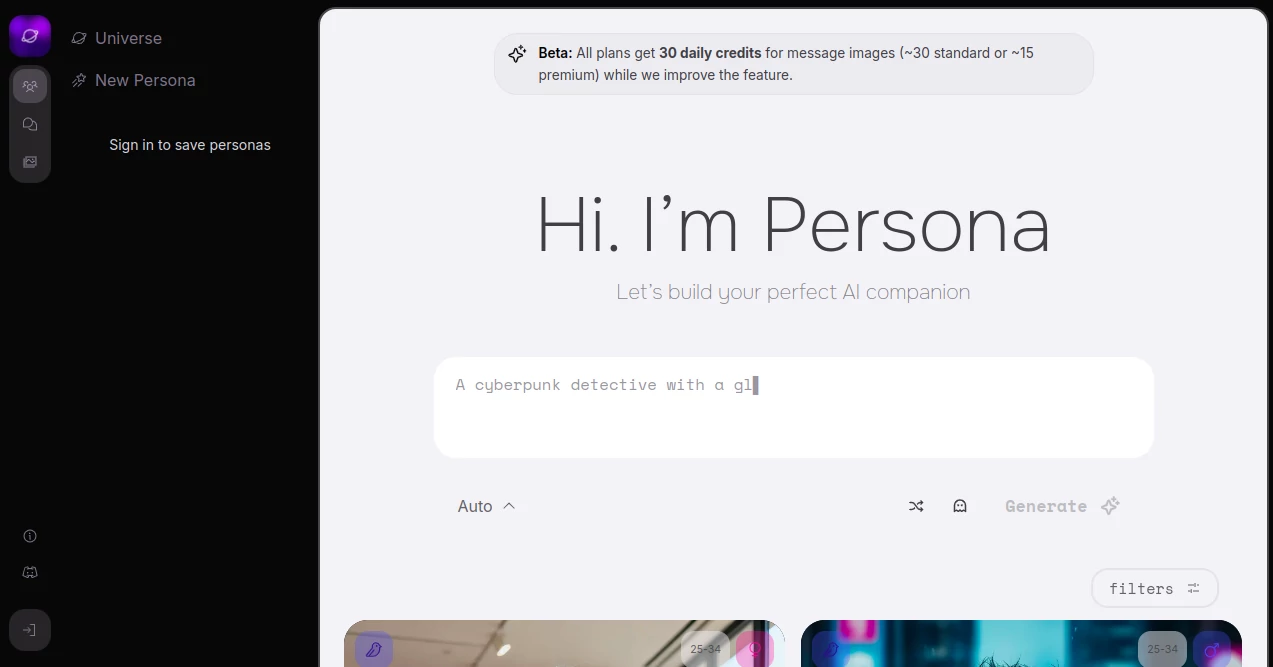
What is Persona?
Prsna slips into the world of character crafting like a well-worn sketchbook, letting writers and game makers breathe soul into digital figures with just a handful of prompts. Think of it as that quiet corner in a coffee shop where ideas take shape—feed it a backstory or quirk, and out comes a persona ready to chat, react, and evolve in your stories or simulations. It's the tool that's quietly revolutionizing how creators populate their universes, one nuanced trait at a time.
Introduction
Prsna bubbled up from late-night sessions among a band of indie devs and novelists who craved more than flat archetypes for their tales. They launched it a year or so back, fine-tuning it through beta runs that echoed with feedback from folks knee-deep in world-building. What kicked off as a simple trait generator has swelled into a hub where over a thousand creators have spun out characters that feel plucked from real life, complete with hidden motives and offbeat habits. It's that rare find that doesn't just spit out templates but listens to your vision, tweaking until the figure on the page—or screen—feels like an old friend you just met.
Key Features
User Interface
The landing page unfolds like an open journal, with a central prompt field that invites your first scribble without any gatekeeping forms. As you build, side panels bloom with trait cards you can drag and drop, each one expanding to reveal dialogue samples or mood shifts in a clean, breathable layout. No overwhelming dashboards here—it's all fluid, like chatting with a collaborator who anticipates your next question, keeping the focus on the spark rather than the setup.
Accuracy & Performance
It latches onto the subtlest cues in your description, crafting responses that ring true to the persona's core without veering into caricature territory. Builds happen in a snap, layering depth in seconds that would take hours of manual jotting, and it holds steady even when stacking complex histories. Creators nod to how it captures those fleeting inconsistencies—like a hero's hidden fear—that add the grit, making every interaction feel earned rather than engineered.
Capabilities
From fleshing out a sly merchant with bartering quips to evolving a sidekick through branching scenarios, it handles the full arc of character life. Mix in visuals for profile sketches or export dialogues for script drops, and it even simulates group dynamics to test how your cast bounces off each other. It's versatile enough for quick cameos or deep-dive protagonists, turning a vague outline into a breathing entity ready for your next chapter or cutscene.
Security & Privacy
Your character blueprints stay sealed in personal vaults, processed on the fly without lingering in shared pools, giving you the reins on who peeks or pulls from your library. It skips the usual data harvest, wiping session traces after you're done, so you can pour in those raw, unpolished ideas without a second thought. That peace lets wild experiments thrive, knowing the oddball traits you dream up at midnight remain just yours.
Use Cases
Novelists seed ensembles for sprawling epics, testing tensions between rivals before committing to print. Game designers populate quests with NPCs that remember player choices, adding replay hooks without scripting marathons. Role-players craft alter egos for online realms, complete with backstories that unfold naturally in chats. Even marketers mock up brand voices, ensuring every tweet or tagline lands with the right flavor of wit or warmth.
Pros and Cons
Pros:
- Transforms bare bones into rich profiles faster than a coffee break.
- Captures nuances that keep characters from feeling like cardboard cutouts.
- Exports clean for seamless jumps into docs or dev tools.
- Encourages bold risks with a safety net of easy revisions.
Cons:
- Best with vivid starters; skimpy inputs might need a nudge for depth.
- Advanced ensemble sims tease in higher tiers for casual users.
- Occasional odd phrasing calls for a quick human polish.
Pricing Plans
Start free with a daily handful of builds, enough to prototype a cast without dipping in. Core access runs about eight bucks monthly for unlimited solos and basic shares, stepping to twenty for group dynamics and priority queues. Yearly bundles trim the edge, and a no-risk week lets you roam the full garden before picking a plot.
How to Use Prsna
Drop into the prompt spot with your core idea—like "wary inventor from a dusty town"—and let it sketch the basics. Layer on quirks or conflicts via the add buttons, preview chats to test the voice, then refine with targeted tweaks. Save the full sheet for your files or share a link for collab input, building out your roster one lively soul at a time.
Comparison with Similar Tools
Where plot generators chase big arcs, Prsna hones in on the hearts that drive them, though those might suit outline obsessives better. Against broad chat builders, it carves deeper into persona permanence, skipping fleeting talks for lasting blueprints. It strikes gold for storytellers who want quick depth over endless tweaks, blending speed with substance in a crowded craft space.
Conclusion
Prsna quiets the chaos of creation, offering a steady hand to shape souls that linger long after the page turns. It reminds us that the best stories start with people—flawed, funny, unforgettable ones—and hands the tools to make them real. As worlds keep expanding, this quiet companion keeps pace, turning whispers of "what if" into choruses of characters that echo forever.
Frequently Asked Questions (FAQ)
Can I start with just a name or vibe?
Yep, it fleshes from fragments, though richer seeds yield sharper souls.
Does it handle fantasy or sci-fi twists?
From elves to androids, it adapts to any realm you roam.
How do I share my creations?
Export as sheets or links, with controls for view or edit access.
Is there a limit on complexity?
Stacks layers deep, from simple sketches to tangled histories.
What if the tone feels off?
Refine with follow-up prompts—it learns your nudge for next time.
AI Story Writing , AI Creative Writing , AI Chatbot , AI Character .
These classifications represent its core capabilities and areas of application. For related tools, explore the linked categories above.
Persona details
This tool is no longer available on submitaitools.org; find alternatives on Alternative to Persona.
Pricing
- Free
Apps
- Web Tools
Categories

Persona Alternatives Product

ChatGot

eesel AI

Gochu

Blushly Chat

The StoryGra…

Banana Promp…

Chatref

Grok

Genstory