🧠 AI Quiz
Think you really understand Artificial Intelligence?
Test yourself and see how well you know the world of AI.
Answer AI-related questions, compete with other users, and prove that
you’re among the best when it comes to AI knowledge.
Reach the top of our leaderboard.


















SciScoper
Your AI Ally in Academic Deep Dives

What is SciScoper?
SciScoper slips into the grind of scholarly pursuits like a trusted notebook that thinks ahead, pulling apart dense stacks of studies to spotlight what's truly moving the needle in your field. Researchers lean on it to sift through the fog of findings, piecing together threads that might otherwise slip by unnoticed. It's that quiet boost in the late hours, turning mountains of print into maps that point straight to the next big question, and folks who've waded through it swear it shaved weeks off their timelines without skimping on the rigor.
Introduction
SciScoper took shape a few years back when a handful of grad students and profs hit the wall of endless scrolling through databases, craving a way to cut deeper without losing the plot. What kicked off as a weekend tweak to handle their own lit hunts grew legs fast, drawing in a crowd of lab coats and thesis warriors who needed more than keyword hits. These days, it's a steady hand for those knee-deep in peer-reviewed piles, blending sharp scans with thoughtful ties that echo the slow burn of real inquiry. Users swap nods over how it catches those elusive gaps, like a fresh angle on old data that sparks a whole new line of chasing, proving it's less a shortcut and more a sharper lens on the work that already lights them up.
Key Features
User Interface
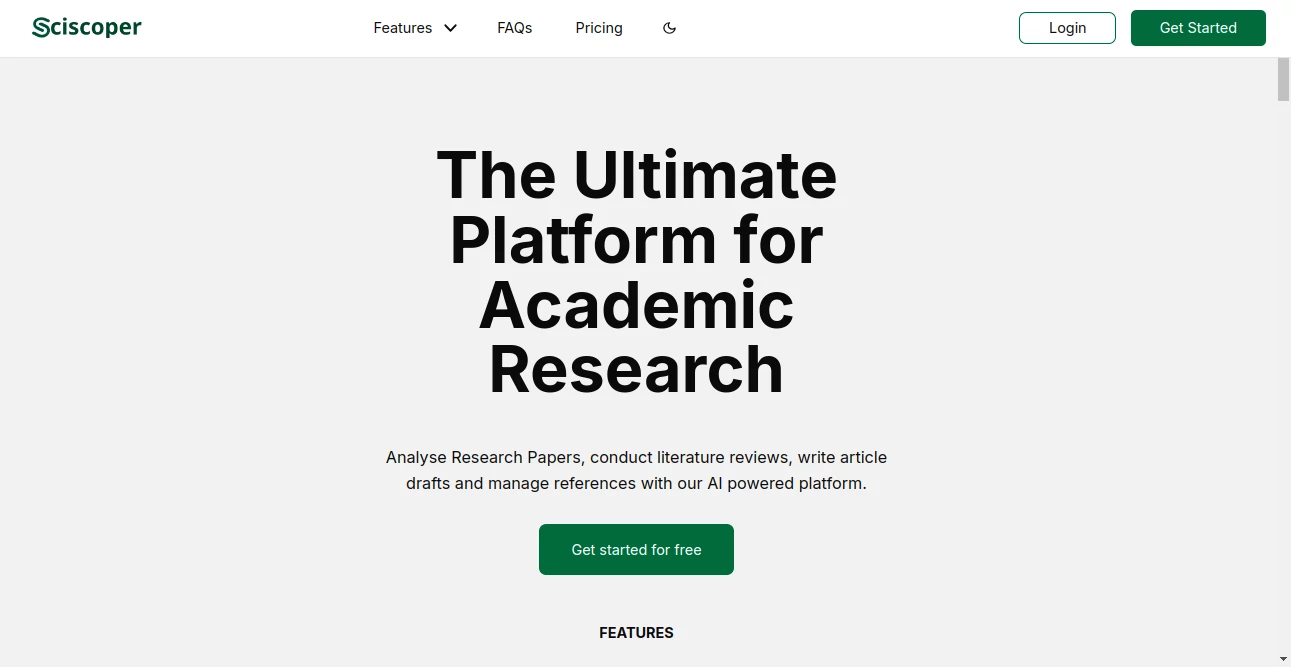
The landing page eases you in with a clean sweep of options, from dropping files to firing off queries, all laid out like a well-thumbed journal—no flashy distractions, just spots that invite your next move. Side-by-side views unfold as you add pieces, with tables that line up thoughts neatly and chats that pop open smooth for back-and-forth with your uploads. It's the kind of setup that feels familiar after a few pokes, letting you stack workbooks or hunt across vast troves without the screen turning into a puzzle.
Accuracy & Performance
It latches onto the meat of studies with a steady grip, drawing out nuances in approaches and outcomes that hold water under close looks, often mirroring the precision of a sharp-eyed reviewer. Even when tackling hefty batches, it keeps pace without faltering, churning through clusters in moments to hand back overviews that ring true. Scholars note how it guards the fine points, like a tricky equation or a subtle trend, ensuring the wrap-ups don't wander off course but stay anchored in the source material.
Capabilities
SciScoper stretches from teasing apart paired papers to weaving broad sweeps of readings into flowing narratives, complete with nods to the origins that keep things grounded. You can quiz uploads in plain talk to pull specifics, condense cores while holding onto vital bits like charts or steps, or roam semantic trails to unearth fits beyond surface matches. It even tends to your source lists, tagging and pulling details to slip right into drafts, covering the loop from hunt to polish with exports that play nice across tools.
Security & Privacy
Your uploads and notes rest under standard wraps, processed on the spot and cleared out once the job's done, with no trails left for outsiders to follow. It sticks to common guards on access, letting you gatekeep folders or shares as needed, so the quiet hours of pondering stay just that—yours alone. The setup earns quiet trust from those handling sensitive early ideas, knowing the backend keeps watch without prying into the process.
Use Cases
Grad folks stack recent runs on a hot topic, letting it flag drifts in takes to sharpen their angle for the next grant pitch. Profs blend old stacks into fresh overviews for class packs, pulling themes that tie loose ends without rewriting from scratch. Lab teams query fresh drops to spot methods worth borrowing, while lone wolves chase semantic leads to build cases that stand out in crowded journals.
Pros and Cons
Pros:
- Unpacks batches with a keen eye, surfacing ties that save deep reads.
- Builds tidy overviews that flow natural, citations and all.
- Scales from quick peeks to full hauls, fitting solo or squad paces.
Cons:
- Caps on free spins might nudge heavy haulers to step up early.
- Best on clear uploads; fuzzy scans could use a clean pass first.
- Semantic roams shine in English troves, other tongues lag a bit.
Pricing Plans
You ease in with a no-cost stretch that covers basics like a dozen file drops and a handful of hunts, giving a full month to roam without a hitch. The mid step at fifteen a month opens wider gates for steady stacks and endless queries, while the top at fifty handles unlimited waves for those in the thick of it. Yearly wraps trim the tally, and you can slip away anytime, keeping the fit flexible as your workflow shifts.
How to Use SciScoper
Start by slipping in a link or file to your stack, letting it chew through to lay out the bones. Pick pairs to pit against each other, or flood it with a theme to watch clusters form, then quiz away for the bits that bite. Tweak the pulls into a draft with one nudge, snag the nods for your list, and export to your corner—be it a fresh page or shared sheet. Circle back as piles grow, building books that track the trail over time.
Comparison with Similar Tools
Where plain searchers toss lists without the weave, SciScoper knots them into stories that breathe, though those might nip quicker for bare keyword chases. Against broad note keepers, it zeros on scholarly slices with deeper digs, skipping the fluff but perhaps missing wide-file hugs. It edges for those chasing academic arcs, blending hunt and craft where others halt at the first gate.
Conclusion
SciScoper stands as a thoughtful thread in the tapestry of tough inquiries, lifting the load so minds can wander freer toward what matters. It turns the tide of tangled texts into trails that lead true, fostering finds that fuel real leaps in knowing. As fields keep unfolding, this quiet partner keeps pace, inviting scholars to probe bolder with a nudge that feels like second nature.
Frequently Asked Questions (FAQ)
What counts as a workbook?
A spot to group your pulls and chats, like a project folder for one chase.
Can it handle non-English works?
It leans heavy on English stacks, but pokes at others with growing reach.
How do exports work?
Snags clean to pages or lists, ready for your next draft or share.
Is there a cap on file heft?
Plans set limits, but most handle the usual journal drops without a sweat.
What if I hit a snag?
Drop a line to the crew—they're quick on the draw for tweaks or tips.
AI Summarizer , AI Research Tool , AI Knowledge Management .
These classifications represent its core capabilities and areas of application. For related tools, explore the linked categories above.
SciScoper details
This tool is no longer available on submitaitools.org; find alternatives on Alternative to SciScoper.
Pricing
- Free
Apps
- Web Tools
Categories

SciScoper Alternatives Product

SciSpace

Yorph AI

IntoTheBlock

GLM 5

AlphaTax

Keepmind

Humanize AI …

PDFgear

Domain Rank …