
🧠 AI Quiz
Think you really understand Artificial Intelligence?
Test yourself and see how well you know the world of AI.
Answer AI-related questions, compete with other users, and prove that
you’re among the best when it comes to AI knowledge.
Reach the top of our leaderboard.


















seedream video
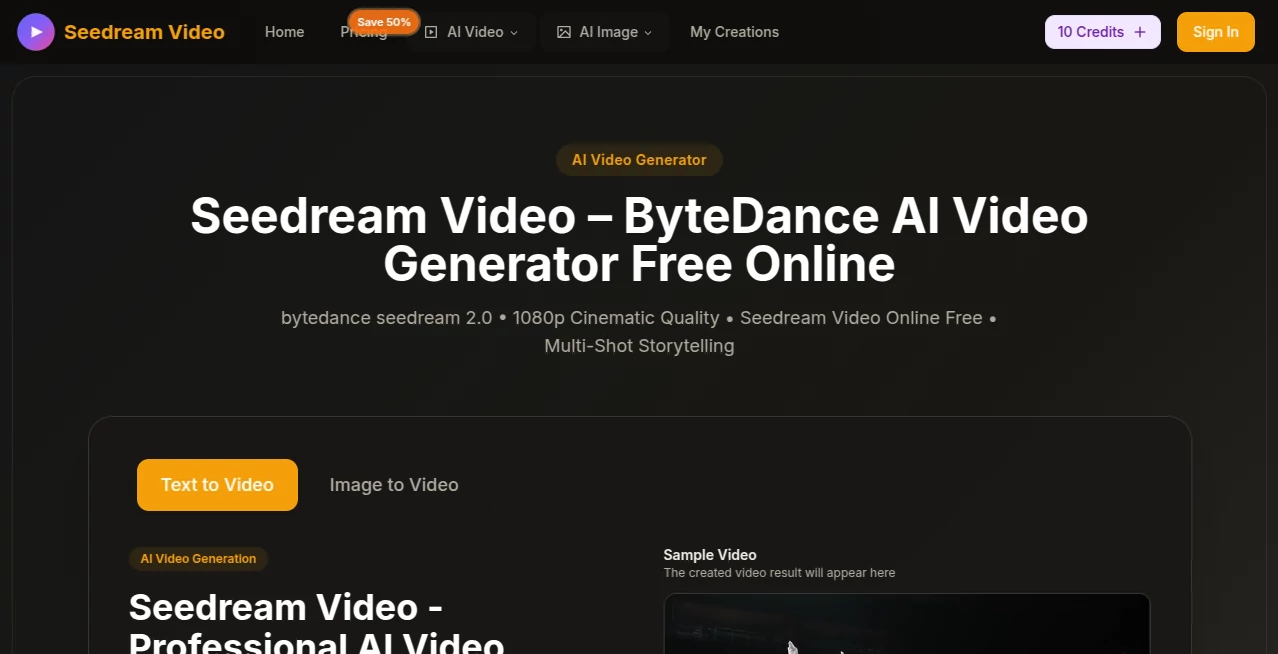
What is seedream video?
Write one sentence. Hit enter. Thirty seconds later a short film plays—lighting that feels golden-hour real, camera moves that have purpose, characters whose expressions shift naturally. It’s the kind of clip that makes you pause and re-watch because it doesn’t look “AI-generated” in the usual sense. I’ve shown these to video editors who normally scoff at text-to-video tools; their silence after watching is the best compliment. This isn’t about flashy effects—it’s about quiet storytelling that actually lands.
Introduction
Most AI video generators still feel like proof-of-concept demos: jerky cuts, drifting faces, lighting that forgets where the sun is. This one arrived with a different ambition. It treats every prompt like a short-film brief and tries to honor it with cinematic grammar—motivated camera, emotional continuity, believable physics. Early users started posting side-by-sides of their prompt vs the result and the gap was startling: what they typed became something that felt directed, not computed. For creators who think in scenes rather than frames, that difference is addictive. It turns “I have an idea” into “here’s the proof of concept” faster than anything else right now.
Key Features
User Interface
One wide prompt box. Optional image upload below it. A couple of sliders for aspect ratio and duration. One big generate button. That’s it. No nested menus, no twenty parameters to tune. Previews appear quickly enough that you stay in creative flow instead of waiting. It’s deliberately minimal so your attention stays on the story you’re telling, not on wrestling software. Beginners finish their first clip in under a minute; experienced users appreciate how little stands between idea and output.
Accuracy & Performance
Character identity holds across shots and lighting changes—same face, same wardrobe, same emotional tone. Motion follows real-world rules: hair catches wind, fabric drapes naturally, hands don’t morph. Generation times sit comfortably in the 20–60 second range for most clips, even on moderately complex prompts. When it does misfire, the error is usually traceable to ambiguous wording rather than random hallucination. That predictability lets you iterate with purpose instead of gambling on chaos.
Capabilities
Text-to-video, image-to-video, hybrid mode (prompt + reference image), multi-shot narrative flow, cinematic camera language (push-ins, gentle pans, motivated zooms), native audio sync for music or dialogue, multiple aspect ratios, and strong handling of emotional close-ups, dialogue scenes, product reveals, and stylized looks. It keeps visual and character continuity across cuts better than most—something many models still struggle with even on paid tiers. The cinematic choices give clips a directed feel rather than algorithmic drift.
Security & Privacy
Inputs are processed ephemerally—nothing stored long-term unless you save the output. No mandatory account for basic use, no sneaky model training on user content. For creators working with client mockups, personal stories, or brand-sensitive ideas, that clean boundary provides real peace of mind.
Use Cases
A boutique coffee brand turns a single product photo into an 8-second pour-over scene that feels like a real ad and outperforms their last live shoot. A musician drops a song lyric into the prompt and gets a visualizer that actually matches the track’s emotional arc. A short-form creator builds a consistent character universe for daily Reels without daily filming. A filmmaker sketches pivotal emotional beats to test tone before committing to full production. The common thread is speed plus quality—getting something watchable, shareable, and emotionally resonant without weeks of work.
Pros and Cons
Pros:
- Outstanding character and style consistency across shots—rare at this level.
- Cinematic camera and lighting decisions that feel thoughtful, not random.
- Hybrid image+text mode gives precise creative steering.
- Generation speed that supports real iteration instead of long waits.
Cons:
- Clip length caps at around 5–10 seconds (multi-shot workflows extend storytelling).
- Extremely abstract or contradictory prompts can still confuse it.
- Higher resolutions and priority queues require paid access.
Pricing Plans
Generous free daily credits let anyone test the quality without commitment. Paid plans unlock higher resolutions, longer clips, faster queues, and unlimited generations. Pricing feels fair for the leap in output fidelity—many creators say one month covers what they used to spend on freelance editors or stock footage for a single campaign.
How to Use Seedance 2 Video
Open the generator, write a concise scene description (“golden-hour rooftop, young woman in red dress dances slowly, camera circles gently”). Optionally upload a reference image for stronger visual grounding. Choose aspect ratio (vertical for social, horizontal for trailers) and duration. Hit generate. Watch the preview—tweak wording or reference strength if needed—then download or create variations. For longer narratives, generate individual shots and stitch in your editor. The loop is fast enough to refine several versions in one sitting.
Comparison with Similar Tools
Many competitors still show visible drift, uncanny faces, or lighting mismatches between frames. This one prioritizes narrative flow and cinematic intent, often delivering clips that feel closer to human-directed work. The hybrid input mode stands out—letting you steer with text and images together gives more director-like control than most alternatives offer.
Conclusion
Video is still the most demanding creative medium—until tools like this quietly lower the bar. They don’t erase the need for taste or vision; they amplify both. When the distance between an idea in your head and a watchable clip shrinks to minutes, storytelling becomes more accessible and more frequent. For anyone who thinks in motion, that’s a quiet revolution worth experiencing.
Frequently Asked Questions (FAQ)
How long can clips be?
Typically 5–10 seconds per generation; longer stories come from combining multiple connected shots.
Is a reference image required?
No—text-only works well—but adding one dramatically improves consistency.
What resolutions are available?
Up to 1080p on paid plans; free tier offers preview-quality.
Can I use outputs commercially?
Yes—paid plans include full commercial rights.
Watermark on free generations?
Small watermark on free clips; paid removes it completely.
AI Animated Video , AI Image to Video , AI Text to Video , AI Video Generator .
These classifications represent its core capabilities and areas of application. For related tools, explore the linked categories above.
seedream video details
Pricing
- Free
Apps
- Web Tools
Categories

seedream video Alternatives Product

seedream 5

Veo 3.2

Seedance 2.0…

Seedance 2.0…

VidiOne

Kling 3.0 – …

Sora 2 AI

VO4 AI

Seedance 2.0