
🧠 AI Quiz
Think you really understand Artificial Intelligence?
Test yourself and see how well you know the world of AI.
Answer AI-related questions, compete with other users, and prove that
you’re among the best when it comes to AI knowledge.
Reach the top of our leaderboard.


















Snow day Calculator
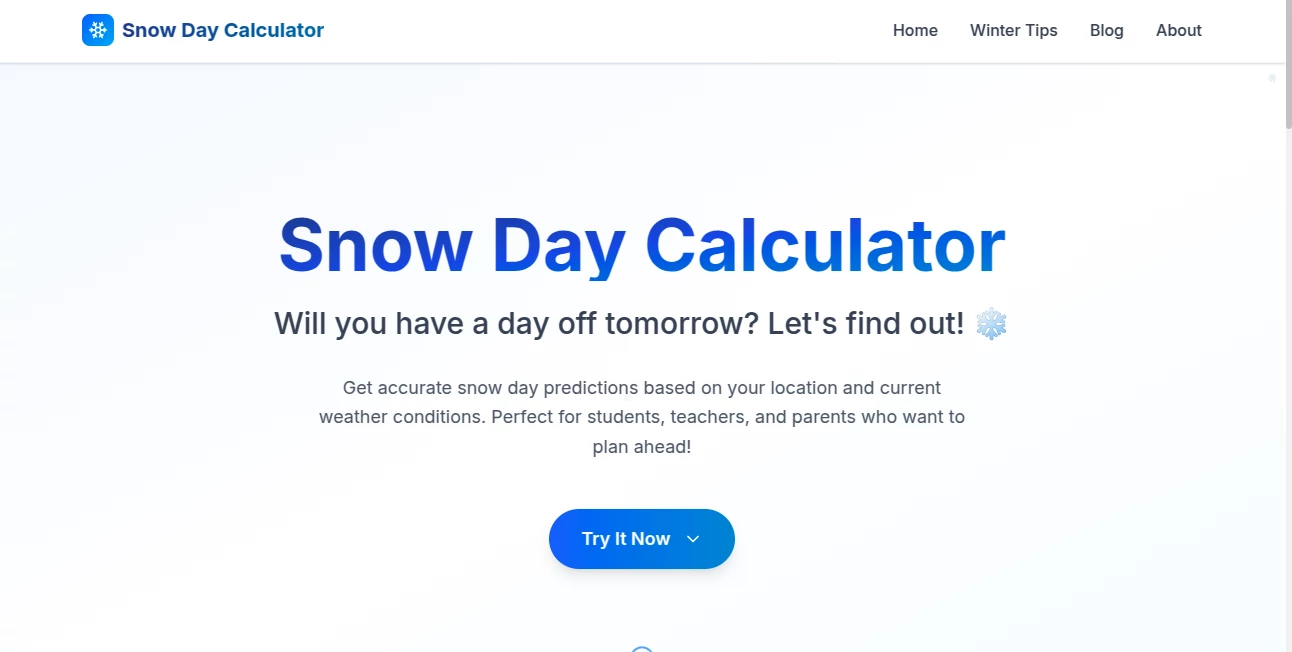
What is Snow day Calculator?
There’s nothing quite like the quiet thrill of waking up to a world blanketed in white and realizing school might be canceled. This little site turns that childhood hope into something you can actually plan around. You put in your school district or zip code, and it crunches the latest weather data, school policies, and historical patterns to give you a real probability—sometimes down to the hour—of whether tomorrow will be a snow day. I’ve seen parents who used to stay up refreshing district websites now just check this once in the evening and sleep better. It’s simple, surprisingly accurate, and honestly kind of magical for anyone who still gets a little excited about a day off.
Introduction
School districts don’t always make snow day calls easy to predict. One year it’s three inches and everything shuts down; the next it’s six and buses still run. This tool steps in with a calm, data-driven answer when everyone else is guessing. It pulls real-time forecasts, layers in local road conditions, temperature trends, and even how different districts have called it in the past under similar weather. The result isn’t just “maybe”—it’s a percentage chance, updated frequently, that feels trustworthy. Parents, teachers, students, even commuters use it to plan ahead instead of waiting for the 5 a.m. robo-call. In a world of uncertainty, having one clear number to lean on before bed is surprisingly comforting.
Key Features
User Interface
It couldn’t be simpler: type your city, school name, or zip code into one clean search box. Results load instantly—big, readable percentage at the top, hourly breakdown below, and a short explanation of why the chance is what it is. No ads crowding the screen, no forced sign-ups. You can bookmark your district for one-tap checks later. It’s the kind of design that respects your time when you’re already stressed about tomorrow’s commute or kids’ schedule.
Accuracy & Performance
The forecast pulls from multiple high-quality weather sources and adjusts in real time as new data arrives. Historical call patterns for thousands of districts are baked in, so it knows that some places close at a trace while others need a foot. Updates happen automatically every few hours (or faster during storms), so the number you see at 10 p.m. usually holds through morning unless conditions change dramatically. Users consistently say it’s more reliable than waiting for official announcements—often nailing the call before the district even meets.
Capabilities
Beyond the headline probability, you get an hourly forecast view, wind chill and ice risk breakdowns, and notes on specific factors (e.g., “roads expected to refreeze overnight”). It covers public schools, private schools, and some colleges across the U.S. and Canada. You can compare nearby districts side-by-side and see how micro-climate differences play out. During big storms it even shows trending call patterns from similar past events. It’s a surprisingly deep tool wrapped in a very simple package.
Security & Privacy
No account needed, no personal data collected beyond your search query (which isn’t stored long-term). It’s just you asking a question and getting an answer—nothing tracked, nothing sold. In an era where every site wants your email, that clean approach feels refreshing and trustworthy.
Use Cases
A parent in the Midwest checks at 9 p.m. and sees an 85% chance—decides to let the kids stay up a bit later knowing sleep won’t be ruined by a 5 a.m. alarm. A teacher in New England uses it to plan whether to prep remote lessons or bring home grading. A high-school senior in the South (where snow days are rare) tracks the forecast obsessively and celebrates when the percentage finally ticks above 50%. Commuters in northern cities glance at it before deciding whether to risk the drive. It’s become a small but meaningful part of winter decision-making for a lot of people.
Pros and Cons
Pros:
- Dead-simple to use—no registration, instant results.
- Surprisingly accurate thanks to district-specific history and real-time updates.
- Hourly breakdowns and explanations make the number feel earned, not random.
- Covers thousands of districts across two countries—huge reach.
- Completely free, no ads, no upsell pressure.
Cons:
- Very rural or tiny districts sometimes lack full historical data (though still pulls strong forecast).
- Can’t override district policy quirks (e.g., a school that never closes no matter what).
- No push notifications (you have to check manually).
Pricing Plans
It’s completely free. No premium tier, no hidden costs, no ads interrupting your check. The creators seem to run it as a public service—probably because they remember being kids waiting for snow days themselves. That generosity makes the whole experience feel even better.
How to Use Snow Day Calculator
Type your school name, district, or zip code into the search bar at the top. Hit enter. The main probability shows immediately, with a short reasoning paragraph. Scroll down for the hourly forecast, wind chill details, and any special notes (like “buses delayed last time under similar conditions”). Check back in the evening or early morning for updates as new forecast data arrives. Bookmark the page for your school so it’s one tap next time. That’s literally it—fast, clean, useful.
Comparison with Similar Tools
Most snow day predictors are either basic weather apps that guess based on accumulation alone or district-specific sites that only post after the decision’s made. This one combines real forecast data with historical call patterns and does it nationwide (plus Canada), giving a much clearer picture before the official word. It’s less about telling you what will happen and more about helping you understand what’s likely—way more useful than waiting for the 6 a.m. text.
Conclusion
Winter weather decisions shouldn’t be stressful. This tool takes the guesswork out of one of the most anticipated calls of the year and does it with clarity and care. It’s free, fast, accurate, and feels like it was made by someone who still remembers how exciting a snow day announcement can be. Whether you’re a parent hoping for a cozy day in, a teacher planning lessons, or just someone who likes knowing what tomorrow might bring—this quiet little site makes waiting for snow a lot more enjoyable.
Frequently Asked Questions (FAQ)
How accurate is the percentage?
It’s a probability based on forecast + historical behavior, not a guarantee—but users say it’s often spot-on or very close.
Does it cover private schools?
Yes, many private and charter schools are included, especially larger ones with public call history.
Why does my district sometimes go against the prediction?
Local factors (road crews, parent concerns, politics) can override weather data. The tool shows trends, not final decisions.
Can I get alerts?
Not yet—you have to check manually, but many people just bookmark it and glance in the evening.
Is it only for the U.S.?
Primarily U.S., but it covers many Canadian districts too, especially in snowy provinces.
AI Life Assistant , AI Fun Tools .
These classifications represent its core capabilities and areas of application. For related tools, explore the linked categories above.
Snow day Calculator details
Pricing
- Free
Apps
- Web Tools
Categories

Snow day Calculator Alternatives Product

ZenMako

Ablaze AI

Lexikon AI

MemoTune

Pixel Flow L…

Dialogues wi…

Kitchendary

Kirkify

Caricature A…