
🧠 AI Quiz
Think you really understand Artificial Intelligence?
Test yourself and see how well you know the world of AI.
Answer AI-related questions, compete with other users, and prove that
you’re among the best when it comes to AI knowledge.
Reach the top of our leaderboard.

















Transcribe Audio to Text
What is Transcribe Audio to Text?
I still remember the first time I dragged a two-hour interview recording into a tool like this one. Within minutes the whole conversation was sitting there in clean, readable text—no more rewinding, no more guessing what someone mumbled at 3:17. That feeling of relief is exactly what this platform delivers every single time. It’s straightforward, surprisingly precise, and suddenly makes long audio feel manageable instead of overwhelming.
Introduction
There was a moment not long ago when transcribing meant either paying someone a small fortune or spending your entire weekend hunched over headphones with a foot pedal. This service quietly changes that equation. You upload your file—MP3, WAV, M4A, whatever—and it returns structured, timestamped text that actually makes sense. No forced punctuation weirdness, no random capital letters in the middle of sentences. What really stands out is how natural the output reads; it’s the kind of transcript you could hand to a client or paste into an article without spending another hour cleaning it up.
Key Features
User Interface
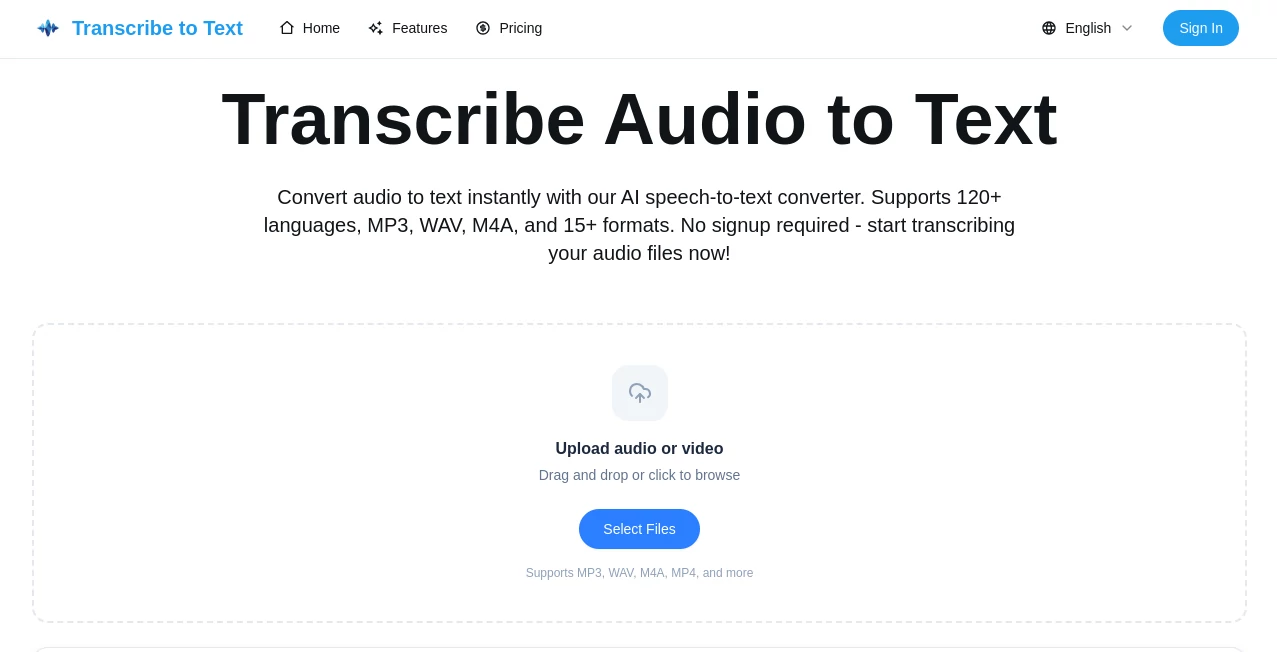
The page greets you with one big, friendly upload area. No account nagging on the first try, no ten-step wizard. Just drop the file or paste a YouTube link and watch the progress bar move. Once it’s done, the text appears in a clean editor with timestamps on the left and clickable jumps—super handy when you need to verify a quote. I’ve used it on my phone in a café and on a laptop at 2 a.m.; both experiences felt equally smooth.
Accuracy & Performance
It genuinely listens. Accented English, overlapping voices, background café chatter—it handles all of it better than most tools I’ve tried in the same price range. Numbers, names, and technical terms come through cleanly more often than not. Speed is impressive too; a 60-minute file usually finishes in under ten minutes. That quick turnaround means you can iterate—upload a revised cut, get fresh text, compare—without losing your afternoon.
Capabilities
Beyond basic transcription you get speaker labels (when it can tell who’s talking), searchable text, export to Word, SRT for subtitles, and even summarized key points if you want them. YouTube integration is a personal favorite: paste the link, let it pull the audio, and receive a full transcript plus timestamps. It supports a long list of languages and dialects, which opens the door for interviews, lectures, or podcasts recorded anywhere.
Security & Privacy
Your files are encrypted during upload and processing, and they’re deleted from the servers shortly after you download the result. No permanent storage unless you explicitly choose to save the job. For anyone working with sensitive interviews, client calls, or research material, that matters—a lot.
Use Cases
Journalists transcribe long-form interviews and jump straight to quotes without losing context. Podcasters turn raw episodes into show notes or blog posts in one pass. Students capture lectures and focus on understanding instead of frantic note-taking. Content creators pull key moments from YouTube videos for repurposing into threads or articles. Small businesses document client calls or team meetings so nothing important slips through the cracks. Every time I use it I think: this is one of those tools you don’t realize you needed until it’s already saving you hours.
Pros and Cons
Pros:
- Remarkably clean output that needs very little editing.
- Fast turnaround even on longer files.
- YouTube link support is a huge time-saver.
- Speaker detection and timestamps just work.
- Affordable pay-as-you-go model with generous free tier.
Cons:
- Very noisy or heavily accented audio can still trip it up (though far less than most competitors).
- Free tier has a monthly cap—fine for occasional use, less ideal for daily heavy lifting.
Pricing Plans
You get a solid free allowance every month—enough for several shorter files or one long one. After that it’s pay-per-minute with rates that stay reasonable even if you transcribe regularly. No subscriptions to forget about, just top up when you need more. For most people the free tier covers casual needs, and the paid minutes feel fairly priced for the quality you receive.
How to Use TranscribeToText
Go to the homepage, drag your audio file in or paste a YouTube URL. Choose the language (or let it auto-detect), tick speaker labels if you want them, then hit start. While it processes you can walk away; you’ll get an email when it’s ready. Open the result, read through, jump to any timestamp, make quick edits if needed, then export as .txt, .docx, .srt or copy straight to clipboard. I usually export to Word, do a five-minute proofread, and I’m done.
Comparison with Similar Tools
Plenty of transcription services exist, but very few combine this level of accuracy, speed, and clean formatting at such approachable pricing. Tools that charge by the hour often feel overpriced once you see how quickly this one finishes. Others force you into subscriptions or bury speaker detection behind expensive tiers. Here everything useful is either free or reasonably metered. That simplicity and reliability are what keep bringing me back.
Conclusion
Good transcription should disappear into the background and let your real work shine. This tool does exactly that—quietly excellent, surprisingly affordable, and consistently trustworthy. Whether you’re dealing with one important interview a month or churning through hours of content every week, it removes the friction so you can focus on the ideas instead of the typing. Give it a try with your next recording; I’m willing to bet you’ll wonder how you managed without it.
Frequently Asked Questions (FAQ)
How accurate is it with multiple speakers?
Very good in most cases—clear voices and reasonable audio quality give near-perfect speaker separation.
What file formats are supported?
MP3, WAV, M4A, OGG, FLAC, WMA, AAC and more—pretty much anything you’d encounter.
Can I transcribe YouTube videos directly?
Yes—just paste the link and it pulls the audio for you.
Is there a limit on file size or length?
Free tier has reasonable monthly quotas; paid usage is per minute with no hard cap on single files.
Do I need to create an account to try it?
You can upload and transcribe once without signing up; account unlocks history and higher quotas.
AI Transcription , AI Audio Enhancer , AI Speech to Text , AI Documents Assistant .
These classifications represent its core capabilities and areas of application. For related tools, explore the linked categories above.
Transcribe Audio to Text details
Pricing
- Free
Apps
- Web Tools
Categories

Transcribe Audio to Text Alternatives Product

AI ASMR Gene…

TurboScribe

SAM Audio

TO MD
Adobe Podcast

Read
TuCanChat

Transpocket

Klyra AI
