
🧠 AI Quiz
Think you really understand Artificial Intelligence?
Test yourself and see how well you know the world of AI.
Answer AI-related questions, compete with other users, and prove that
you’re among the best when it comes to AI knowledge.
Reach the top of our leaderboard.


















vei4 ai
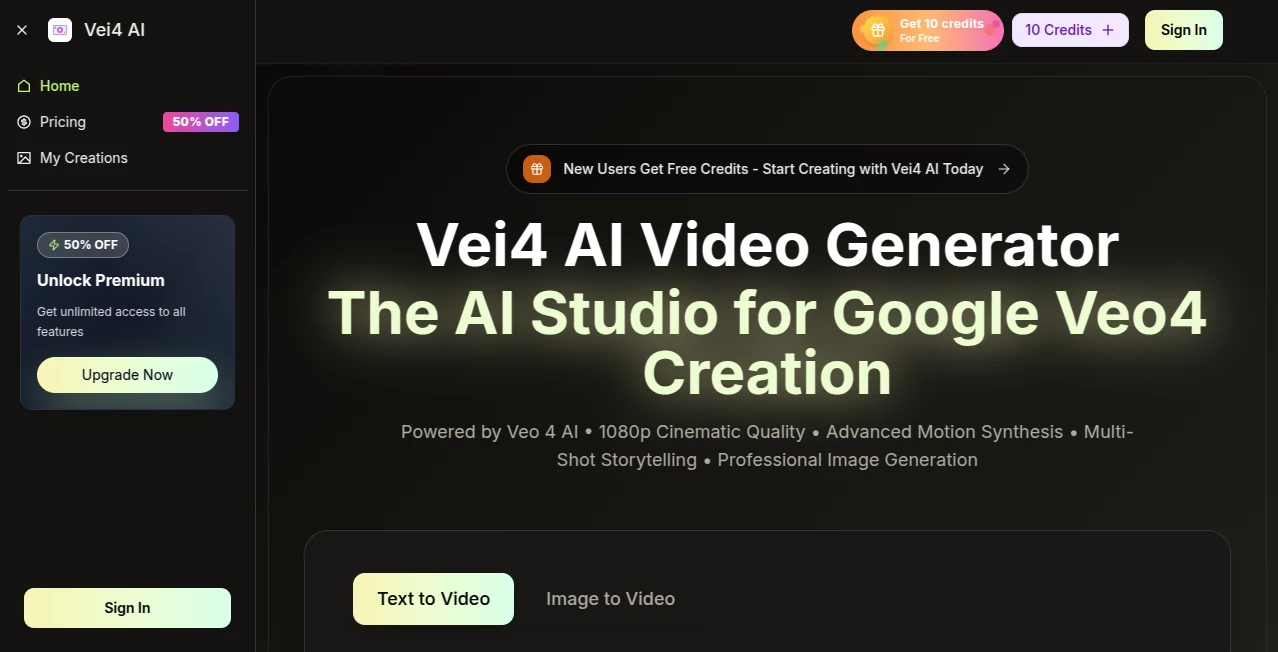
What is vei4 ai?
There's something quietly thrilling about typing a single sentence and watching a full cinematic scene unfold—smooth camera moves, perfect lighting, characters that actually feel alive. This tool does exactly that, and it does it with a kind of effortless elegance that still catches me off guard every time I use it. One afternoon I described a rainy Tokyo street at dusk with neon reflections on wet pavement, hit generate, and within a couple of minutes I had something that looked like it belonged in a high-budget short film. The first feeling wasn't even "wow"—it was more like "finally, someone made this simple."
Introduction
Video creation used to mean hours (or days) of editing, stock footage hunting, voice-over recording, color grading… the list goes on. This platform quietly removes almost every one of those steps without sacrificing quality. You write what you see in your head—or upload an image as a starting point—and it builds a short, cohesive clip that actually tells a story. No watermarks on paid generations, no forced style overlays, just clean, intentional motion and atmosphere. What started as a research-grade model has turned into one of the most approachable yet powerful video tools available right now, especially for creators who want cinematic results without learning an entirely new craft.
Key Features
User Interface
The moment you open the workspace it's almost disarmingly clean: one big prompt box, a few sensible sliders (duration, aspect ratio, motion strength), and an optional image upload area. No nested menus, no overwhelming sidebar. You type, you tweak, you press generate—done. Previews load quickly enough that you can iterate without losing momentum. I especially appreciate how the prompt history stays visible so you can revisit and remix earlier ideas without starting from scratch every time.
Accuracy & Performance
Consistency across shots is where it really shines. Characters keep the same face, outfit, and even subtle mannerisms from frame to frame. Lighting and color grade stay coherent even when the prompt describes changing time of day. Generations usually finish in under two minutes (often faster on paid tiers), and the output resolution holds up beautifully at 1080p or higher. In my own tests, even moderately complex prompts—multiple subjects interacting, specific camera language—rarely produced the weird artifacts that still plague many competitors.
Capabilities
Text-to-video, image-to-video, and hybrid modes are all handled gracefully. You can describe camera movement explicitly ("slow dolly in," "handheld tracking shot") and it actually listens. Motion is natural rather than robotic, faces stay recognizable across long takes, and the model understands basic physics so things don't float or glitch unnaturally. Multi-shot storytelling is possible by generating in segments and stitching later. The stylistic range is wide—realistic, painterly, anime-inspired, retro film grain—all without feeling forced.
Security & Privacy
Uploads are processed and then immediately discarded from their servers after generation (unless you explicitly save the project). No training on user content happens by default. For creators working on client projects or personal stories, that level of discretion matters a lot. Paid plans add private mode so even your public gallery stays hidden if you prefer.
Use Cases
A small marketing agency creates weekly product teasers by uploading hero shots and describing the desired mood—saves them thousands in freelance video budgets. An indie musician visualizes lyrics with cinematic scenes that match the emotional arc of the track. A novelist mocks up book-trailer sequences to pitch to publishers. Content creators batch short-form hooks for TikTok/Reels/YouTube Shorts in an afternoon instead of a week. The common thread: people who have strong visual ideas but no time or team to execute them traditionally.
Pros and Cons
Pros:
- Exceptional motion quality and character consistency for the current generation of models
- Very fast turnaround even on detailed prompts
- Clear, natural camera language understanding
- No forced style filters—you control the aesthetic
- Generous free tier with meaningful daily quota
Cons:
- Longer than ~8–10 seconds still requires segmenting and manual stitching
- Occasionally over-smooths very fast action (though this is improving rapidly)
- Free tier includes watermark (removable on paid)
Pricing Plans
The free plan gives you enough daily generations to seriously test-drive the tool—more generous than most competitors at launch. Paid tiers unlock watermark-free output, higher resolutions, faster queue priority, and significantly more monthly credits. Pricing feels fair for the quality; many users report the basic paid plan pays for itself after just one client project or content batch. Annual billing saves a noticeable chunk if you're planning to use it regularly.
How to Use VEI4
Sign up (takes seconds), head to the generator page. Write a descriptive prompt—be as specific as you like about shot type, lighting, mood, camera movement. Upload a reference image if you want style or character consistency. Choose duration (up to 10 seconds on most plans), aspect ratio, and any motion intensity preferences. Hit generate. While it works, you can queue more variations. Download when ready (MP4). For longer pieces, generate segments and stitch in any basic editor. That’s it—start to finish usually under 10 minutes for a polished short clip.
Comparison with Similar Tools
Where many competitors still produce jittery motion or lose character identity after a few seconds, this one delivers noticeably more cinematic coherence. It understands directed camera language better than most, avoids the "dreamy over-smooth" look some models default to, and gives cleaner results from minimal prompting. For anyone who values narrative flow over raw gimmick effects, it currently sits in its own tier—especially at the price point.
Conclusion
Video used to be the most time-expensive medium for creators. This tool is quietly making that sentence feel outdated. It doesn't replace human directors or editors—it amplifies them, letting ideas move from brain to screen at the speed of thought. For solo creators, small teams, or anyone who dreams visually but never had the production bandwidth, it's one of those rare moments where the tech genuinely feels like an unfair advantage—in the best possible way.
Frequently Asked Questions (FAQ)
How long can a single generation be?
Up to 10 seconds is reliable right now; longer pieces work best when broken into shots and stitched.
Do I need high-end hardware?
No—everything runs in the cloud. A basic laptop or even a tablet is enough.
Can I use my own music?
Yes—upload audio tracks or use royalty-free libraries inside the editor.
Is there watermark on free generations?
Small watermark on free tier; completely removed on any paid plan.
Does it keep characters consistent across multiple generations?
Very well when using image references or the same seed/prompt structure.
AI Animated Video , AI Image to Video , AI Text to Video , AI Video Generator .
These classifications represent its core capabilities and areas of application. For related tools, explore the linked categories above.
vei4 ai details
Pricing
- Free
Apps
- Web Tools
Categories

vei4 ai Alternatives Product
Whisper Thun…

Nano Banana …

Seedance 2.0…

ImagineToVid…

Seedance 2.0
Aura AI
Seedance 2 A…

CinemaDrop

Sora-2.co
