
🧠 AI Quiz
Think you really understand Artificial Intelligence?
Test yourself and see how well you know the world of AI.
Answer AI-related questions, compete with other users, and prove that
you’re among the best when it comes to AI knowledge.
Reach the top of our leaderboard.


















Dagster

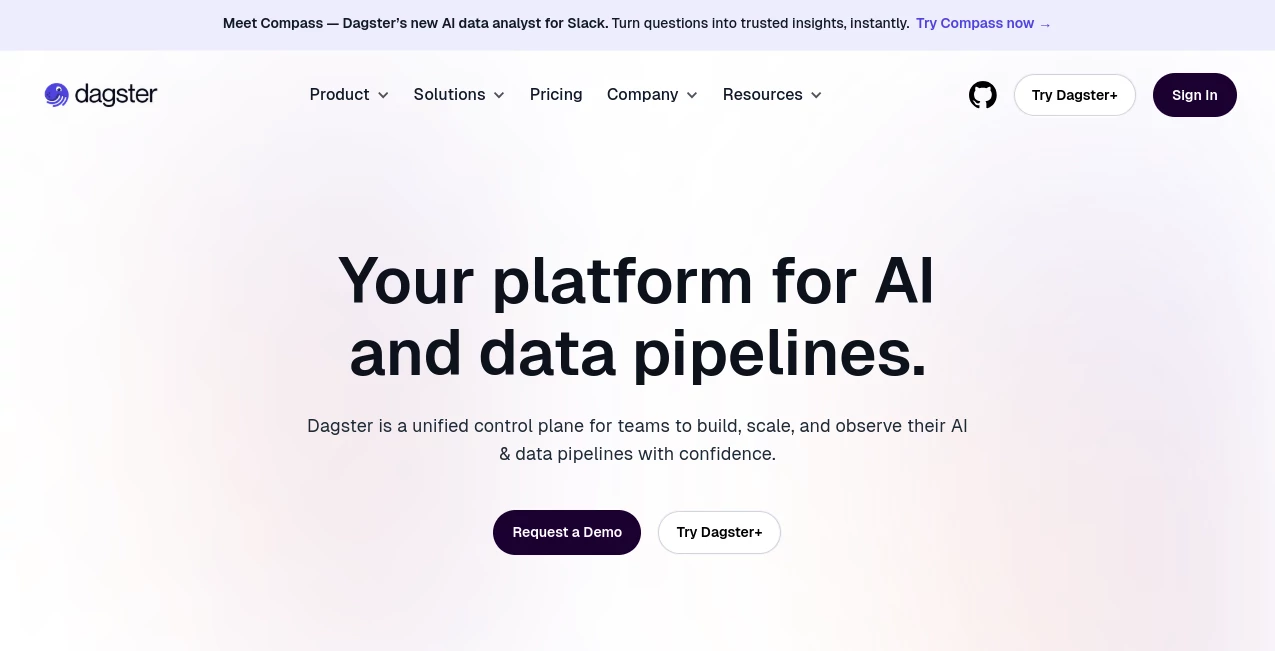
What is Dagster?
Imagine a world where your data pipelines hum along like a well-oiled machine, catching issues before they snowball and handing your team the insights they need without the usual headaches. That's the magic at play here—a powerhouse that turns chaotic data workflows into something elegant and reliable, all while keeping your folks focused on what they do best: innovating. I've seen teams light up after switching over, going from months of muddled processes to delivering breakthroughs in days, and it's hard not to get excited about a tool that feels like it was custom-built for the grind of modern data work.
Introduction
Picture this: you're knee-deep in a project, juggling ML models, ETL jobs, and analytics reports, and suddenly everything clicks because one platform holds it all together. That's the story behind this gem, born from the real-world frustrations of data teams who needed more than just another scheduler—they craved a full control center that scales with their ambitions. From its roots in open-source simplicity, it's grown into a trusted ally for high-stakes environments, where visibility isn't a luxury but a lifeline. What hooks me is how it empowers everyone on the team, from engineers tweaking code locally to leaders spotting trends at a glance, all without the silos that slow things down. It's not just software; it's the kind of shift that makes you wonder how you ever managed without it.
Key Features
User Interface
The dashboard hits you like a breath of fresh air—clean lines, real-time glances at asset health, and customizable views that let you slice data your way, whether you're chasing freshness alerts or cost breakdowns. I remember firing it up for the first time and thinking, "Finally, something that doesn't bury the good stuff under menus." It's got that intuitive flow where you drag in components, watch pipelines light up, and tweak on the fly, all while keeping the big picture in sight. No more squinting at logs; it's all there, polished and ready to roll.
Accuracy & Performance
When stakes are high, you need something that doesn't flinch, and this delivers with rock-solid tracking that flags quality hiccups early and scales without breaking a sweat. Teams I've chatted with swear by its end-to-end observability—metadata on everything from sources to freshness, ensuring your data's as trustworthy as your gut. It's the kind of reliability that turns potential disasters into footnotes, letting you push boundaries knowing the system's got your back, even under heavy loads.
Capabilities
From modeling assets like tables or ML models to weaving in lineage that traces every transform, it covers the full spectrum with reusable bits that make self-service a breeze. Hook it up to your stack—S3 buckets, Snowflake queries, whatever—and watch it automate the rest, complete with cost insights that keep surprises at bay. What stands out is how it unifies notebooks, jobs, and reports into one cohesive flow, turning isolated efforts into a symphony of insights that actually move the needle.
Security & Privacy
In an era where data's your goldmine, this one shines with built-in audits that document every step for compliance peace of mind, all while locking down access so only the right eyes see the goods. It's that quiet confidence—automatic integrity checks across the lifecycle—that lets teams breathe easy, knowing governance isn't an afterthought but woven right in. No wonder pros lean on it for sensitive ops; it's secure without being stuffy.
Use Cases
Take a data squad racing to train ML models: they orchestrate stages on cloud runners, reproduce runs effortlessly, and scale without the usual headaches, cutting timelines from weeks to days. Or picture an analytics crew delivering reports—raw feeds morph into polished dashboards via ELT magic, with quality baked in so leaders get fresh truths fast. I've heard from ETL warriors how it tamed sprawling jobs, integrating tools seamlessly to keep things humming, whether you're building for AI experiments or just keeping the lights on in daily ops.
Pros and Cons
Pros:
- Blasts through silos, unifying codebases so teams move at warp speed.
- Local testing and branch deploys that feel like second nature.
- Insights that pop—lineage, costs, health—all without extra elbow grease.
- Self-service smarts that free up brainpower for the big swings.
Cons:
- Cloud perks shine brightest, so open-source fans might miss a few bells.
- Steep for absolute newbies, though the docs make the climb quick.
Pricing Plans
It kicks off free and open-source, perfect for dipping toes or building solo, with all the core orchestration you need to get rolling. For teams craving that extra polish—like advanced UI and seamless deploys—the cloud tiers step in affordably, scaling as you grow without the sticker shock. Sign up for a spin and see how it fits; it's the kind of value that pays for itself in the first streamlined run.
How to Use Dagster
Start by grabbing the open-source bits and sketching your first pipeline—define assets, wire in dependencies, and test locally like you're just debugging a script. Push to a branch for staging magic, integrate your tools, and let it handle the observability. Before long, you're deploying with confidence, tweaking via the UI, and pulling reports that wow. It's that straightforward ramp-up that turns skeptics into superfans overnight.
Comparison with Similar Tools
Where old-school schedulers shove you into production blind, this one lets you test anywhere, anytime, with assets that track like a hawk—think Airflow's power but with modern dev vibes that don't fight your flow. It's less about brute force and more about smart, sustainable builds, edging out the competition by keeping teams agile and informed, not just automated.
Conclusion
This isn't merely a tool; it's the spark that ignites data teams, turning tangled workflows into triumphs that fuel real breakthroughs. By blending engineering rigor with user-friendly insights, it sets the stage for innovation that sticks, earning raves from heads of engineering who've slashed delivery times dramatically. If you're ready to ditch the drag and embrace velocity, dive in—your pipelines (and your sanity) will thank you.
Frequently Asked Questions (FAQ)
Can I run it without the cloud?
Absolutely—the open-source core is robust and free, ideal for local or self-hosted setups, with cloud add-ons for when you scale.
How does it handle big teams?
Governance and visibility keep everyone aligned, with self-service that cuts handoffs and boosts collaboration across the board.
What's the learning curve like?
Gentle for devs, with docs that guide you from hello world to hero pipelines in a weekend.
Does it play nice with my tools?
Seamlessly—plug in Snowflake, S3, or your ML runners, and it orchestrates without a fuss.
How's the support?
Community-driven for open-source, plus dedicated help on cloud tiers—folks say it's responsive and spot-on.
AI Data Mining , AI Developer Tools , AI Research Tool , AI Workflow Management .
These classifications represent its core capabilities and areas of application. For related tools, explore the linked categories above.
Dagster details
This tool is no longer available on submitaitools.org; find alternatives on Alternative to Dagster.
Pricing
- Free
Apps
- Web Tools
Categories

Dagster Alternatives Product

Prelight

AutoChangelog

Tate-A-Tate

LocaFlow

JSON to TOON…

Harvey

onuml

Screenshot t…

FINIITE AI