
🧠 AI Quiz
Think you really understand Artificial Intelligence?
Test yourself and see how well you know the world of AI.
Answer AI-related questions, compete with other users, and prove that
you’re among the best when it comes to AI knowledge.
Reach the top of our leaderboard.


















genie3
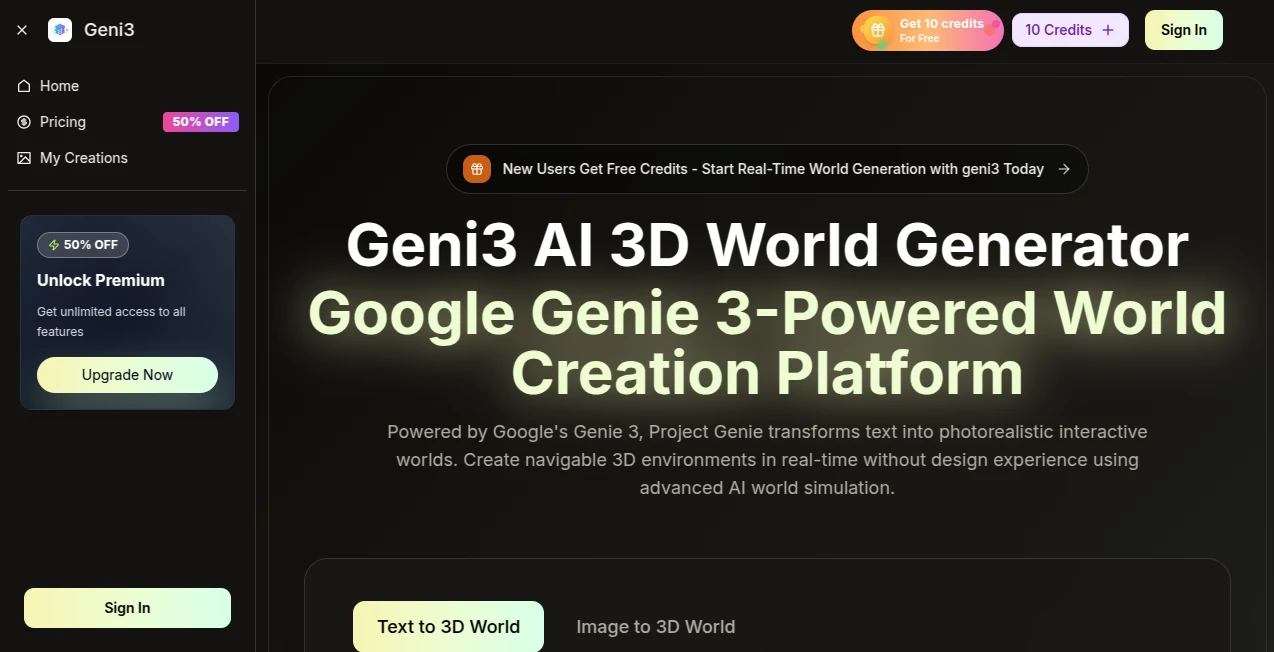
What is genie3?
There’s a quiet thrill when a sentence you type — something as simple as “a tiny dragon perched on a stack of old books” — turns into a fully realized 3D model you can spin, light, and even 3D-print if you want. That’s the kind of moment this tool creates over and over. It doesn’t just spit out generic assets; it listens carefully to your words (or your reference image) and delivers geometry that feels thoughtful and finished. I’ve watched designers go from “I wish I had time to model this” to “wait, it’s already done?” in under two minutes. The surprise on their faces is always the same.
Introduction
Most 3D generation tools still feel like experiments — lots of promise, but too many jagged edges or missing details. This one quietly crossed the line into everyday usefulness. You describe what you want, optionally drop a reference photo or concept sketch, and it returns clean, usable meshes with good topology, sensible UVs, and textures that actually look like what you imagined. It’s become a favorite among indie game artists, product visualizers, and even architects who need quick massing studies or prop concepts. The speed is addictive: prompt → generation → download → straight into Blender or Unreal. No cleanup marathons. That alone changes how people think about early ideation.
Key Features
User Interface
The workspace is calm and focused — big prompt box, clear upload area for images, a couple of sliders for style strength and detail level, and that’s basically it. No overwhelming panels or nested menus. You see a live progress preview so you’re not staring at a blank screen, and once it’s ready you can rotate, zoom, change lighting presets, or export with one click. It feels like the tool is trying to disappear so you can stay in the creative headspace.
Accuracy & Performance
It consistently delivers coherent topology — no nightmare ngons or floating verts that make retopo a nightmare. Edge flow tends to be logical, especially on organic shapes, and the text prompt adherence is unusually strong. You say “worn leather satchel with brass buckles” and you actually get buckles that look metallic and leather that reads as aged. Generation times hover between 30–90 seconds depending on complexity, and the model is ready to drop into most pipelines without heroic fixes.
Capabilities
Text-to-3D, image-to-3D, text+image hybrid, multiple style presets (realistic, stylized, low-poly, clay, etc.), quad-dominant meshes, PBR texture baking, and direct export to GLB, OBJ, FBX. You can also request variations from the same prompt to explore directions quickly. It handles hard-surface and organic equally well, which is still rare in this space. The baked normals and AO give assets instant polish for game engines or presentation renders.
Security & Privacy
Uploads are processed ephemerally — nothing is stored long-term unless you explicitly save the model to your account. Commercial usage rights are clearly granted on paid generations, and there’s no sneaky model training on user data. For anyone working on client concepts or proprietary designs, that clarity is worth its weight in gold.
Use Cases
A tabletop RPG creator needs a unique monster for next session — describes it, gets three variations, picks one and prints a miniature by evening. A furniture designer sketches a chair on paper, photographs it, and generates a clean 3D version to show clients before committing to CAD. An indie animator needs background props fast — generates stylized crates, lanterns, and barrels in the same art direction and drops them straight into the scene. The common thread is speed without sacrificing quality — it’s the difference between “maybe next week” and “done by lunch.”
Pros and Cons
Pros:
- Exceptionally good prompt following — what you describe is usually what you get.
- Clean topology and usable UVs save hours compared to most generators.
- Fast enough to stay in flow instead of waiting.
- Hybrid text+image input gives you precise control when you need it.
Cons:
- Very complex multi-object scenes can still need manual cleanup.
- Credit-based system means heavy users will need to top up regularly.
Pricing Plans
It keeps the entry barrier low so anyone can test-drive the quality. A generous free tier gives enough generations to understand the strengths. Paid credits are reasonably priced and stack up nicely for frequent use — the more you buy, the better the rate. No subscriptions forcing monthly spend if you’re project-based; just top up when you need more. Feels fair and creator-friendly.
How to Use It
Start with a descriptive prompt — the more vivid, the better. Add a reference image if you want to lock in a style or shape. Adjust the style preset and detail slider to taste, then generate. Preview arrives quickly; rotate, change lighting, decide if you want variations. Happy? Download in your preferred format. For best results, use clear lighting in reference photos and avoid overly crowded scenes on the first try. Iterate a couple times and you’ll usually land exactly where you want to be.
Comparison with Similar Tools
Plenty of 3D generators exist now, but most still trade off either speed, quality, or usability. This one finds a rare balance: prompt accuracy close to the best research models, topology good enough for real work, and a workflow so frictionless you actually want to keep generating. It’s not the absolute bleeding-edge in raw fidelity (yet), but for practical daily use — prototyping, concepting, asset libraries — it punches far above most of the competition.
Conclusion
Good tools disappear into the background and let the imagination run. This one does exactly that. It takes the friction out of early 3D exploration so you spend more time playing with ideas and less time fighting software. Whether you’re mocking up a game world, visualizing a product, or just seeing what happens when you describe “a cyberpunk vending machine covered in vines at midnight,” it meets you with enthusiasm and delivers results worth showing off. Once you experience the loop — prompt, generate, smile, iterate — it’s hard to go back.
Frequently Asked Questions (FAQ)
How many objects can I describe in one prompt?
One main subject usually works best. For scenes with multiple elements, the AI handles it better when you give a clear hierarchy (e.g., “a lone astronaut standing in front of a giant crystal cave”).
Can I use the models commercially?
Yes — paid generations come with full commercial rights.
What file formats are supported for export?
GLB (recommended for most uses), OBJ, FBX — all with baked textures where applicable.
Do I need a powerful computer?
No — everything runs in the cloud. A basic laptop or even a tablet works fine.
How good are the textures?
Very usable PBR sets — albedo, normal, roughness, metallic — that look great in real-time engines without much tweaking.
AI Design Generator , AI 3D Model Generator , AI Text to 3D , AI Image to 3D Model .
These classifications represent its core capabilities and areas of application. For related tools, explore the linked categories above.
genie3 details
Pricing
- Free
Apps
- Web Tools
Categories

genie3 Alternatives Product

Luma AI

bratgenerator

Nano Banana 2

AIImageEdit

Image to Ima…

Tripo 3D

MuseArt AI

Nano Banana 2
Square Image