
🧠 AI Quiz
Think you really understand Artificial Intelligence?
Test yourself and see how well you know the world of AI.
Answer AI-related questions, compete with other users, and prove that
you’re among the best when it comes to AI knowledge.
Reach the top of our leaderboard.


















Geometry Dash Lite

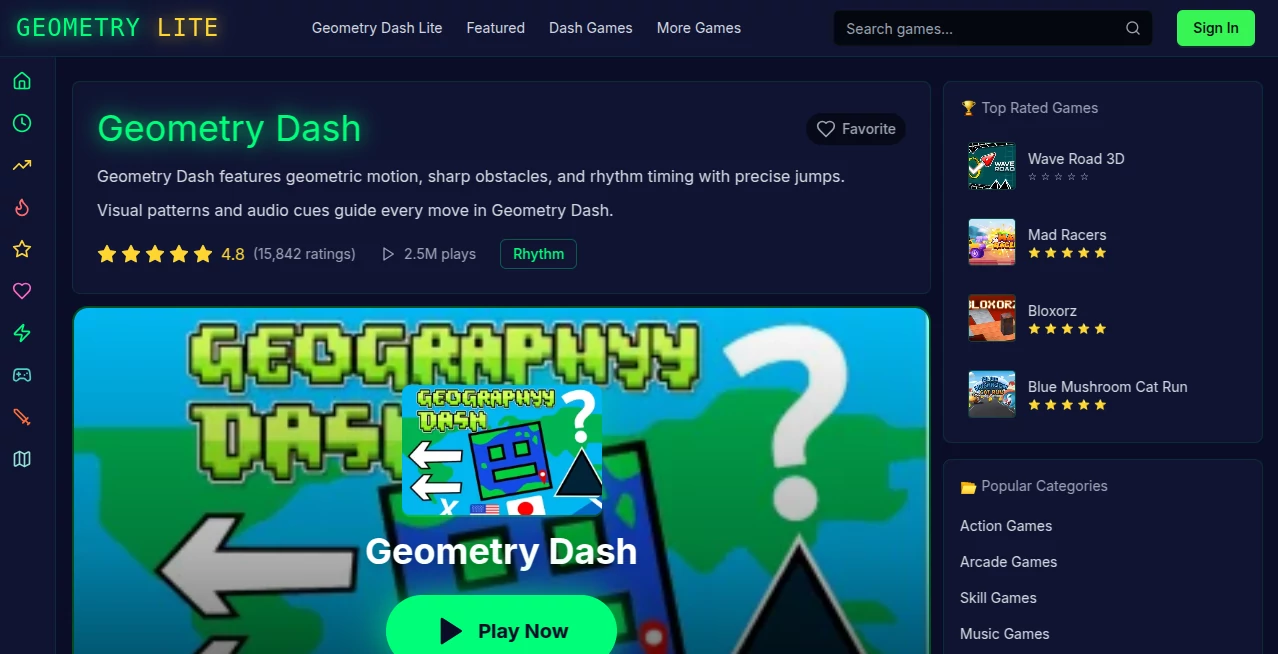
What is Geometry Dash Lite?
There's something deeply satisfying about taking a vague idea in your head—a weird chair, a strange creature, a futuristic building—and seeing it appear as a real, rotatable 3D model in seconds. This tool makes that leap feel almost casual. You type what you want, maybe sketch a rough shape or drop in a reference image, and it builds something coherent, clean, and surprisingly usable. I've watched friends who normally shy away from 3D software light up when they realize they can actually hold their concept in a browser—no install, no tutorials, no frustration. It's the kind of thing that turns "I wish I could model that" into "look what I just made."
Introduction
3D modeling used to mean steep learning curves, powerful (and expensive) workstations, and hours spent on tutorials just to make a cube look interesting. This platform quietly dismantles all of that. It's a lightweight, browser-based creator that uses AI to handle the hard parts—topology, proportions, basic texturing—so you can focus on the idea instead of fighting vertices. Built for speed and accessibility, it appeals to game devs prototyping assets, designers mocking up products, educators explaining spatial concepts, and hobbyists who just want to see their imagination in 3D. The joy comes from how fast it goes from "describe it" to "here it is, rotate it, tweak it, export it"—democratizing 3D in a way that feels genuinely fresh.
Key Features
User Interface
The workspace is calm and uncluttered. A big prompt box welcomes you, with quick buttons for common starting points (character, object, environment). Reference upload sits right beside it, and a live 3D viewer spins your model as it generates. Simple controls—rotate, pan, zoom, basic scale/move/rotate gizmos—appear only when needed. No overwhelming panels or hidden menus; it feels like sketching in 3D rather than wrestling software.
Accuracy & Performance
It interprets prompts with surprising intelligence—understands "low-poly cyberpunk motorcycle with neon accents" or "cute chibi fox in a scarf" without turning them into generic blobs. Geometry stays clean (mostly quad-dominant, good edge flow), and generation times rarely exceed 30–90 seconds even for detailed requests. Viewer performance is smooth in-browser, even on mid-range laptops. The model rarely produces broken topology or floating parts—results are almost always immediately usable or very close to it.
Capabilities
Text-to-3D, image-to-3D, hybrid mode (text + image guidance), basic in-browser editing (move, scale, rotate parts), automatic UV unwrapping, simple PBR material assignment, export to GLB/GLTF/OBJ/FBX/USDZ. It handles characters, hard-surface objects, environments, and stylized/low-poly looks equally well. Output is production-ready for game engines, AR previews, 3D printing (after minor cleanup), or further sculpting in heavier tools.
Security & Privacy
Uploads are processed ephemerally—images and generated models are not stored long-term unless you explicitly save them to your account. No mandatory login for basic generation. For creators working with client references or personal concepts, that low-retention approach provides genuine peace of mind.
Use Cases
An indie game dev sketches a monster concept on paper, snaps a photo, uploads it, and gets a rough 3D base to refine in Blender—saving days of blockout work. A product designer mocks up a new chair design from a quick description and reference images, then exports to show clients in AR. A teacher generates simple 3D molecules or historical artifacts for classroom demos that students can rotate on their phones. A hobbyist creates custom keychain models from pet photos for 3D printing gifts. Wherever "I need this in 3D right now" arises, it quietly delivers.
Pros and Cons
Pros:
- Blazing-fast from idea to usable 3D model—no install, no waiting.
- Surprisingly clean topology and good edge flow for AI-generated assets.
- Hybrid text+image guidance gives real creative control.
- Browser-based with smooth in-viewer editing and instant exports.
- Free tier is generous enough for meaningful prototyping.
Cons:
- Complex or highly detailed prompts can occasionally produce minor artifacts (fixable with quick re-rolls).
- Maximum model complexity is still limited compared to manual sculpting.
- Advanced editing and high-poly refinement require external tools.
Pricing Plans
Free tier offers several generations per day at decent resolution—enough to prototype ideas or build a small asset pack. Paid plans unlock higher polycounts, unlimited generations, faster queue times, priority access to new model updates, and commercial-use rights without attribution. Pricing stays approachable for indie creators and small studios; many say the monthly cost is less than one freelance modeling gig.
How to Use Normal Map Generator
Type your idea into the prompt box ("futuristic low-poly robot dog with glowing blue eyes"). Optionally upload a sketch, concept art, or reference photo for stronger guidance. Choose style hints if desired (realistic, stylized, low-poly, etc.). Hit generate—watch the 3D viewer fill in seconds. Rotate, zoom, and inspect from all angles. Tweak prompt or strength sliders and re-generate if needed. When happy, export in your preferred format (GLB is great for web/engines). Done—usable 3D asset in under two minutes.
Comparison with Similar Tools
Many 3D AI generators still produce messy topology, floating parts, or inconsistent scale. This one delivers cleaner, more usable meshes with better edge flow and instant in-browser editing. Where some focus only on high-poly sculpts, this leans toward game-ready/low-poly output that integrates smoothly into workflows. Speed, accessibility, and practical results make it a standout for creators who need fast iteration rather than museum-piece detail.
Conclusion
3D creation should be about imagination, not endless technical hurdles. This tool gently removes many of those hurdles, handing you believable models from mere words or sketches so you can focus on what matters: the design, the story, the feeling. When you can go from "what if..." to "here it is in 3D" in under a minute, creativity opens up in ways that feel genuinely exciting. For indie devs, designers, educators, and hobbyists alike, that’s not just convenient—it’s liberating.
Frequently Asked Questions (FAQ)
How detailed can the models get?
Great for game-ready/low-poly to mid-detail assets; very intricate organic sculpts still benefit from traditional refinement.
Do I need to install anything?
No—everything runs in your browser, no downloads required.
Can I edit the model after generation?
Yes—basic move/scale/rotate tools are built-in; export to Blender/Unity for deeper work.
What file formats can I export?
GLB/GLTF (recommended), OBJ, FBX, USDZ—covers most engines and AR use cases.
Is it free to use?
Generous free tier for daily use; paid plans unlock unlimited generations and higher quality.
AI 3D Model Generator , AI Image to 3D Model , AI Design Generator , AI Developer Tools .
These classifications represent its core capabilities and areas of application. For related tools, explore the linked categories above.
Geometry Dash Lite details
This tool is no longer available on submitaitools.org; find alternatives on Alternative to Geometry Dash Lite.
Pricing
- Free
Apps
- Web Tools
Categories

Geometry Dash Lite Alternatives Product

PicLumen AI …

CozAIPhoto

Reztune

SVG to 3D

chibi genera…

Z-Image

Image to STL

Use Nano Ban…

Nano AI