
Insider Trading Tracker
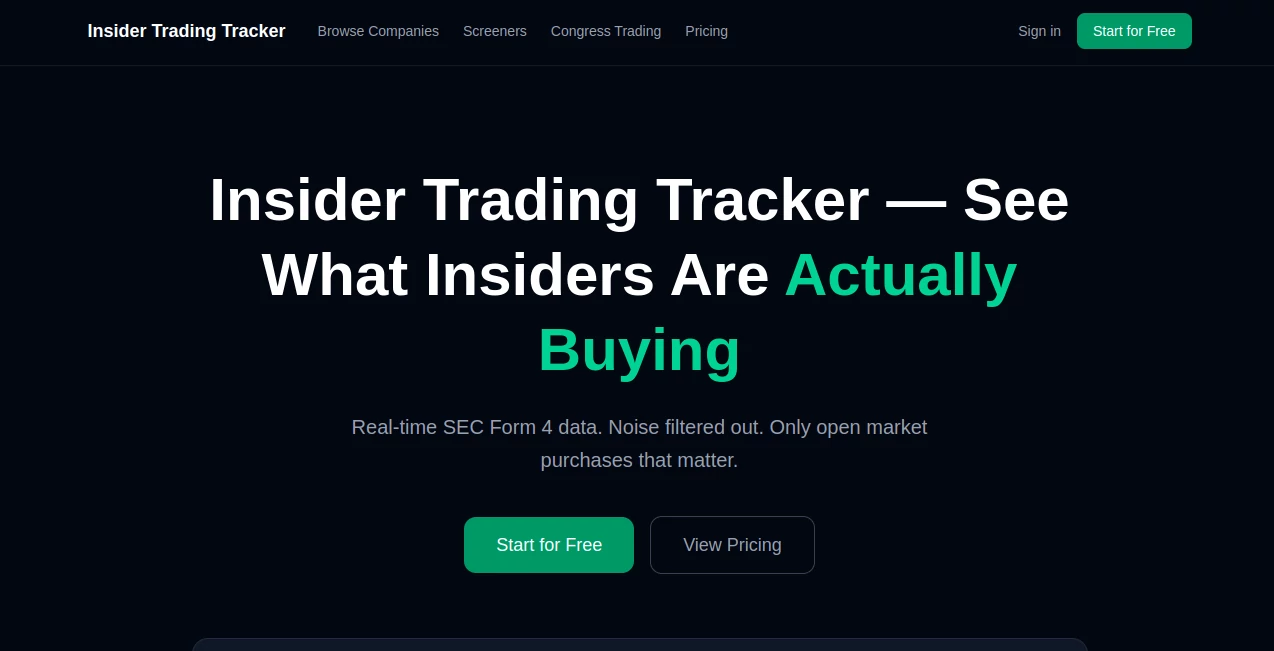
What is Insider Trading Tracker?
Most investors have heard the phrase "follow the smart money" — but actually doing it has always been harder than it sounds. Sifting through thousands of SEC filings every day, separating meaningful purchases from routine compensation transactions, and then acting on that data before it goes stale? That's a full-time job. Or at least it used to be.
This platform changes that. It's a real-time SEC Form 4 intelligence tool that does the heavy lifting — monitoring over 10,000 filings daily, stripping out the noise, and surfacing only the open market purchases that actually signal something. When a CEO spends their own cash buying company stock on the open market, that's different from a routine options exercise. This tool knows the difference, and it makes sure you see only what matters.
Free to start, with a Pro tier that unlocks the full arsenal of filters, alerts, and AI-powered analysis. Whether you're a retail investor researching small-caps or a fund analyst tracking executive conviction signals, the data here is clean, fast, and actionable.
Key Features
User Interface
The dashboard loads fast and reads clearly — a live ticker of recent insider purchases scrolls across the top of the page, showing the company ticker, dollar value, insider name and role, and date. It's the kind of first screen that immediately tells you whether the platform is worth your time. It is.
Navigation is straightforward: browse by company, run a screener, check congressional trading, or jump to pricing. Nothing is buried. On mobile the layout holds together well — trades are readable, filters are accessible, and alerts can be checked on the go without pinching and zooming. For traders who want to check a quick signal during market hours from their phone, the experience is genuinely usable rather than just technically functional.
The "Why does this stand out?" AI context button on individual trades is a nice touch. Rather than leaving you to interpret raw numbers, it gives you a quick analytical summary of why a particular transaction might be meaningful — useful for newer investors who are still building pattern recognition around insider activity.
Accuracy & Performance
The EDGAR poller runs every 30 minutes. Data typically appears in the system within an hour of being filed with the SEC — which, given that Form 4 filings must be submitted within two business days of a transaction, means you're working with information that's as fresh as legally possible.
The filtering logic is where the performance really shows. Roughly 80% of all Form 4 filings are routine — options exercises, RSU vestings, pre-planned 10b5-1 sales. These get discarded automatically. Only transactions coded as "P" (open market purchase) in the Form 4 XML make it through. That's not a small distinction. Without this filter, a signal-seeking investor would drown in compensation paperwork and miss the actual conviction buys. Here, the default view already has that problem solved.
Capabilities
The platform covers more ground than it might initially appear. Beyond the basic feed, the capabilities worth knowing about include:
- Pre-built screeners: Largest insider buys by dollar value, top cluster buys (three or more distinct insiders buying at the same company within 30 days), top executive buys (CEOs, CFOs, COOs, Presidents), largest sells, and most active insider trading stocks by transaction volume in the past 7 days.
- Advanced filters: Pro users can filter by market cap, sector, insider role, and trade size — so if you only care about small-cap biotech CEOs buying more than $100K worth of stock, you can set exactly that and nothing else.
- Cluster buying detection: One of the more statistically interesting signals in insider trading research. When multiple insiders at the same company independently buy shares within a short window, the conviction signal is considerably stronger than a single purchase. The screener surfaces this automatically.
- Congressional trading tracker: All 407 active politicians are tracked under STOCK Act disclosure requirements. You can browse by individual politician — disclosure lag time is visible, which adds a layer of transparency that's genuinely interesting for investors who follow congressional portfolio activity.
- Email alert rules: Up to 20 customizable alert rules on the Pro plan. Set your criteria and get notified the moment a matching trade hits the system.
- Company and insider watchlists: Track specific executives or companies and get a dedicated feed of their activity.
Security & Privacy
All data sourced from SEC EDGAR is public record — Form 4 filings are legally required disclosures, accessible to anyone. The platform makes this data easier to find and filter, but there's nothing here that wouldn't be available through direct EDGAR access. That's an important point for users who are cautious about data sourcing: everything shown is mandated public disclosure, not scraped private information.
Standard privacy policy and terms of service are in place. The platform is clear that nothing shown constitutes financial advice, which is the appropriate and honest framing for a data intelligence tool. Users are expected to apply their own judgment to the signals they find.
Use Cases
The most natural user is a self-directed retail investor who wants an edge that doesn't require a Bloomberg terminal subscription. Imagine you're researching a mid-cap industrial company and you notice that the CFO, the President, and two directors all bought shares in the same two-week window. That cluster signal, surfaced automatically by the screener, might prompt a deeper look at a company you'd otherwise have missed. That's the core value proposition in action.
Beyond individual stock research, the platform is genuinely useful for:
- Portfolio monitoring: Using the watchlist feature to track insider activity at companies you already hold, so you're not caught off guard if insiders start selling in volume.
- Sector-level trend spotting: Filtering by sector to see whether insider buying is concentrated in particular industries during a given period — a macro signal that can inform broader allocation decisions.
- Small-cap discovery: Insider buying in small-cap stocks is often more informative than in large-caps, because executives at smaller companies have less diversified wealth and more specific knowledge. The market cap filter makes this population easy to isolate.
- Congressional trade monitoring: Tracking specific politicians' disclosed trades — with disclosure lag visibility — for investors who include political portfolio activity in their research process.
- Due diligence support: Reviewing the complete insider transaction history of a company before making an investment decision, including the balance of buys versus sells over time.
Pros and Cons
What works well:
- The noise filtering is excellent — seeing only open market purchases by default is the right design decision and saves significant time
- 30-minute EDGAR polling keeps data as fresh as it can practically be
- Cluster buying detection is a genuinely useful signal layer that most competitors don't surface cleanly
- Congressional trading tracker adds meaningful depth beyond standard insider data
- AI context on individual trades is a smart usability feature, especially for less experienced investors
- The free tier is genuinely useful rather than a token offering — 7 days of trade history with basic filters is enough to evaluate whether the Pro upgrade is worth it
- Mobile experience is solid, which matters for traders who check signals during market hours
Limitations to consider:
- The free tier caps trade history at 7 days, which limits its usefulness for historical pattern research
- 20 alert rules on the Pro plan may feel restrictive for power users tracking many sectors simultaneously
- International markets are not covered — this is a US equities tool, built around SEC filings
- The AI context feature, while useful, works best as a starting point for analysis rather than a definitive signal
Pricing Plans
Two tiers, cleanly differentiated:
- Free — $0/month: Last 7 days of trade data, basic date and value filters, open market purchases only, mobile-friendly dashboard. No credit card required. Enough to understand what the platform does and whether the data quality is worth upgrading for.
- Pro — $29/month: Full trade history, all filters (market cap, sector, insider role), up to 20 email alert rules, company and insider watchlist, AI context on every trade, cluster buying detection, and priority support. At $29/month for a data source that covers the entire US public equity universe, this is notably affordable compared to competing financial data services.
There's no annual commitment mentioned, which keeps the entry point low-risk. For a retail investor running even a modest portfolio, the cost of one Pro subscription is easily justified by a single well-timed trade informed by a cluster buying signal.
How to Use Insider Trading Tracker
Getting started takes about two minutes. Sign up for free, no credit card required, and you land directly on the dashboard with live insider purchase data in front of you.
- Step 1 — Browse the live feed: The homepage shows the most recent significant open market purchases with ticker, dollar value, insider role, and date. This gives you an immediate feel for the current activity level across the market.
- Step 2 — Run a screener: Head to the Screeners section and choose a pre-built list — largest buys, cluster buys, executive buys, or most active stocks. These are the fastest way to find high-signal trades without needing to configure your own filters.
- Step 3 — Filter by your criteria: On the Pro plan, apply filters for sector, market cap range, insider role, and minimum trade size. If you're focused on healthcare executives buying more than $200K worth of their own stock, set exactly that.
- Step 4 — Set email alerts: Configure alert rules based on your investment criteria. When a trade matches your rules, you'll get an email notification — so you're not checking the dashboard constantly, just acting on the signals that reach you.
- Step 5 — Dig into a trade: Click into any individual transaction to see the full filing details. Use the "Why does this stand out?" feature for AI-generated context on the specific trade's significance.
- Step 6 — Check congressional activity: Browse the Congress section to see recent disclosures from politicians, filterable by individual politician or political party.
Comparison with Similar Tools
The most commonly cited alternative is OpenInsider, which has been around for years and has a loyal following. The key difference is default behavior: OpenInsider shows all Form 4 transactions by default, which means users spend significant time manually filtering out option exercises and grants. This platform filters that noise automatically, showing only open market purchases from the moment you open the dashboard. For most investors, that's a meaningful quality-of-life improvement.
SEC EDGAR itself is the original source — free and comprehensive, but designed for compliance filing and retrieval, not for active market research. Parsing XML filings manually is not a realistic workflow for most investors.
Premium financial data services like Bloomberg or FactSet include insider trading data as one feature among hundreds. For investors who already subscribe to those platforms, the insider data coverage is solid. For everyone else, paying four figures a month for data access to get the insider trading layer is not a practical option. At $29/month for a purpose-built tool, this platform occupies a sensible position in the market.
Congressional trading tools have proliferated in recent years — Quiver Quantitative and Capitol Trades being the most well-known. This platform's Congress section covers the same disclosure data, but integrated alongside corporate insider data in one place, which simplifies the research workflow for investors who follow both signal types.
Conclusion
Insider buying data has always been publicly available. The problem has never been access — it's been extraction. Pulling meaningful signals from thousands of daily Form 4 filings, discarding the compensation noise, and presenting the results in a format that's actually useful for investment research has historically required either expensive data subscriptions or significant manual effort.
This platform solves that problem cleanly. The filtering logic is sound, the data is as fresh as the SEC's own filing system allows, and the additional layers — cluster detection, congressional trading, AI context, customizable alerts — add real analytical depth at a price point that's accessible to individual investors rather than just institutional teams.
The free tier is a genuine on-ramp rather than a locked preview. If you follow US equities and you're not already using an insider trading intelligence tool, this is a reasonable place to start — and at $29/month for the full Pro feature set, the cost of upgrading is unlikely to be a serious consideration once you've seen what the signal quality looks like in practice.
Frequently Asked Questions (FAQ)
Is tracking insider trading actually legal?
Completely. Form 4 filings are mandatory public disclosures submitted to the SEC by corporate insiders whenever they buy or sell company stock. They're public record, available to anyone through EDGAR. The platform simply makes this data easier to find, filter, and act on. The platform tracks only legal insider trading — disclosed transactions by officers, directors, and large shareholders — not trades based on material non-public information, which is the illegal variety.
How is this different from just using SEC EDGAR directly?
EDGAR is a filing and retrieval system, not a research tool. It doesn't filter out noise transactions, doesn't provide screeners or alerts, doesn't detect cluster buying patterns, and doesn't offer AI analysis on individual trades. Using EDGAR directly would require parsing XML filings manually and building your own filtering logic — which is exactly the problem this platform eliminates.
How quickly does new data appear?
The EDGAR poller runs every 30 minutes. Data typically shows up in the system within an hour of being filed with the SEC. Given that insiders must file within two business days of a transaction, this means you're seeing disclosures as quickly as they become available.
What makes cluster buying a useful signal?
When a single insider buys shares, it could reflect any number of personal financial decisions. When three or more distinct insiders at the same company buy shares within a 30-day window, each acting independently and spending their own money, the aggregate signal is considerably stronger. It suggests a shared view of the company's near-term prospects that goes beyond individual circumstance. The cluster buying screener surfaces exactly these situations automatically.
Does the platform cover non-US markets?
No — the platform is built around SEC Form 4 filings, which are specific to US-listed companies. International markets have different disclosure frameworks and are not covered.
Can I track what specific politicians are trading?
Yes. The Congress section covers all 407 active politicians who disclose trades under the STOCK Act. Individual politician pages show their full disclosed trading history, including how long they waited between executing a trade and filing the disclosure — a data point that some investors find analytically interesting.
AI Investing Assistant , AI Research Tool , AI Analytics Assistant , AI Trading Bot Assistant .
These classifications represent its core capabilities and areas of application. For related tools, explore the linked categories above.
Insider Trading Tracker details
Website unavailable — View Alternatives
Pricing
- Free
Apps
- Web App
Categories

Insider Trading Tracker Alternatives Product

GEO Checker

Sourcetable

CloudByte PMS

RankPeak

UseWok

AI Entity

AI Complianc…

Roipad

Empiriolabs …