
🧠 AI Quiz
Think you really understand Artificial Intelligence?
Test yourself and see how well you know the world of AI.
Answer AI-related questions, compete with other users, and prove that
you’re among the best when it comes to AI knowledge.
Reach the top of our leaderboard.


















Kling-4 Video Studio
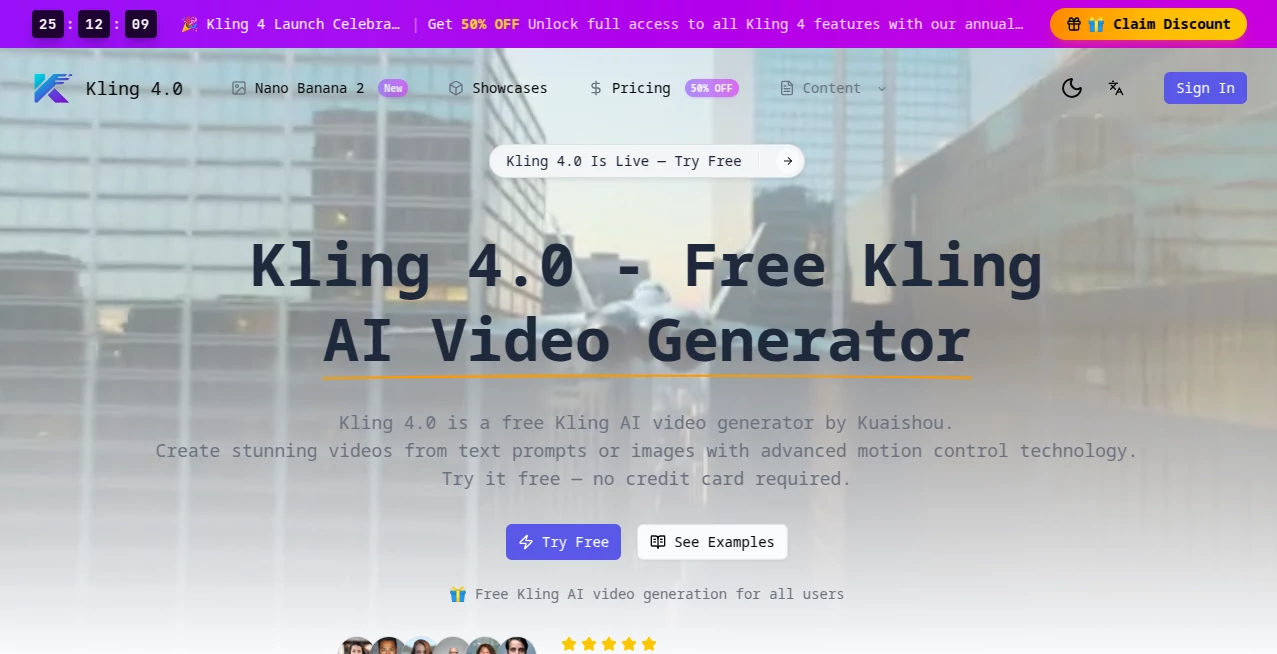
What is Kling-4 Video Studio?
There’s something special about typing a short scene description and watching a polished little film appear moments later—lighting that feels natural, motion with real weight, and characters that actually look consistent from one cut to the next. This tool delivers that experience with a level of cinematic quality that still surprises people who’ve tried other AI video generators. I’ve shown clips to friends who normally dismiss generated video as “cool but obviously fake,” and watched their expressions shift when they realized the movement, physics, and emotional tone held together so convincingly. It’s not perfect every single time, but when it clicks, the result feels like a real short film rather than a tech demo.
Introduction
Creating video has always been one of the most time-consuming and expensive parts of storytelling. Kling 4 quietly lowers that barrier by turning text prompts or reference images into short cinematic clips with impressive coherence and visual polish. Powered by the latest Kling AI technology, it focuses on realistic motion, natural lighting, and consistent subjects across frames. Whether you’re a content creator needing quick social clips, a filmmaker prototyping ideas, or a marketer building engaging ads, it offers a fast way to see your vision move without a full production team. The free access makes it easy to experiment, while the quality keeps you coming back for more serious work.
Key Features
User Interface
The interface stays out of your way—clean prompt box, optional image upload, simple controls for aspect ratio and duration, and one prominent generate button. Previews load reasonably fast, letting you iterate without losing momentum. It feels designed by people who actually make videos: no unnecessary clutter, just the tools you need to shape the scene. Beginners can create their first clip in minutes; experienced users appreciate how quickly they can refine prompts and test variations.
Accuracy & Performance
Motion feels natural rather than robotic—characters move with believable weight, cloth and hair respond to movement, and camera work has that subtle cinematic touch. Subjects stay consistent across shots, even with complex actions or changing angles. Generation times are practical for short clips, and the output quality holds up well at 1080p. The model handles both text-only prompts and image-guided generations effectively, reducing the random glitches that still plague many alternatives.
Capabilities
It supports text-to-video and image-to-video generation with strong motion control, multi-shot storytelling, and realistic physics simulation. You can guide style, camera movement, and emotional tone through detailed prompts. Outputs are suitable for social media, marketing, prototyping, or even short narrative pieces. The combination of visual fidelity and temporal coherence makes it particularly useful when you need clips that look directed rather than randomly animated.
Security & Privacy
Your prompts and uploaded images are handled responsibly during generation. The platform maintains standard security practices so you can experiment without worrying about your creative ideas being misused. For commercial or personal projects, that baseline trust matters—especially when you’re putting original concepts into the system.
Use Cases
A small brand creates elegant product lifestyle clips from a single hero image, saving on expensive shoots. An indie filmmaker mocks up emotional story beats to test pacing before full production. A musician builds a visualizer that actually matches the song’s mood instead of generic stock footage. A social creator generates daily Reels with consistent character style without filming every day. In each case, the tool turns ideas into watchable video faster than traditional methods while keeping a cinematic feel.
Pros and Cons
Pros:
- Strong character and style consistency across frames.
- Cinematic motion and lighting that feel thoughtfully directed.
- Fast enough generation to support real creative iteration.
- Free tier lets you test the quality without commitment.
- Works well with both text prompts and reference images.
Cons:
- Clip lengths are best suited for short-form content (longer stories require multiple generations).
- Extremely abstract or contradictory prompts can still produce unexpected results.
- Higher resolutions and unlimited use require a paid plan.
Pricing Plans
The free tier provides daily credits so anyone can try the quality firsthand—no card needed. Paid plans unlock higher resolutions, longer clips, faster processing, and more generous daily limits. Pricing stays reasonable for the leap in output quality; many creators find it pays for itself after replacing even a single traditional video project or stock footage purchase.
How to Use Kling 4
Start with a clear, descriptive prompt that includes scene, action, mood, and camera movement if desired. Optionally upload a reference image to guide style or character appearance. Choose aspect ratio (vertical for social, horizontal for other uses) and desired length. Hit generate and review the preview. Tweak the prompt or reference strength for another variation, then download when it feels right. For longer stories, generate individual shots and combine them in your favorite editor. The process stays simple enough for quick tests yet flexible for more ambitious ideas.
Comparison with Similar Tools
Many AI video generators still struggle with character drift, unnatural physics, or lighting inconsistencies between frames. This one prioritizes temporal coherence and cinematic intent, often producing clips that feel closer to human-directed work. The balance of quality, speed, and ease of use makes it stand out—especially for creators who want reliable short-form results without excessive technical friction.
Conclusion
Video creation has always demanded time, skill, and resources. Tools like this quietly shift the balance, giving more people the ability to turn ideas into moving images without a full crew or months of work. It doesn’t replace creative vision—it amplifies it. When the gap between “I have an idea” and “here’s a watchable clip” shrinks dramatically, storytelling becomes more accessible and fun. For anyone who thinks visually, that’s worth exploring.
Frequently Asked Questions (FAQ)
How long can generated clips be?
Best suited for short clips; longer narratives are possible by combining multiple generations.
Do I need a reference image?
No—text-only prompts work well—but adding one improves consistency and style control.
What resolutions are available?
Up to 1080p with strong visual quality; higher options may be available on paid plans.
Can I use the videos commercially?
Yes—paid plans typically include commercial rights; check current terms for details.
Is there a watermark on free generations?
Free clips may include a small watermark; paid generations remove it.
AI Animated Video , AI Image to Video , AI Video Generator , AI Text to Video .
These classifications represent its core capabilities and areas of application. For related tools, explore the linked categories above.
Kling-4 Video Studio details
Pricing
- Free
Apps
- Web Tools
Categories

Kling-4 Video Studio Alternatives Product

AI Hug

JSON to Video
Aura AI

Nano Banana …

Seedance 2 V…

WonderShare …

Free Sora Ge…

KOOX AI

VIGGLE