


















PawAI Hub
What is PawAI Hub?
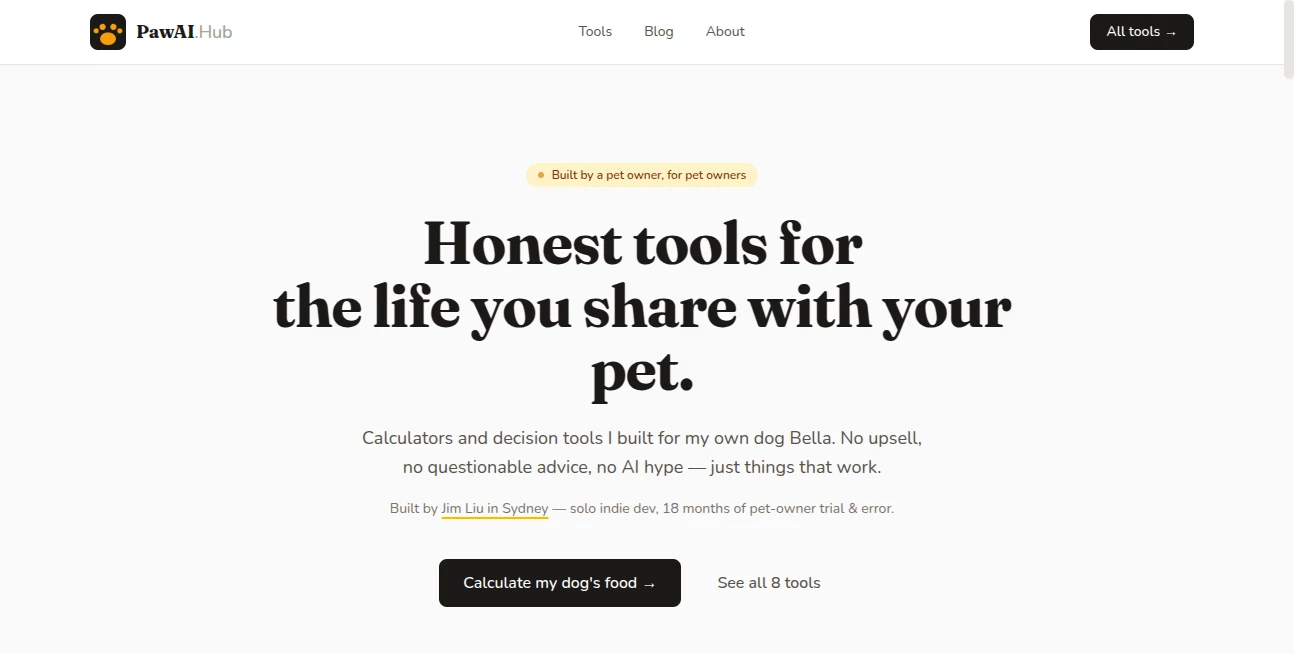
Most pet care apps fall into one of two traps: they either drown you in generic advice that could apply to any animal on the planet, or they push you toward paid upgrades before you've even asked a single question. Jim Liu, a solo developer based in Sydney, got tired of both and decided to build something different — a small but carefully considered suite of free calculators and decision tools designed for the specific, real-world moments that come with owning a dog or cat.
The whole project started with one dog named Bella and 18 months of trial and error. What began as personal tools for figuring out how much to feed her, how old she really was in human terms, and why she wouldn't stop barking at 2am turned into a platform that other pet owners could actually use. No signup required, no ads on the tools, no upsell prompts buried between the results. Just tools that work.
That's a rarer thing than it sounds.
Key Features
User Interface
The design is deliberately uncluttered. Each tool loads directly with the inputs front and centre — you're not navigating through menus or clicking through onboarding screens to get to the actual calculator. The dog age tool, for example, lets you type your dog's age, select a size class, and get results immediately. The biological age output is clearly labelled alongside the ×7 myth comparison, so you can see exactly how the two differ without needing to read a methodology page first.
Across the eight tools currently available, the interaction model stays consistent. Decision tools like the cat vomit triage and dog night-barking diagnoser use a step-by-step question format that feels closer to a conversation than a form. That matters when you're stressed at midnight wondering whether your cat needs an emergency vet visit.
Accuracy & Performance
The standout commitment here is methodological transparency. The dog age calculator uses the UCSD 2019 epigenetic formula published by Wang et al. in Cell Systems — a logarithmic model calibrated on Labrador Retrievers — rather than the multiply-by-seven shortcut that has no scientific source. The cat age calculator references AAFP/AAHA 2021 guidelines. The dog food calculator incorporates breed, weight, age, and activity level rather than just body weight.
Every threshold in the decision tools has been tested against real outcomes on actual pets. The cat vomit triage was built from real observations. The kitten week-by-week calculator came out of fostering 14 kittens across three litters. The tools don't just cite academic sources — they've been pressure-tested in a Sydney apartment by someone who had a personal stake in getting the numbers right.
Capabilities
The current tool set covers eight distinct use cases, and each one addresses a genuine pain point rather than a hypothetical one:
- Dog Food Calculator: Calculates daily caloric needs by breed, weight, age, and activity level. Takes the guesswork out of portioning without requiring a nutrition degree.
- Dog Age Calculator: Uses the UCSD 2019 epigenetic formula plus AKC size-adjusted bands. Toy, small, medium, large, and giant size classes all produce different results — because they genuinely age differently.
- Cat Age in Human Years: Biological age based on actual feline developmental curves, not the outdated linear myths.
- Cat Vomit Triage: Input colour, frequency, and accompanying symptoms to get a clear recommendation — vet today, or watch and wait.
- Dog Night-Barking Diagnoser: Four questions, eight possible causes. Narrows down whether the problem is anxiety, pain, insufficient exercise, or environmental fear.
- Kitten Week by Week: Weight targets, developmental milestones, feeding guidance, and vaccine timing from week one to week twenty.
- Cat Litter Cost Calculator: Total cost of ownership comparison across clumping, crystal, and wood pellet litter types, scaled by number of cats.
- Pet Insurance Compare: Side-by-side real quotes with the builder's own recommendation included. Unusually candid for a comparison tool.
The blog adds another layer of depth — 18 hand-written articles covering everything from whether pet insurance actually makes financial sense (with a linked spreadsheet comparing three years of premiums against a single ACL surgery) to 448 observations on one cat's scratching post preferences across 12 months.
Security & Privacy
There's no account creation, no email capture, and no tracking beyond what's standard for a modern website. The tools run without storing personal data about you or your pet. The save-result feature on the dog age calculator works locally — it's a convenience function, not a data collection mechanism.
The privacy policy is straightforward, and the overall approach to data is consistent with the platform's stated values: no fluff, no upsell, no hidden extraction of value from the people using the tools.
Use Cases
Think about the specific moments this kind of tool actually gets used. It's 11pm and your cat has vomited twice in an hour — is this a tonight problem or a tomorrow-morning call? It's your dog's birthday and someone mentions the seven-year rule and you're not sure if that's real. You're fostering kittens for the first time and you have no idea whether a 200-gram weight at week three is normal or concerning.
Those are the moments these tools were designed for. Not for general research in a calm afternoon, but for the specific, slightly-panicked situations that come with caring for an animal who can't tell you what's wrong.
- New pet owners who don't yet have the pattern recognition that comes with years of experience
- Foster carers managing multiple animals at different developmental stages simultaneously
- Multi-cat households trying to compare litter costs across options they've never actually quantified
- Dog owners unsure whether their feeding portions are accurate after switching food brands
- Anyone weighing pet insurance who wants a structured framework rather than just testimonials
The blog content also serves people in research mode — the pet insurance piece in particular, with its real premium and vet cost data, is the kind of article that gets bookmarked and shared in pet owner groups because there genuinely isn't much like it.
Pros and Cons
What works particularly well:
- Every tool is free with no signup — the barrier to first use is essentially zero
- Methodology is cited and explained, not buried or hidden
- Decision tools use real clinical logic, not generic advice dressed up as triage
- The builder's personal experience with real animals shows in the specificity of the thresholds
- No ads on any of the tools — a meaningful commitment for an indie project
- Blog content is written from direct testing, not assembled from third-party sources
- Insurance comparison includes a genuine personal recommendation, which most comparison tools avoid
Honest limitations:
- Eight tools is a focused set — if you need species outside dogs and cats, this isn't the right platform
- Built and maintained by one person, so expansion pace depends entirely on that individual's availability
- No mobile app — it's a web-based experience, which is fine but worth noting if you want offline access
- The tools are explicitly not a substitute for veterinary advice — they're decision-support, not diagnosis
Pricing Plans
Everything is free. There are no tiers, no premium features, no credits system, and no paywall. The tools load without an account and produce results without requiring an email address.
This is worth stating plainly because it's genuinely unusual. Most tool collections in this space either gate the useful functionality behind a subscription or use the free tools as lead generation for a paid service. Here, there's no paid service to upsell. The platform is funded by the builder's own time and runs on the principle that useful tools should be accessible to anyone who needs them.
If you use the tools and find them valuable, the most useful thing you can do is share them with other pet owners who'd benefit.
How to Use PawAI Hub
There's no onboarding process. You go to the platform, choose the tool that matches your current situation, and use it. That said, a few tools benefit from knowing how they're structured:
- For the dog age calculator: Select the correct size class carefully — a medium dog (18–28 kg, like a Border Collie or Labrador under 60 lb) has a meaningfully different biological age curve than a giant breed. The difference between the UCSD formula and the AKC size-adjusted output is displayed side by side so you can see both.
- For the cat vomit triage: Note the colour and frequency before you start. The tool asks specific questions and the quality of the recommendation depends on accurate inputs. "Yellowish bile, twice in four hours, no blood, eating normally" will give you a different outcome than vague "seems unwell."
- For the night-barking diagnoser: Work through all four questions even if you think you already know the answer. The decision tree is designed to surface causes you might have overlooked.
- For the kitten week-by-week tool: This is most useful if you're tracking weight consistently. The milestones and red flags are keyed to age and weight together, not age alone.
- For the insurance comparison: Read the personal recommendation section. It's the part that took three years of real claims data to write.
Comparison with Similar Tools
The closest comparisons are general pet care apps like PetCoach, Chewy's vet chat, or the various AI symptom checkers that have launched in the last two years. The difference is in the approach to specificity and transparency.
Most pet symptom tools give you a broad answer — "this could be serious, consult a vet" — that doesn't actually help you decide whether to call the emergency vet at midnight or book a morning appointment. The triage tools here give you a directional recommendation based on actual clinical logic, which is more useful in the moment even with the explicit caveat that they don't replace professional advice.
The dog food calculators on most breed-specific sites use simplistic formulas based on bodyweight alone. The one here incorporates activity level and age alongside weight and breed context, which produces more accurate daily calorie targets — particularly for working dogs or dogs with weight management needs.
The pet insurance comparison stands apart because it includes real claims data from the builder's own experience. Most comparison tools are affiliate-driven and optimised for commission rather than accuracy. This one names the product the builder actually uses and explains the reasoning in detail.
What makes the platform different overall isn't any single feature — it's the combination of genuine personal investment in the subject matter, cited methodology, and a consistent refusal to extract value from the people using it.
Conclusion
There's a certain kind of tool that only gets built by someone who actually needed it. The specificity here — the 14 foster kittens, the 448 scratching post observations, the three years of insurance premium tracking, the real dog named Bella who started the whole thing — isn't marketing copy. It's the record of a person solving their own problems and then making those solutions available to everyone else.
For pet owners, that matters more than feature counts or integrations. The tools here are genuinely useful in the moments that count, built on real data, and available without any friction. That's a harder thing to build than it looks, and it shows in how the platform feels to use.
If you have a dog or cat and you've ever wished for a resource that treated you like an intelligent adult rather than a potential customer, this is worth bookmarking.
Frequently Asked Questions (FAQ)
Is any of this actually free, or is there a paid tier hidden somewhere?
Genuinely free. No signup, no email required, no premium tier. All eight tools are fully accessible at no cost. The builder has explicitly stated there's no upsell — the platform exists because the tools are useful, not as a funnel to something else.
Can I use the triage tools instead of going to a vet?
No — and the platform is transparent about this. The triage tools are decision-support aids, not diagnostic instruments. They help you decide whether a situation is likely urgent or can wait, but they don't replace professional veterinary assessment. The cat vomit and night-barking tools in particular carry clear disclaimers that professional consultation is always the appropriate course for anything health-related.
How was the dog age calculator formula chosen?
The primary formula is the UCSD 2019 epigenetic study by Wang et al., published in Cell Systems. It uses a logarithmic model based on DNA methylation patterns in Labrador Retrievers, calibrated against human aging data. The AKC size-adjusted output uses published breed-size band data. Both are explained in the full methodology article linked from the tool.
Does the platform cover pets other than dogs and cats?
Currently, no. The tools are focused specifically on dogs and cats, which reflects the builder's direct experience. There's no indication of planned expansion to other species at this stage.
Who built this and why should I trust the numbers?
Jim Liu, a solo developer in Sydney, built the platform starting with tools for his own dog. The methodology is cited for each tool, the testing is documented in the blog with real data from real animals, and the builder is reachable directly by email. There's no corporate layer between the tools and the person responsible for them.
How often are the tools updated?
Updates are made when the underlying research or guidelines change, or when user feedback surfaces edge cases that need handling. Since the platform is maintained by one person, this is necessarily responsive rather than scheduled — but the cited sources for each tool make it possible to verify whether the methodology is current.
These classifications represent its core capabilities and areas of application. For related tools, explore the linked categories above.

PawAI Hub Alternatives Product

KronoPrompt

Olabiba

SomniaScope …

ZenMako

FeelsTheAura

MediTailor -…

Parking Prac…

AI Job Risk …

Ask Bishop
