
🧠 AI Quiz
Think you really understand Artificial Intelligence?
Test yourself and see how well you know the world of AI.
Answer AI-related questions, compete with other users, and prove that
you’re among the best when it comes to AI knowledge.
Reach the top of our leaderboard.


















RankingRider
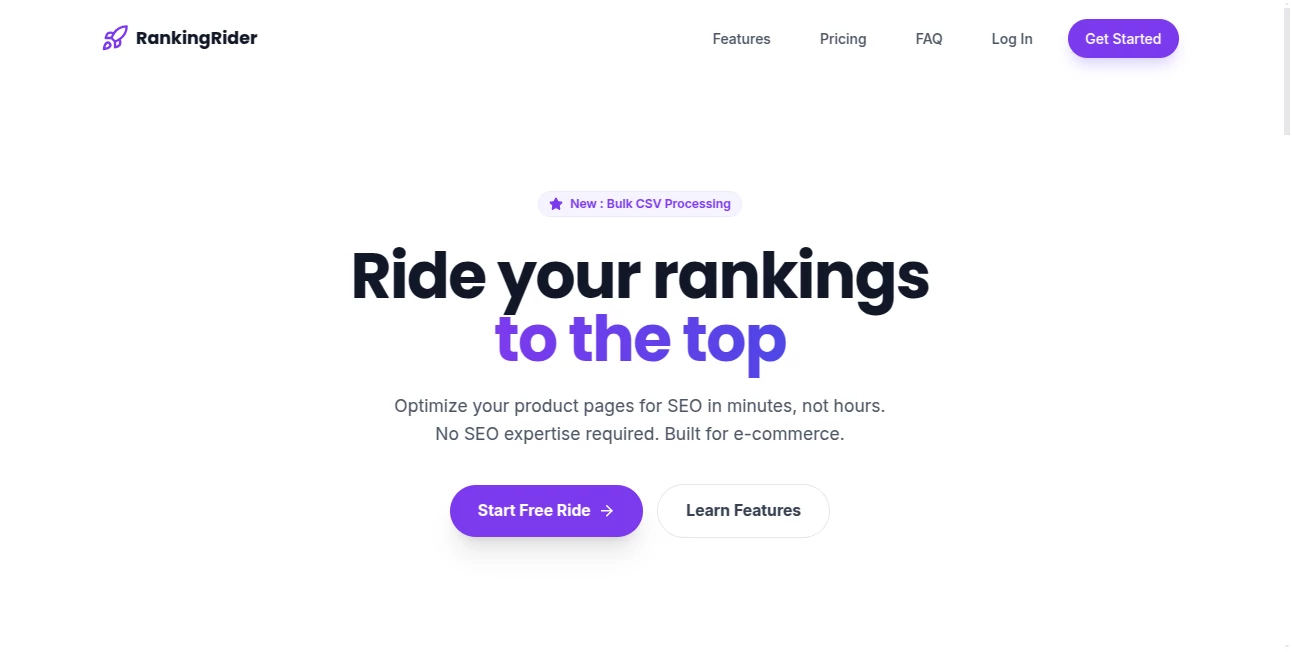
What is RankingRider?
Running an online store means every product page is fighting for attention in crowded search results. When titles are bland, descriptions ramble, and keywords feel forced, sales quietly slip away. This tool quietly changes that picture. You paste in your product data, and it hands back sharper titles, tighter descriptions, and a clear keyword score that actually guides improvement. I’ve watched shop owners go from staring at low-traffic listings to seeing impressions climb after one thoughtful pass through this system. It’s not flashy; it’s focused, and that focus delivers.
Introduction
Most e-commerce sellers know the theory of product SEO—better titles rank higher, stronger descriptions convert, relevant keywords matter—but actually doing it consistently across hundreds of SKUs is exhausting. This platform steps in as a practical copilot that handles the heavy lifting without ever needing access to your store backend. No risky app installs, no granting permissions, just copy-paste speed. It’s built for busy founders and teams who want real gains without adding another complicated tool to their stack. The moment you see a before-and-after comparison on one of your own listings, it clicks: small, intentional changes really do move the needle.
Key Features
User Interface
The flow is deliberately simple. Paste your product title and description (or upload a batch), and everything happens right there in one screen. Suggested improvements appear instantly alongside your original text, with keyword scores and explanations that are easy to scan. No overwhelming dashboards or buried settings—just the information you need to make a confident edit. It feels like having a very patient SEO friend looking over your shoulder.
Accuracy & Performance
The suggestions are grounded in real e-commerce ranking patterns, not generic advice. It spots missed long-tail opportunities, flags overly repetitive phrasing, and recommends title structures that search engines reward. Processing is near-instant, even for multiple products at once. Shop owners who have compared results often notice the difference in impressions and click-through rates within days, which is rare for SEO tools.
Capabilities
It rewrites titles to be more clickable and keyword-rich, crafts concise yet persuasive descriptions, scores keyword relevance on a clear scale, and supports bulk operations so you can lift an entire catalog quickly. It works across platforms—Shopify, WooCommerce, and others—without any integration required. The output is always editable, so you keep full creative control while getting data-backed direction.
Security & Privacy
Because nothing connects to your store, your data never leaves your session unless you choose to save or export it. There’s no persistent storage of sensitive product information on their side. For anyone cautious about third-party access, that standalone approach is a genuine relief.
Use Cases
A boutique clothing brand refreshes 200 listings before a big seasonal push and sees organic traffic lift noticeably within two weeks. A dropshipping store owner optimizes top sellers overnight, turning marginal performers into consistent revenue drivers. A new Shopify entrepreneur uses it to get their first 50 products search-ready fast, skipping months of trial-and-error. It’s especially powerful when time is short but growth can’t wait.
Pros and Cons
Pros:
- No app installation or store permissions needed—pure copy-paste simplicity.
- Bulk optimization saves hours compared to manual rewrites.
- Keyword scoring gives you confidence that changes are actually strategic.
- Results feel tailored to real e-commerce ranking factors, not generic SEO rules.
Cons:
- Best when you already have decent raw product data to work from.
- Free tier is limited; heavier catalogs benefit from paid plans.
Pricing Plans
It starts with a free tier generous enough to optimize a small catalog or test the difference on key products. Paid plans unlock unlimited bulk processing, higher-priority suggestions, and advanced filters that speed up large stores even more. Pricing stays reasonable for the time it saves—many users say it pays for itself after one good round of improvements.
How to Use RankingRider
Copy your product title and description from your store. Paste them into the input fields. Hit analyze and watch suggestions appear side-by-side with scores. Tweak anything you like, then copy the improved versions back into your listings. For bigger catalogs, upload a spreadsheet and let it process everything at once. Review, refine, publish. The whole cycle can take minutes per product instead of hours.
Comparison with Similar Tools
Many SEO helpers require store access or complex setups, while this one stays completely standalone—zero risk, zero friction. Others give generic advice; here the recommendations are tuned specifically for e-commerce product pages and backed by real ranking signals. It strikes a rare balance: powerful enough for serious sellers, simple enough for beginners.
Conclusion
Good product SEO doesn’t have to be a soul-crushing chore. This tool turns it into something approachable and surprisingly fast, letting you focus on growing the business instead of wrestling with wording. When your listings start showing up higher and converting better after a single pass, the value becomes obvious. It’s quiet, effective help that quietly moves the needle—exactly what busy sellers need.
Frequently Asked Questions (FAQ)
Do I need to install anything in my store?
No—everything happens outside your platform. Pure copy-paste.
Can I process many products at once?
Yes, bulk mode handles catalogs quickly on paid plans.
Will the suggestions work on any platform?
They are platform-agnostic—Shopify, WooCommerce, BigCommerce, and more.
How long until I see results?
Many notice impression and click-through lifts within days to a couple weeks.
Is there a free way to try it?
Yes, the free tier lets you optimize several listings to feel the difference.
AI E-commerce Assistant , AI SEO Assistant , AI Marketing Plan Generator , AI Digital Marketing Generator .
These classifications represent its core capabilities and areas of application. For related tools, explore the linked categories above.
RankingRider details
Pricing
- Free
Apps
- Web Tools
Categories

RankingRider Alternatives Product

SellerPic

seedancetwo2…

Aiso

BlogBuster

SeoWebChecker

LeadAny

Maestra

Supawazap

Ad Suite AI