RFP Quest
What is RFP Quest?
If you've ever lost a public sector contract because you found out about it a day too late, you already understand the problem this platform solves. UK government procurement moves fast — and for most bid teams, the gap between "tender published" and "we found out" is far wider than it should be.
This is a UK tender intelligence platform built specifically for the way public sector procurement actually works. It monitors Find a Tender, Contracts Finder, and major framework feeds in near real-time, enriches every opportunity with buyer history and award data, and helps bid teams make faster, smarter go/no-go decisions. It's not a global RFP tool with a British flag slapped on it. It was built from the ground up for one market — and that focus shows.
Currently in private beta and launching in Q2 2026, the platform is already indexing over 707,000 UK tenders. For any business targeting the UK's £300 billion annual public sector spend, this is a serious piece of infrastructure worth knowing about now.
Key Features
User Interface
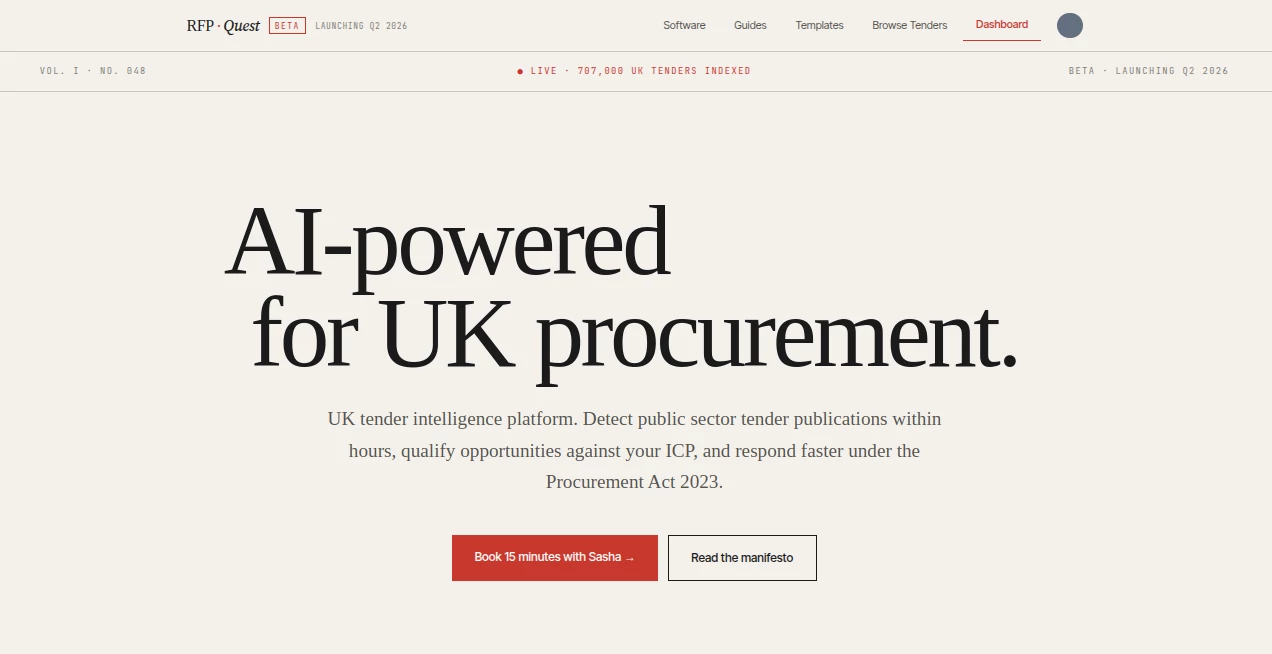
The interface follows a clean, task-first layout — the kind of design that comes from people who actually understand how bid managers work. The dashboard surfaces high-priority opportunities without burying you in noise. Navigation between tender discovery, document analysis, and buyer intelligence is fluid and logical.
There's no steep learning curve. Someone joining a bid team mid-sprint could open the dashboard and understand what's in front of them within minutes. The visual design is restrained and professional — this isn't a tool trying to impress you with animations, it's trying to help you win contracts.
Accuracy & Performance
The platform runs on an hourly monitoring cycle, pulling from official UK government portals and cross-referencing against your company profile and bid history. Match scores are generated on a 0–100 scale, so your team isn't wading through irrelevant contracts — you're seeing opportunities ranked by how closely they match your actual capabilities.
Under the hood, the AI pipeline uses GPT-4o with vision capabilities, running through an 8-node LangGraph architecture. That's not marketing language — it means document analysis is genuinely capable of extracting structured requirements, scoring criteria, and compliance obligations from complex procurement documents, including those with embedded tables and formatted annexes.
Capabilities
The platform covers four core workflows that typically require separate tools or manual effort:
- Real-time tender detection: Continuous monitoring of Find a Tender Service, Contracts Finder, and Crown Commercial Service framework feeds. Tenders detected and classified within hours of publication.
- Buyer intelligence: Every opportunity is enriched with the contracting authority's award history, prior framework usage, evaluation criteria patterns, and incumbent supplier data. Top director profiles are pulled from Companies House and refreshed on a 24-hour cache cycle.
- ICP qualification: Opportunities are scored against your ideal customer profile — filtering by sector, contract value, geography, and certification requirements like ISO 27001, Cyber Essentials, or Constructionline. High-signal contracts surface; low-signal noise is suppressed.
- PA23-aligned bid writing: Response generation is built for the Procurement Act 2023 regime — Most Advantageous Tender criteria, mandatory social value weighting under PPN 002, and Preliminary Market Engagement guidance. Export in DOCX or PDF, ready for submission.
There's also a collaborative review layer, which allows multiple team members to edit and approve proposals before anything goes out the door. For agencies managing bids across several clients simultaneously, this alone changes how a team operates.
Security & Privacy
The platform is currently undergoing SOC 2 Type II audit — a meaningful commitment for any tool handling sensitive commercial bid content. This matters in the context of public sector procurement, where the documents involved often contain commercially sensitive pricing strategies, partner arrangements, and technical methodologies.
The UK government compliance angle is built in by design rather than bolted on. Procurement Act 2023 is not a checkbox — it's woven into the templates, qualification logic, and response guidance throughout the platform.
Use Cases
The most obvious user is a dedicated bid team at an SME or mid-sized firm that's trying to build a public sector revenue stream without hiring a full-time tender researcher. One person with access to this platform can realistically cover what used to require a team of three trawling portals manually every morning.
But it's equally relevant for larger organisations with established bid functions. Framework specialists managing multiple call-offs across G-Cloud, Digital Outcomes & Specialists, or NHS Shared Business Services will find the buyer intelligence and ICP scoring genuinely useful — especially for framework refreshes where understanding evaluation criteria patterns from prior awards gives a measurable edge.
- Technology and IT services firms targeting central government and NHS digital transformation contracts
- Facilities management and construction companies pursuing local authority and emergency services procurement
- Professional services consultancies responding to education and higher education RFPs
- Charities and social enterprises with Procurement Act 2023 social value obligations to meet
- Bid writing agencies managing concurrent responses for multiple clients
There's also a straightforward compliance use case: any organisation currently using pre-2025 templates and processes needs to update for the new procurement regime. The built-in PA23 guidance makes that transition significantly less painful.
Pros and Cons
What works well:
- Hourly monitoring genuinely closes the detection gap — a meaningful operational advantage over daily digest services
- The buyer intelligence layer adds real context that changes go/no-go decisions, not just surface-level data
- PA23 alignment is built-in, not retrofitted — a significant advantage given how recent the regulatory change is
- GPT-4o with vision handles complex document formats that simpler extraction tools struggle with
- SME pricing tier makes this accessible to smaller bid teams that can't justify enterprise-level tooling
- Purpose-built for UK public sector means no irrelevant global features cluttering the experience
Limitations to be aware of:
- Currently in private beta — general availability isn't until Q2 2026, so access requires booking a call
- Pricing starts at £499 per month, which is a meaningful commitment for very early-stage businesses still testing public sector viability
- The platform is intentionally UK-focused — if your procurement work spans Europe or North America, you'll need complementary tools for those markets
- Some content library and integration features typical of more mature response platforms are still being built out
Pricing Plans
Three plans cover most scenarios a UK bid team will face:
- Discover — £499/month: Designed for small teams establishing their first public sector pipeline. Includes real-time detection, buyer intelligence, and PA23-aware templates.
- Respond — £1,499/month: Built for active bid teams running five or more concurrent responses. Increased seats, monitored portals, and AI generation volume.
- Enterprise — from £2,999/month: For bid teams managing framework portfolios across multiple buyer relationships. Full-scale monitoring, maximum AI generation, and dedicated support.
All plans include the core functionality — detection, intelligence, and templates. The differences come down to scale: how many portals you're monitoring, how many team members need access, and how much AI-generated content you're producing per month. For most SMEs entering public sector work seriously, the Discover plan is a rational starting point.
How to Use RFP Quest
Access is currently by request — you book a 15-minute introductory call with the founding team, which serves as both onboarding and intake. This isn't unnecessary friction; it's how they ensure the platform is configured correctly for each firm's specific sector focus and capability profile from day one.
Once onboarded, the workflow follows four clear steps:
- Step 1 — Profile your capabilities: Define your sector focus, contract value range, geography, and certifications. This feeds the ICP scoring engine and determines how opportunities are ranked for your team.
- Step 2 — Connect to live tender feeds: The platform automatically monitors the relevant portals based on your profile. No manual feed configuration required.
- Step 3 — Review qualified opportunities: The dashboard surfaces ranked opportunities with match scores, buyer history, and award intelligence already attached. Go/no-go decisions happen with real context, not guesswork.
- Step 4 — Generate and review responses: Upload tender documents, run them through the LangGraph pipeline, and generate draft responses using your content library. Team members review and refine before export to DOCX or PDF for submission.
Comparison with Similar Tools
The competitive landscape splits into two categories: global RFP response platforms and UK-specific tender intelligence tools.
Platforms like Loopio, Responsive (formerly RFPIO), and Proposify are genuinely excellent for managing large content libraries across global enterprise deals. They're built for high-volume RFP response with sophisticated content management. What they're not built for is UK public sector procurement — they lack the portal integrations, buyer intelligence, framework awareness, and PA23 guidance that UK bid teams actually need.
On the UK intelligence side, tools like Tussell, Stotles, and Spend Network provide award data and market intelligence but are primarily analytics and research platforms rather than end-to-end bid workflow tools. They tell you what happened; this platform helps you respond to what's happening now.
The genuine differentiator is the combination: real-time detection plus buyer intelligence plus PA23-aligned response generation in a single platform. That stack hasn't existed in a purpose-built UK tool before. Most bid teams today are running three or four separate tools — and losing coordination time between them — to achieve what this platform covers in one workflow.
Conclusion
For any UK business seriously pursuing public sector revenue, the detection gap is a real and costly problem. By the time a tender shows up in a morning digest, the window for a properly considered response has already shrunk. Buyer intelligence — the kind that tells you whether a procurement is genuinely contested or effectively pre-wired — is scattered across Companies House searches, manual award database trawls, and institutional memory that walks out the door when a bid manager leaves.
This platform addresses both problems in a single, focused tool. It's not trying to be everything to everyone. It's built for UK public sector procurement under the Procurement Act 2023 regime, and that focus makes it considerably more useful than a generic global tool with a British flag in the navigation.
The private beta window is narrow — twelve firms per week by design, to maintain onboarding quality. If public sector pipeline is a strategic priority for your business in 2026, getting on the list early is worth the 15-minute call.
Frequently Asked Questions (FAQ)
What exactly does this platform do that Find a Tender doesn't?
Find a Tender is the official UK government publication portal — comprehensive and free, but not designed for active prospecting. There's no scoring, no buyer history overlay, no real-time push notifications, and no response support. This platform sits on top of Find a Tender (and Contracts Finder, and major frameworks) and turns raw publication data into actionable opportunity intelligence.
Is it suitable for SMEs, or only large bid teams?
The Procurement Act 2023 explicitly aims to widen SME access to public contracts, and the entry-level plan is sized for small teams establishing their first public sector pipeline. The ICP qualification logic is particularly useful for SMEs — it filters out contracts you can't realistically win, so you focus effort where it counts.
Which UK procurement portals are monitored?
Find a Tender Service for above-threshold contracts, Contracts Finder for lower-value opportunities, Crown Commercial Service framework call-offs, NHS procurement portals, and major regional buying consortia. The coverage is designed to match where UK public sector spend actually flows.
How does the AI bid writing work?
Tender documents are uploaded and processed through an 8-node LangGraph pipeline powered by GPT-4o with vision capabilities. The pipeline extracts requirements, scoring criteria, and compliance obligations, then generates draft responses using your content library, enriched with buyer intelligence and PA23-aligned guidance. Output is exported as DOCX or PDF.
When is general availability?
The platform is in private beta now, with general availability planned for Q2 2026. Access during the beta period requires booking a 15-minute call with the founding team.
How does it compare to Loopio or Responsive?
Those platforms are excellent for managing large content libraries across global enterprise RFP workflows. This platform is purpose-built for UK public sector procurement — with portal integrations, buyer intelligence, framework awareness, and Procurement Act 2023 guidance that global tools don't offer. Many bid teams find it worth running both: global response tools for enterprise sales, this platform for public sector bid work.
AI Project Management , AI Documents Assistant , AI Research Tool , AI Writing Assistants .
These classifications represent its core capabilities and areas of application. For related tools, explore the linked categories above.

RFP Quest Alternatives Product
Schema Synth

Fill PDF fro…

Free AI Gene…

MacroMicro

Free AI Chat

LyricStudio

TrueSource AI

Duct Tape 3

Rank++