
shepi
What is shepi?
Anyone who has worked through M&A due diligence knows the pain point well. You're post-LOI, the clock is ticking, and someone hands you three years of messy financials in a mix of PDFs and spreadsheets. The traditional path — commissioning a CPA firm for a full Quality of Earnings report — takes four to eight weeks and can cost anywhere from $15,000 to $80,000. And while you wait, competing offers don't.
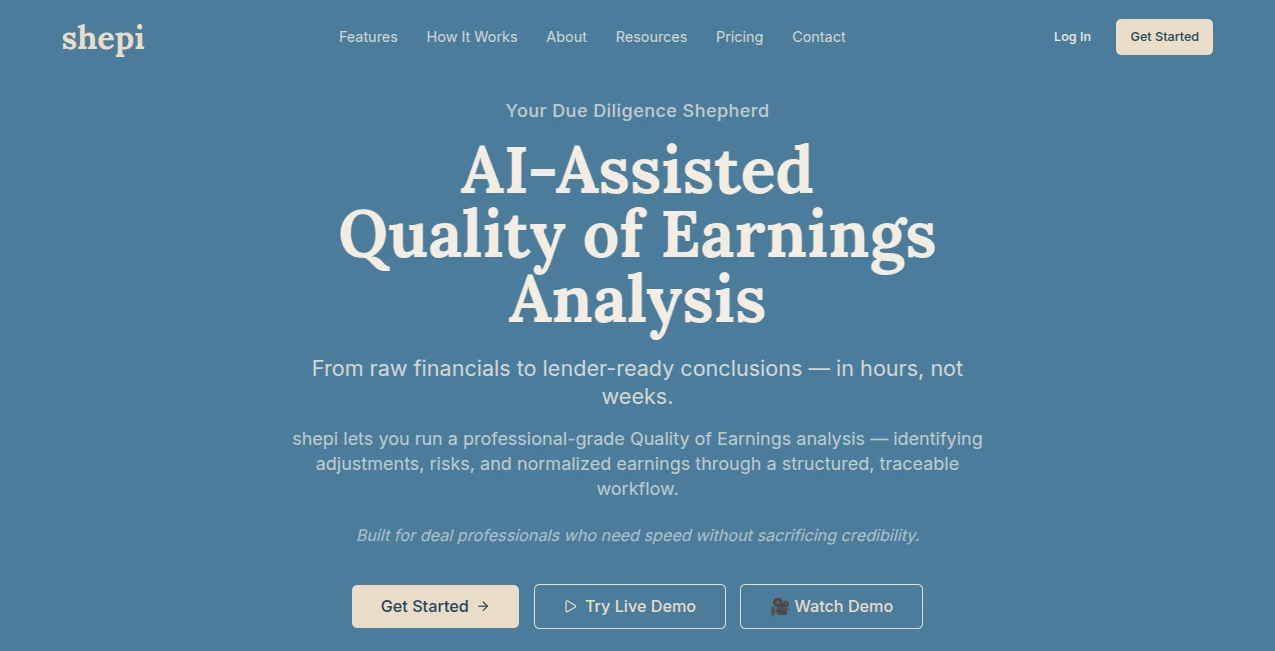
Shepi was built to change that equation. It's an AI-assisted Quality of Earnings platform that takes your raw financial documents and turns them into EBITDA adjustments and lender-ready QoE reports in hours, not weeks. It's purpose-built for deal teams, private equity firms, search fund operators, and lenders who need institutional-grade financial analysis without the timeline that traditionally comes with it.
The positioning is precise: this isn't a general-purpose financial AI or a repurposed accounting tool. It was built by M&A professionals, for M&A professionals, to address one of the most time-sensitive and high-stakes parts of the deal process.
Key Features
User Interface
The interface is cleanly focused on the workflow that matters — upload your financials, configure the analysis parameters, and get your output. There's no sprawl of irrelevant features or cluttered dashboards trying to do too many things. Deal professionals working under deadline pressure will appreciate that the platform stays out of the way and lets them move fast.
The upload experience is designed to handle real-world financial documents, which are rarely clean. Whether you're working with PDFs exported from QuickBooks, formatted Excel reports, or management accounts stitched together by a seller's bookkeeper, the platform is built to process them without requiring extensive pre-formatting work on your end.
Accuracy & Performance
The core promise — lender-ready QoE output in hours — is the performance metric that matters most for this category of tool. Traditional QoE engagements take four to eight weeks largely because they're labor-intensive: analysts manually spread financials, identify adjustments, and write up findings. AI-assisted analysis compresses that cycle dramatically by automating the first pass on all of it.
The output is calibrated for the standard a lender or investor actually expects to see: normalized EBITDA, documented adjustments with supporting rationale, and analysis of revenue quality and sustainability. This is not a quick summary — it's structured analysis that can be presented to a financing partner or used to anchor deal negotiations.
For searchers and smaller deal teams that have historically relied on Excel for preliminary diligence, the jump in analytical depth compared to a self-built model is significant. And for teams that commission traditional QoE anyway, having AI-assisted preliminary analysis done before engaging a CPA firm can meaningfully reduce the scope — and therefore the cost — of the full engagement.
Capabilities
The platform's core analytical workflow covers the essential components of a QoE report:
- EBITDA adjustment identification: Systematic identification of non-recurring items, owner-specific add-backs, one-time expenses, and other adjustments that affect normalized earnings. These are the numbers that drive valuation, and getting them right matters.
- Revenue quality analysis: Examination of revenue consistency, customer concentration, and sustainability of reported revenue streams — the questions a buyer and their lender will ask.
- Lender-ready report generation: Output structured for presentation to SBA lenders, bank lenders, and investors who expect a clear, documented earnings picture.
- Financial document processing: Ingestion of raw financial uploads including P&L statements, tax returns, and management accounts, with AI-driven extraction and structuring of the underlying data.
The platform is positioned for use across the deal lifecycle — both as a rapid screening tool during preliminary diligence and as a foundation for the formal QoE process when combined with a traditional CPA engagement.
Security & Privacy
The documents flowing through a QoE process contain some of the most commercially sensitive data in a transaction: revenue detail, margin structure, add-back rationale, and owner compensation arrangements. Any platform handling this data needs to take security seriously, and the architecture reflects that expectation.
For deal teams with institutional data governance requirements, it's worth evaluating the platform's data handling policies directly before uploading transaction materials. This is standard practice for any SaaS tool touching deal data, and Shepi operates in a category where buyers should ask those questions and expect clear answers.
Use Cases
The platform is built around three primary user profiles, and the fit is tight for all three:
- Search fund operators and independent sponsors: Self-funded searchers and independent sponsors are the users who feel the QoE cost problem most acutely. A $20,000–$30,000 CPA firm engagement on a deal that may not close is a real financial risk. AI-assisted QoE lets them do credible preliminary analysis before committing to that spend — and gives them something to bring to lender conversations earlier in the process.
- Private equity deal teams: PE firms running multiple active processes simultaneously benefit from the speed advantage. Being able to turn preliminary QoE analysis around in hours rather than scheduling a CPA firm engagement means faster go/no-go decisions and fewer bottlenecks in the deal pipeline. Senior deal professionals can focus on judgment and negotiation while the platform handles the analytical groundwork.
- Lenders and credit teams: SBA lenders and bank credit teams underwriting acquisition loans need to understand normalized EBITDA and debt service coverage. Having borrowers arrive with structured, lender-ready QoE documentation accelerates credit review and reduces back-and-forth on basic financial questions.
There's also a compelling use case for M&A advisors and business brokers who want to prepare sell-side QoE documentation to support a transaction — presenting buyers with clean, pre-analyzed financials that reduce friction and support a faster close.
Pros and Cons
What works in its favor:
- Speed is a genuine competitive advantage. Hours versus weeks is not a marginal improvement — it changes the dynamics of deal timing and parallel process management.
- Cost is dramatically lower than traditional QoE. For the preliminary analysis use case, the economics are compelling, especially for searchers and smaller deal teams.
- Purpose-built for M&A. The output format and analytical framework are calibrated for how deals and lenders actually work, not adapted from a general finance tool.
- Reduces CPA firm engagement scope. Using AI-assisted analysis as a first pass means the formal CPA engagement can start from a more structured baseline, potentially reducing hours and fees.
- Built by M&A professionals. The design reflects an understanding of how deal teams actually operate, which shows in what the platform prioritizes.
Limitations worth noting:
- AI-assisted analysis is not a substitute for a signed CPA QoE on closing. Lenders and sophisticated buyers will still require a full traditional QoE for material transactions. The platform is explicit about this positioning.
- Output quality depends on input quality. Messy or incomplete financial records will produce less complete analysis. The platform doesn't manufacture data that isn't in the source documents.
- Newer platform in a category still establishing norms. Deal teams with established CPA firm relationships and processes will need to evaluate how AI-assisted QoE fits their existing workflow, rather than assuming it replaces it wholesale.
Pricing Plans
Specific pricing details are not publicly listed on the platform's website, which is consistent with a product in active development that is likely working with early clients on customized arrangements. This is common for deal-focused SaaS tools where transaction volume, deal size, and feature scope vary significantly by user type.
For accurate, current pricing tailored to your deal volume and team size, contacting the platform directly is the recommended path. Given the cost comparison against traditional QoE fees — which commonly run $15,000–$80,000 per engagement — the economics for AI-assisted analysis are likely to be favorable for most deal team use cases even at a premium SaaS price point.
How to Use Shepi
The workflow is designed to be straightforward even under deal pressure:
- Step 1 — Upload your financial documents: Provide the target company's financials — typically three years of P&L statements, tax returns, or management accounts. The platform ingests these and begins extracting and structuring the underlying data.
- Step 2 — Review the AI-generated EBITDA analysis: The platform identifies and categorizes adjustments to reported EBITDA, flagging non-recurring items, owner add-backs, and other normalization entries with documented rationale.
- Step 3 — Refine and validate: Deal professionals review the AI-generated analysis, add context from management discussions or document review, and validate or adjust the identified items against their own deal knowledge.
- Step 4 — Generate and export the report: The final output is structured for presentation to lenders, investors, or internal deal committees — formatted as a lender-ready QoE document that supports financing conversations and deal negotiations.
For teams using the platform as a screening tool rather than a final report, the workflow stops earlier — get the preliminary EBITDA picture, make the go/no-go call, and only invest in a full CPA engagement on the deals worth closing.
Comparison with Similar Tools
The competitive landscape for AI-assisted QoE is small but growing. A few reference points for comparison:
Traditional CPA firm QoE remains the gold standard for closing-level diligence. Big Four and specialist firms bring deep experience, professional accountability, and signed reports that carry institutional weight with lenders and investors. The tradeoff is four to eight weeks of timeline and $15,000–$80,000 in fees. AI-assisted QoE and traditional QoE are not competing products — they serve different moments in the deal process, and the smartest approach is often both.
Excel-based DIY analysis is what most deal teams fall back on without a dedicated tool. It's flexible but time-intensive, error-prone, and produces output that requires extensive formatting before it's presentable to a lender. Moving from Excel to a purpose-built platform is a meaningful upgrade in both speed and output quality.
General M&A due diligence platforms like Hebbia and similar tools focus on document analysis and data room management across the full diligence scope. They're excellent for broad document review but aren't specifically calibrated for the QoE workflow — normalized EBITDA, add-back documentation, and lender-ready report structure.
Provafi occupies similar territory with a hybrid AI-plus-human model for SBA acquisitions, combining software-assisted analysis with CFA-reviewed output. The differentiation versus Shepi comes down to workflow design and target user profile — Provafi leans toward a managed service model, while Shepi puts the analytical workflow directly in the deal team's hands.
The category is early enough that purpose-built focus matters. Shepi's advantage is the depth of M&A-specific calibration in a standalone platform designed for deal teams to operate independently.
Conclusion
Quality of Earnings analysis has been one of the last genuinely manual workflows in M&A due diligence. The process hasn't changed much in decades: hire a CPA firm, wait four to eight weeks, pay a significant fee, get a report. That timeline and cost profile has always created friction — deals delayed, capital committed to diligence that may not close, and decision-making bottlenecks at exactly the moment when speed matters most.
AI-assisted QoE doesn't eliminate the need for professional judgment in complex transactions, and it doesn't try to. What it does is compress the preliminary analysis cycle from weeks to hours, make lender-ready documentation accessible earlier in the process, and give deal teams the financial picture they need to make faster, better-informed go/no-go decisions.
For search fund operators running their first deal, PE analysts managing multiple live processes, or lenders trying to accelerate credit review on acquisition loans, the value proposition is clear. This is a tool built for a specific problem, by people who understand that problem deeply, at a moment when the technology is finally good enough to solve it properly.
Frequently Asked Questions (FAQ)
What is a Quality of Earnings report and why does it matter?
A QoE report is a financial analysis used during M&A due diligence to assess whether a company's reported earnings are sustainable, recurring, and accurately represented. It adjusts EBITDA for non-recurring items, owner-specific expenses, and other normalization entries — producing the "true" earnings picture that drives valuation and lender underwriting. It's one of the most important documents in any acquisition process.
Can AI-generated QoE replace a traditional CPA firm report?
Not for closing-level diligence on material transactions. Lenders and sophisticated buyers typically require a signed report from an independent CPA firm for the final deal. AI-assisted QoE is most valuable as a preliminary screening tool, a rapid first-pass analysis, and a way to reduce the scope and cost of the subsequent CPA engagement by providing a structured starting point.
Who is this platform designed for?
The platform is built for deal teams, private equity firms, search fund operators, independent sponsors, and lenders involved in M&A transactions. Anyone who needs to understand normalized EBITDA faster and at lower cost than a traditional CPA firm engagement is the target user.
What financial documents do I need to use the platform?
Typically, three years of profit and loss statements, tax returns, or management accounts from the target business. The platform is designed to process real-world financial documents that aren't always clean or consistently formatted.
How does this compare to doing QoE analysis in Excel?
Excel is flexible but creates significant manual work: spreading financials, building adjustment schedules, formatting output for presentation. The platform automates the analytical groundwork and produces structured, lender-ready output directly — which is faster, less error-prone, and produces more consistent documentation.
Is the platform suitable for SBA-financed acquisitions?
Yes. SBA lenders require clear documentation of normalized EBITDA and debt service coverage capacity. Producing lender-ready QoE documentation early in the process — before engaging a full CPA firm — supports faster lender conversations and helps identify whether a deal's financial profile actually supports SBA financing before significant diligence costs are committed.
AI Documents Assistant , AI Accounting Assistant , AI Research Tool , AI Analytics Assistant .
These classifications represent its core capabilities and areas of application. For related tools, explore the linked categories above.

shepi Alternatives Product

SeoWebChecker

ChatterSift

Yorph AI
HostFinder

QuickFlip.AI

Document Chat

ReportMaker.…

AISEOMate

aipen.ink