
🧠 AI Quiz
Think you really understand Artificial Intelligence?
Test yourself and see how well you know the world of AI.
Answer AI-related questions, compete with other users, and prove that
you’re among the best when it comes to AI knowledge.
Reach the top of our leaderboard.

















AI 3D World
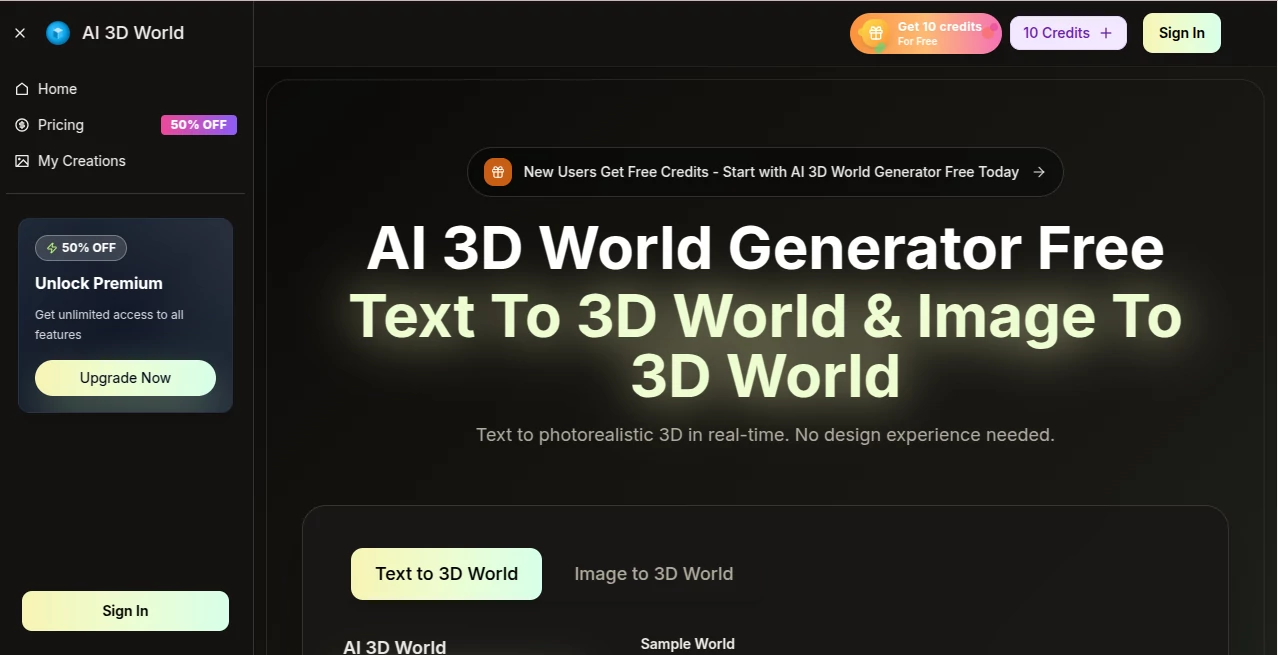
What is AI 3D World?
There's something genuinely exciting about typing a few sentences and suddenly finding yourself inside a living, breathing 3D scene that moves and breathes with you. This platform turns that daydream into reality so smoothly it's almost startling. One minute you're describing a quiet forest at dawn or a bustling city street after rain, and the next you're navigating it at 24 frames per second, watching leaves sway or water ripple in response to your prompts. I tried it with a simple idea of a little girl poking the camera lens while smiling—the way the scene kept her expression consistent while everything else shifted felt like watching a short film come alive right in the browser. For anyone who's ever wished they could step into their imagination without wrestling heavy software, this feels like a quiet revolution.
Introduction
Building immersive 3D worlds used to mean months of modeling, texturing, lighting, and hoping the physics behaved. Now there's a way to skip most of that and go straight to exploration. This tool lets you describe almost anything—realistic environments, fantasy landscapes, historical recreations—and generates an interactive space you can walk through immediately. It holds visual memory across several minutes, so changes you prompt (like shifting weather or moving objects) feel coherent instead of jarring. New users get free credits to try it out, and the whole thing runs in modern browsers on desktop or mobile. What started as a technical feat has become a playground for researchers training agents, educators bringing lessons to life, and creators experimenting without limits. It's the kind of thing that makes you wonder why we ever accepted flat images as the limit.
Key Features
User Interface
The dashboard keeps distractions minimal so you can focus on the prompt. Enter your description (up to 800 characters, with smart expansion if needed), choose aspect ratio and duration, and hit generate. Once the world loads, navigation feels natural—mouse or touch controls let you look around freely. Promptable events are just a text box away: type what you want to change and watch the scene adapt while staying consistent. It's the rare tool that feels powerful yet never intimidating.
Accuracy & Performance
Maintaining coherence over several minutes at 24 FPS in 720p is no small task, yet the results hold together remarkably well. Objects and lighting stay physically plausible even as you alter the scene, and the AI remembers earlier states so new prompts build logically on what's already there. Generations are quick enough for real-time iteration, and the output quality punches above its weight—crisp details, believable motion, no obvious seams. In practice, it turns vague ideas into convincing spaces faster than most people expect.
Capabilities
From text alone or starting with an image, it creates explorable worlds that last minutes rather than seconds. You can trigger events mid-exploration—change the time of day, add characters, shift weather—and the environment responds naturally. It's especially strong for consistent physics, making it ideal for training agents or simulating scenarios. Multiple aspect ratios and quality settings give flexibility, and the cloud-based processing ensures smooth performance across devices without needing powerful local hardware.
Security & Privacy
Your prompts and generated worlds stay private, processed securely with responsible AI practices in place. Outputs are yours to keep or share, and there's no unnecessary data retention. For researchers or creators working on sensitive projects, that level of consideration makes a real difference.
Use Cases
A robotics student generates endless variations of indoor environments to train navigation agents without building physical sets. A history teacher creates immersive recreations of ancient cities, letting students wander streets that feel alive. Game designers prototype levels and atmospheres quickly, iterating on mood and layout in real time. Even filmmakers use it to visualize sequences or test lighting before committing to expensive renders. The range of possibilities—from scientific simulations to pure creative play—is what keeps people coming back.
Pros and Cons
Pros:>
- Real-time generation at 24 FPS makes exploration feel alive and immediate.
- Environmental consistency over minutes allows meaningful interaction and change.
- Promptable events give you control without breaking immersion.
- Free credits on signup let you experience the magic before deciding.
Cons:
- Longer or very complex worlds may need careful prompting for perfect coherence.
- Free tier has limits, so heavy users will want to upgrade.
Pricing Plans
It starts generously with free credits for new users so you can explore without commitment. Annual plans offer strong savings (with limited spots at 50% off), unlocking unlimited access to higher quality, longer durations, and priority generation. You can cancel anytime, and support is available if you need help managing subscriptions. The structure rewards curiosity while scaling smoothly for serious creators.
How to Use AI 3D World
Sign up to claim your free credits, then head to the generator. Type a detailed prompt describing your scene (think lighting, mood, time of day), select aspect ratio and desired length, and launch. Once the world appears, move around freely—use mouse or touch to look and navigate. To alter anything, simply type a new prompt for an event ("make it rain" or "add a deer crossing the path") and watch the change unfold naturally. Save or share your creation when you're satisfied. It's intuitive enough that most people get their first decent world on the first or second try.
Comparison with Similar Tools
Many generators produce static scenes or very short clips that lose coherence quickly. This one stands apart by sustaining interactive worlds over minutes with consistent physics and memory, plus the ability to modify on the fly without restarting. Where others feel like novelties, this delivers something closer to a living environment you can actually explore and shape. It's less about quick snapshots and more about sustained immersion.
Conclusion
This platform quietly opens a door to worlds that used to require teams and years to build. It lets curiosity lead, handing anyone the keys to create, explore, and experiment in 3D without barriers. Whether you're training AI, teaching concepts, prototyping stories, or simply dreaming up places that don't exist yet, it turns "what if" into something you can walk through. The fact that it does all this in real time, for free to start, feels like a small miracle in a very big way.
Frequently Asked Questions (FAQ)
How long do generated worlds last?
Several minutes of coherent interaction, with visual memory keeping everything consistent.
Can I change things after generation?
Yes—use promptable events to add weather, objects, or actions, and the scene adapts naturally.
What quality can I expect?
720p at 24 FPS, with photorealistic detail and smooth motion.
Is it completely free?
Free credits on signup let you try it fully; paid plans unlock unlimited use and extras.
Does it work on mobile?
Yes, runs in modern browsers on phones and tablets with touch navigation.
AI Maps Generator , AI Design Generator , AI 3D Model Generator , AI Image to 3D Model .
These classifications represent its core capabilities and areas of application. For related tools, explore the linked categories above.
AI 3D World details
Pricing
- Free
Apps
- Web Tools
Categories

AI 3D World Alternatives Product

Use Nano Ban…

SVG to 3D

insMind

Try FLux2

bananaai.app

img2img.net

ChromaPeel

Z-Image Free

Image to Ima…