
Kaizen AI Agent Framework
What is Kaizen AI Agent Framework?
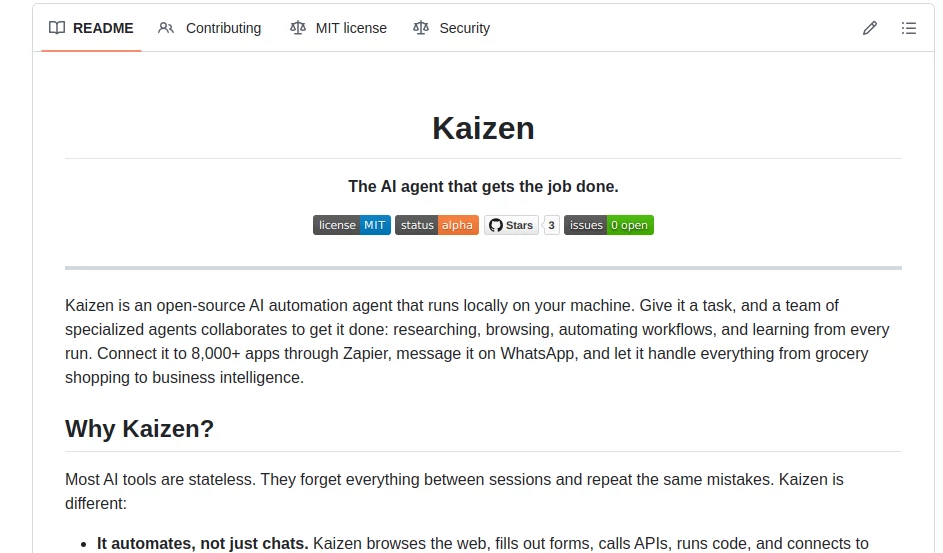
In a world where software development moves faster than ever, teams need systems that do not just generate output, but continuously improve it. This open-source project introduces a structured approach to iterative enhancement powered by artificial intelligence. Instead of treating AI as a one-off assistant, it transforms it into a continuous collaborator that refines results step by step.
The core idea behind this tool is simple yet powerful: build, evaluate, and improve in a loop. Developers can integrate it into their workflows to enhance code quality, automate repetitive refinement tasks, and bring consistency to complex engineering processes. It feels less like a standalone utility and more like an intelligent layer sitting on top of development pipelines.
Key Features
User Interface
The system is designed with developers in mind, offering a clean, minimal, and functional interface. It avoids unnecessary complexity and focuses on workflow clarity. Whether integrated via terminal or development environment, the experience remains consistent and predictable.
Accuracy & Performance
One of its strongest advantages is its iterative feedback mechanism. Instead of producing a single output, it evaluates and refines results through multiple cycles. This significantly improves reliability, especially in tasks like code generation, debugging, and optimization.
Capabilities
- Iterative improvement loops for generated outputs
- AI-assisted code refinement and restructuring
- Workflow automation for development pipelines
- Extensible architecture for custom integrations
- Support for experimentation and rapid prototyping
Security & Privacy
As an open-source framework, it allows teams to deploy and control their own environments. This ensures that sensitive data and internal codebases remain within secure infrastructure, reducing reliance on external processing when privacy is a concern.
Use Cases
- Improving AI-generated code before production deployment
- Automating debugging and optimization workflows
- Enhancing software engineering productivity in teams
- Building AI-assisted development pipelines
- Experimenting with iterative AI workflows in research environments
Pros and Cons
Pros
- Strong focus on iterative improvement
- Highly flexible and developer-friendly
- Open-source and customizable
- Useful for both prototyping and production workflows
Cons
- Requires technical knowledge to fully utilize
- May need setup and configuration effort
- Best results depend on integration quality
Pricing Plans
The project is open-source, meaning there are no direct licensing costs. However, deployment may involve infrastructure costs depending on how and where it is hosted. Teams can choose between local deployment or cloud-based setups based on their needs.
How to Use This Tool
To get started, developers typically clone the repository and set up the environment locally. After installation, the framework can be integrated into existing development workflows. Users define tasks, and the system begins running iterative cycles to refine outputs based on defined objectives.
Advanced users can customize evaluation steps, adjust improvement logic, and connect external APIs to expand functionality. This flexibility makes it suitable for both small projects and large-scale engineering systems.
Comparison with Similar Tools
Unlike traditional AI coding assistants that generate a single response, this framework emphasizes continuous refinement. While many tools focus on speed of output, this system prioritizes quality through repetition and evaluation loops.
Compared to standard automation tools, it offers deeper integration into decision-making processes rather than just executing predefined tasks. This makes it more suitable for teams that value precision and iterative refinement over instant results.
Conclusion
This framework represents a shift in how developers interact with AI systems. Instead of treating AI as a one-time generator, it introduces a mindset of continuous improvement. For teams looking to enhance code quality, streamline workflows, and build smarter development pipelines, it offers a powerful and flexible foundation.
Frequently Asked Questions (FAQ)
What is this project used for?
It is used to improve and refine AI-generated outputs through iterative enhancement cycles, especially in software development workflows.
Is it suitable for beginners?
It is primarily designed for developers and technical users who are comfortable with setup and integration processes.
Can it be integrated into existing systems?
Yes, it is designed to be flexible and can be integrated into various development pipelines and tools.
Does it require external services?
No external dependency is strictly required, but it can be extended to work with external APIs if needed.
What makes it different from other AI tools?
Its focus on iterative improvement rather than single-step output generation sets it apart from most conventional AI assistants.
Github Repos , AI Developer Tools .
These classifications represent its core capabilities and areas of application. For related tools, explore the linked categories above.
Kaizen AI Agent Framework details
Website unavailable — View Alternatives
Pricing
- Free
Apps
- Web App
Categories

Kaizen AI Agent Framework Alternatives Product

volume shade…

GLM 5

Agent Grid
FurWall
Kimi K2.5

Discord Time…

Devplan

git-lrc

Blackbox AI