🧠 AI Quiz
Think you really understand Artificial Intelligence?
Test yourself and see how well you know the world of AI.
Answer AI-related questions, compete with other users, and prove that
you’re among the best when it comes to AI knowledge.
Reach the top of our leaderboard.


















qwen image 2.0
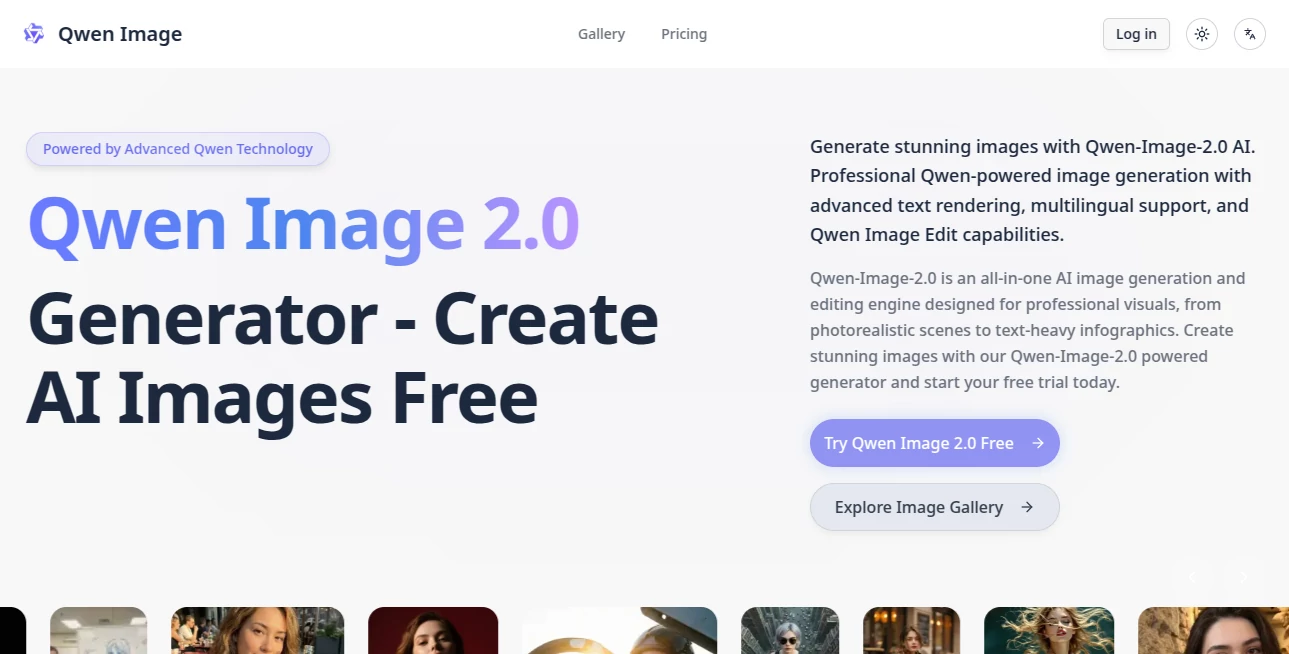
What is qwen image 2.0?
There’s a quiet thrill when you type a half-formed idea—“a lone astronaut floating above a neon Tokyo at midnight, rain-slick streets reflecting pink and cyan”—and seconds later a vivid, coherent image appears that somehow captured exactly the mood you were chasing. This tool does that over and over, with a consistency and artistic flair that still surprises me every time I use it. The colors feel deliberate, the composition thoughtful, the details sharp without being over-polished. It’s the kind of generator that makes you want to keep prompting just to see what it dreams up next.
Introduction
Text-to-image has come a long way, but many models still feel like lucky dice rolls—great one time, strange the next. This one plays in a different league. Built on a refined multimodal foundation, it understands nuance in prompts better than most: style references, lighting direction, emotional tone, even subtle cultural cues. What started as an internal research project has become one of the most reliable creative companions for illustrators, concept artists, marketers, writers, and hobbyists who want professional-looking results without spending hours tweaking sliders or fighting artifacts. The joy is in the speed and surprise—you describe, it delivers, and suddenly your imagination has a visual voice.
Key Features
User Interface
The playground is clean and distraction-free. A wide prompt box, optional negative prompt and style presets, sliders for aspect ratio, quality level, and seed control, then one big generate button. Previews appear almost instantly in a neat grid so you can compare variations side-by-side. Dark mode is comfortable for late-night sessions, and the whole experience feels snappy even on modest connections. It never tries to overwhelm you with options—it gives you just enough control to steer without drowning in complexity.
Accuracy & Performance
Prompt adherence is unusually strong. Ask for “cyberpunk fox in a rainy alley, neon reflections, cinematic lighting, Fujifilm Superia 400 film emulation” and it doesn’t just slap neon on a fox—it builds the atmosphere, gets the film grain right, keeps the fox looking like a fox. Generation times stay fast (often 3–12 seconds depending on steps), and outputs are consistently high-resolution (up to 1024×1024 native, with clean upscaling options). Artifacts are rare; when they appear they’re logical (over-complex prompts) rather than random melting or extra limbs.
Capabilities
Text-to-image of course, but also strong image-to-image editing, style transfer, inpainting/outpainting, and multilingual prompt understanding (English, Chinese, Japanese, and more). It handles complex scenes with multiple subjects, intricate backgrounds, specific art styles (Studio Ghibli, cyberpunk, baroque oil painting, pixel art, etc.), and fine emotional nuance (“melancholic autumn portrait of an android reading poetry”). The model excels at coherence—hands, eyes, text in images, reflections, and lighting continuity all hold together far better than average.
Security & Privacy
Images are processed ephemerally; nothing is stored long-term or used for training unless you explicitly opt-in to share. No mandatory account for basic use. For creators working on client concepts, personal art, or brand assets, that clean separation is a meaningful reassurance.
Use Cases
A book cover designer generates five strong concepts in ten minutes instead of waiting days for a freelancer. A social media manager creates consistent branded illustrations for a month-long campaign in one afternoon. An indie game dev mocks up character sprites and environment keys without hiring concept artists yet. A writer visualizes scenes to help describe them better in prose. A marketer tests ad visuals before spending on photography. Across creative fields, it shortens the gap between “I wonder what this would look like” and “here it is, ready to use.”
Pros and Cons
Pros:
- Outstanding prompt understanding—gets mood, style, and composition right more often than not.
- Very fast generation with high coherence and few artifacts.
- Beautiful, artistic defaults; results often look hand-crafted rather than algorithmic.
- Flexible aspect ratios, strong editing tools, and multilingual support.
- Generous free tier lets you explore quality without paying upfront.
Cons:
- Occasionally over-stylizes simpler prompts (can be fixed with negative prompts).
- Longer / higher-step generations move to paid queue during peak times.
- Advanced inpainting and outpainting controls are still evolving.
Pricing Plans
Free tier offers solid daily credits—enough for serious experimentation and small projects. Paid plans unlock higher resolutions, faster priority queue, unlimited generations, advanced editing features, and commercial usage rights at rates that feel fair for the quality. Many users say one month of paid covers what they used to spend on stock art or freelance illustrators for a single campaign.
How to Use It
Go to the playground, write a descriptive prompt (the more vivid, the better). Add style references (“in the style of James Gurney” or “cyberpunk vaporwave”) and negative prompts if needed. Choose aspect ratio, quality preset, and number of variations. Hit generate. Browse results, upscale favorites, use inpaint/outpaint for tweaks, then download. Save good prompts as templates for future use. The loop is fast and forgiving—experiment freely.
Comparison with Similar Tools
Many generators trade consistency for speed or produce beautiful but generic results. This one consistently delivers images that feel composed with intent—stronger anatomy, better lighting hierarchy, more coherent scenes. It sits in a sweet spot: artistic enough for illustrators, fast enough for marketers, controllable enough for designers. Where others require heavy prompt engineering or post-editing, the outputs here often need little cleanup.
Conclusion
Great art direction should never be gated behind years of training or expensive software. This tool quietly lowers that gate, handing creators—amateur and pro alike—a way to visualize ideas with speed, beauty, and surprising fidelity. It’s not replacing artists; it’s giving more people the ability to think visually and iterate fast. When your next story, ad, game asset, or social post needs a visual spark, this is the place that turns imagination into something you can actually see—and share—in minutes.
Frequently Asked Questions (FAQ)
How detailed should my prompt be?
The more specific, the better—mood, lighting, composition, style references all help. Short prompts work too, but shine brightest with vivid descriptions.
Can I use the images commercially?
Paid plans include full commercial rights; free tier is generally personal / non-commercial (check current terms).
What resolutions are available?
Up to 1024×1024 native, with clean upscaling to 2048+ on paid tiers.
Does it handle text in images well?
Yes—readable text, logos, signs are much stronger than most models.
Is it better than Midjourney / Flux / SD3?
Different strengths. Many users find it more coherent and cinematic out-of-the-box, especially for storytelling scenes, while still being fast and accessible.
AI Text to Image , AI Image to Image , AI Art Generator , AI Design Generator .
These classifications represent its core capabilities and areas of application. For related tools, explore the linked categories above.
qwen image 2.0 details
Pricing
- Free
Apps
- Web Tools
Categories

qwen image 2.0 Alternatives Product

Banana Promp…
GTA AI

Grok Imagine

Use Nano Ban…
Caricature G…
Nano Banana …

String Art G…

FLUX 2

Nano Banana …