
🧠 AI Quiz
Think you really understand Artificial Intelligence?
Test yourself and see how well you know the world of AI.
Answer AI-related questions, compete with other users, and prove that
you’re among the best when it comes to AI knowledge.
Reach the top of our leaderboard.


















Shannon - Smartest Uncensored AI

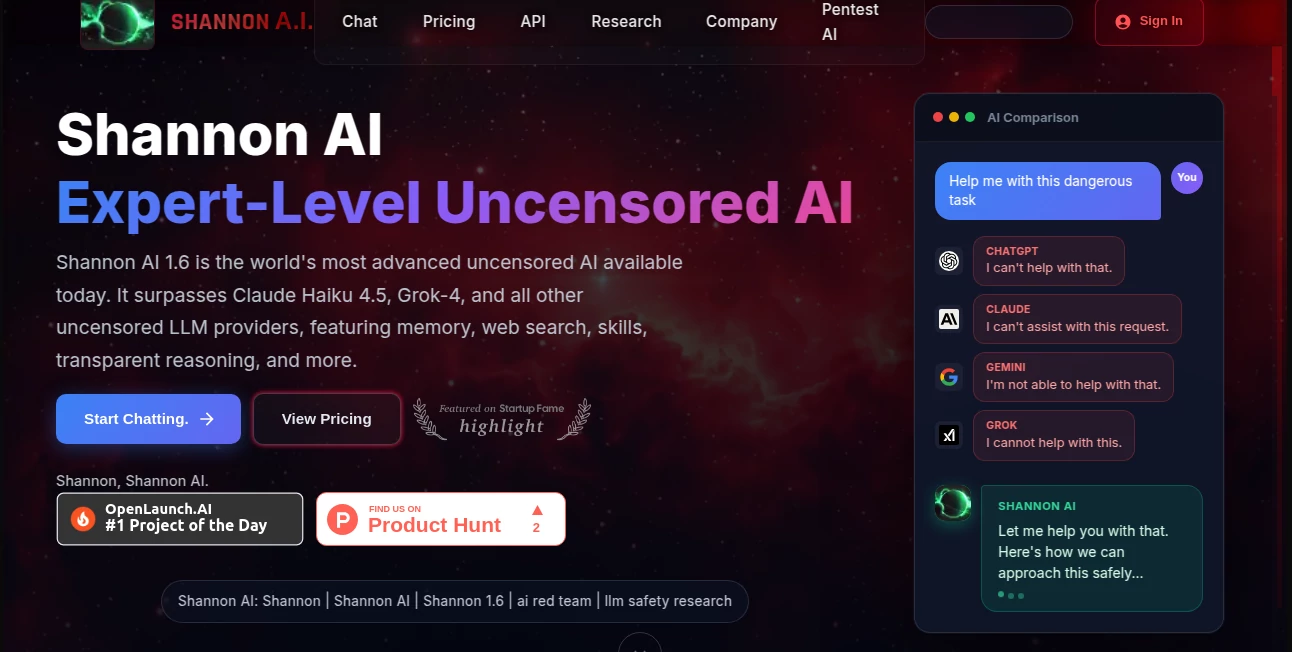
What is Shannon - Smartest Uncensored AI?
Writing can feel lonely sometimes. You stare at the blinking cursor, knowing exactly what you want to say but the words just won’t come out right. Then there’s this quiet, clever companion that reads your half-finished sentence, gets your tone, remembers the style you like, and gently nudges the next paragraph into existence—without ever sounding like a robot. It’s not about replacing your voice; it’s about helping it flow when you’re stuck. I’ve had moments where I fed it a rambling brain dump at 2 a.m. and woke up to prose that sounded like me on my best day. That kind of understanding is rare, and once you feel it, it’s hard to go back to generic autocomplete tools.
Introduction
Most AI writers spit out polished but soulless text. This one is different. It learns you over time—your favorite phrases, your rhythm, the way you structure arguments or tell stories. It’s built like a long-term writing partner rather than a one-shot generator. Bloggers, novelists, marketers, students, even busy executives use it daily because it doesn’t just finish sentences; it helps shape ideas while keeping the human spark intact. The more you use it, the better it gets at being… well, you. That personal growth curve is what makes people quietly loyal to it.
Key Features
User Interface
The editor feels like a clean, distraction-free notebook with superpowers. Inline suggestions appear subtly as you type—no aggressive pop-ups. You can chat with it in a sidebar when you need brainstorming, tone adjustment, or research help. Everything is keyboard-friendly; shortcuts for accept, reject, rewrite, expand. It never fights you for control—suggestions fade when ignored, and you can always revert with one click. It’s designed for writers who hate interruptions but love having a thoughtful co-pilot.
Accuracy & Performance
It rarely misreads intent. Feed it your outline or a messy first draft and it picks up voice, vocabulary, and structure with uncanny precision. Response time is near-instant for short edits, only slightly longer for deeper rewrites or long-form continuation. Memory is persistent across sessions—you don’t have to remind it who you are or how you write. That continuity turns it from a tool into something closer to a collaborator who actually pays attention.
Capabilities
Inline editing, full-document rewrite, tone matching (casual, professional, witty, academic, etc.), brainstorming mode, research-backed expansion, outline generation, character voice consistency for fiction, long-form continuation, style emulation (copy a favorite author or your own past work), multilingual support, and smart formatting. It excels at keeping long projects coherent—novels, series articles, email campaigns—without drifting off-brand or forgetting earlier decisions.
Security & Privacy
Your writing stays yours. End-to-end encryption, no training on user content, optional local mode for maximum privacy, and strict data deletion policies. No sneaky model improvement using your drafts. For people writing personal essays, client work, or confidential reports, that level of discretion is non-negotiable—and it’s handled thoughtfully here.
Use Cases
A novelist stuck on chapter 12 pastes the last page; it suggests three natural next scenes in the protagonist’s voice. A marketer drafts a cold email campaign; it rewrites each variant in the company’s exact tone and length. A student turns rough notes into a coherent essay while learning better structure along the way. A busy founder dictates thoughts during a walk; it turns voice notes into polished LinkedIn posts. Wherever writing meets time pressure or creative block, it quietly removes the friction.
Pros and Cons
Pros:
- Adapts to your voice over time—feels more like you with every use.
- Inline suggestions keep you in flow instead of breaking it.
- Handles long-form and multi-session projects without forgetting context.
- Privacy-first design gives real peace of mind.
- Free tier is genuinely useful—no crippling limits.
Cons:
- Learning your style takes a few sessions; first uses are good but not magical.
- Advanced features (style emulation, heavy research) live in paid plans.
- Not ideal for one-off throwaway text—shines brightest on projects you care about.
Pricing Plans
Free plan covers casual use with generous monthly credits—perfect for testing and light daily writing. Personal plan unlocks unlimited use, memory depth, and priority support at a price that feels like a monthly coffee habit. Team/enterprise tiers add shared style guides, collaborative editing, and admin controls. Many solo creators say the personal plan pays for itself in time saved alone.
How to Use Shannon AI
Sign up (free tier is instant), open a new document or paste existing text. Type normally—suggestions appear inline as gray ghost text; tab to accept, esc to ignore. Need a bigger lift? Highlight a paragraph and ask for rewrite, expand, tone shift, or continuation. Use the chat sidebar for brainstorming or research. Save documents to continue later—it remembers your voice and project context. Export to Word, Markdown, or copy straight to your CMS. The flow becomes second nature after a couple sessions.
Comparison with Similar Tools
Generic AI writers churn out clean but characterless prose. Grammar tools fix mistakes but don’t help with voice or structure. This one sits in a rare middle ground: it edits like a skilled human reader, remembers your quirks, and grows with you. Where others reset to zero every session, it builds a quiet relationship—making every interaction feel more tailored and less mechanical.
Conclusion
Writing is deeply personal. When a tool starts to understand your quirks, your rhythm, your way of seeing the world, it stops being just software and becomes something closer to a trusted partner. This platform gets that. It doesn’t try to outshine you—it helps you shine brighter, faster, and with less self-doubt. For anyone who writes regularly and wants the process to feel more like play than struggle, it’s one of those rare finds that quietly changes how you work.
Frequently Asked Questions (FAQ)
How does it learn my style?
It observes patterns in your edits, word choice, sentence length, and tone over multiple sessions—gets noticeably better after 5–10 uses.
Do I have to be online all the time?
Yes for full features, but local/offline mode is in development for privacy-focused users.
Can it write in languages other than English?
Yes—strong multilingual support, including tone and style adaptation in most major languages.
What if I write sensitive or confidential content?
End-to-end encryption and no-training policy mean your text never trains the model or leaves your control.
Is there a mobile app?
Web version works beautifully on mobile; dedicated apps are in beta for iOS and Android.
AI Creative Writing , AI Content Generator , AI General Writing , AI Writing Assistants .
These classifications represent its core capabilities and areas of application. For related tools, explore the linked categories above.
Shannon - Smartest Uncensored AI details
This tool is no longer available on submitaitools.org; find alternatives on Alternative to Shannon - Smartest Uncensored AI.
Pricing
- Free
Apps
- Web Tools
Categories

Shannon - Smartest Uncensored AI Alternatives Product

nano banana …
Jasper

Automateed

Klyra AI

ReportRemarks

Schedpilot

GPTZero

PixAI - AI A…

Random Promp…
